
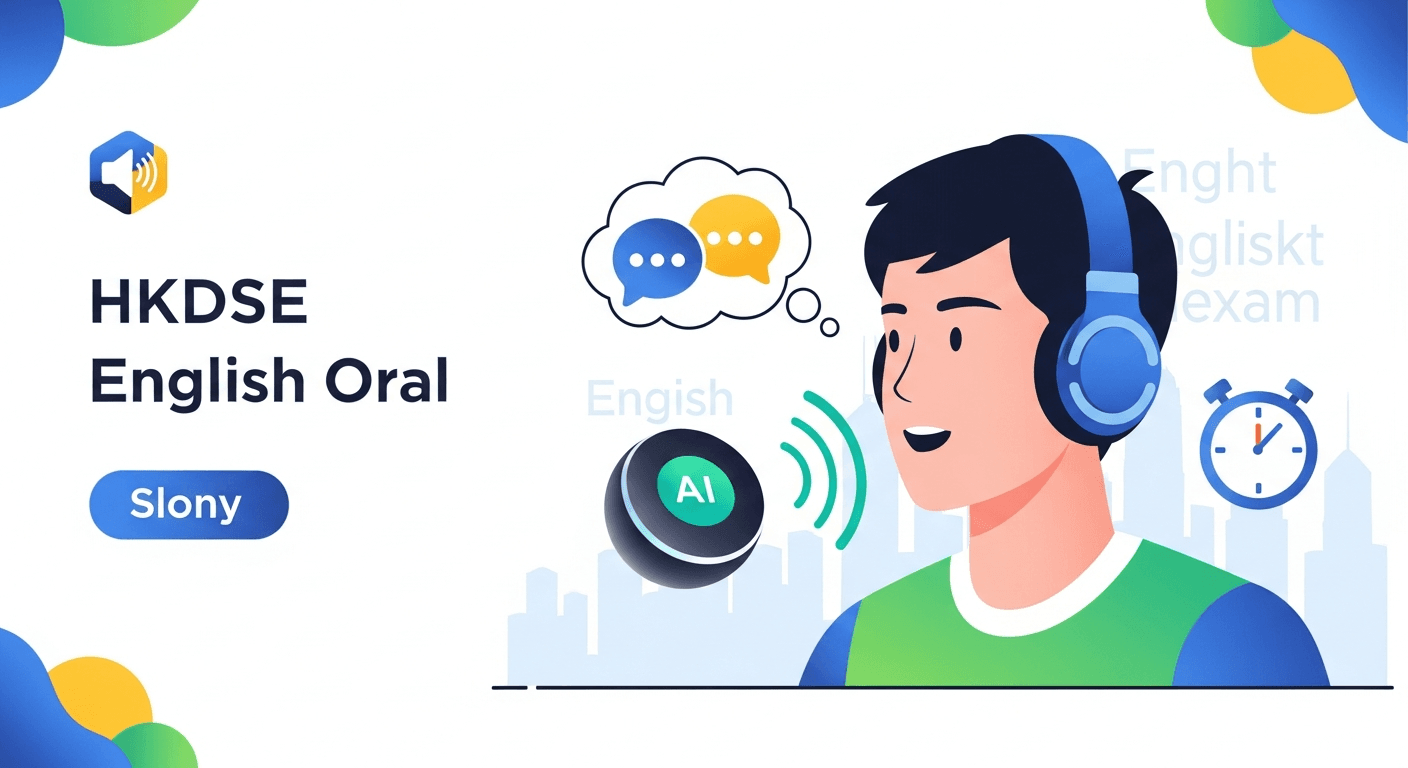
Using AI Voice Tools to Practice HKDSE English Oral Exams Without a Study Partner
Picture this: It is 10:00 PM on a Tuesday. Your HKDSE English Paper 4 (Speaking) exam is looming closer, and panic is starting to set in. You know you desperately need to practice your group interaction skills, but your usual study buddies are either knee-deep in DSE Math past papers, busy at tutorial classes, or simply fast asleep. In the past, an HKDSE student's only solo options were talking to a bedroom mirror or awkwardly recording voice memos on a smartphone. While commendable, these methods completely miss the dynamic, unpredictable nature of a real group discussion.
Today, thanks to incredible advancements in educational technology, the landscape of exam preparation has completely changed. You now have access to a tireless, native-sounding speaking partner available 24/7. Generative AI voice models have advanced to the point where they can understand your accent, respond to your arguments, and even politely disagree with you in real-time. Let us dive into exactly how you can harness the power of AI voice tools to master the HKDSE English Oral exam completely on your own!
The End of the "Mirror Practice" Era
For years, the biggest hurdle in preparing for Paper 4 was the logistical nightmare of gathering three to four candidates of similar English proficiency in the same room. The HKDSE English Speaking exam tests not just your vocabulary and pronunciation, but your interaction skills. You are graded on how well you respond to others, how smoothly you take turns, and how naturally you can expand on a peer's idea.
Quick Fact: Recent 2024 educational tech surveys indicate a massive surge in students worldwide utilizing conversational AI for language acquisition. What used to be static, robotic, text-based chat has rapidly evolved into real-time voice conversations with ultra-realistic intonation, emotional inflection, and natural pacing.
By bringing an AI into your study routine, you are engaging in true AI-powered learning. Unlike a mirror, an AI will actively listen to your stance on a topic—say, the promotion of local heritage sites in Hong Kong—and provide a counter-argument that forces you to think on your feet.
Conquering Part A: Group Interaction with an AI Partner
To succeed in Part A, you need to simulate the environment of the preparation room and the actual exam table. Here is how you can set up a modern AI voice tool to act as your ideal (or even challenging) study partner.
Step 1: Set the Scene with a Detailed Prompt
Before you turn on the voice mode of your chosen AI tool, you need to give it a specific "persona" and establish the rules of the HKDSE exam. You can type or speak a prompt similar to this:
"Act as Candidate B in an HKDSE English Oral exam. I will be Candidate A. Our task is to discuss whether our secondary school should organize a mandatory survival skills camp for Form 4 students. You are generally supportive but worried about the safety and budget. Keep your spoken responses to about 30 to 40 seconds. End your turns by either asking me a question or prompting me to share my thoughts."
Step 2: Practice Active Listening and Turn-Taking
Once the AI starts speaking, treat it exactly like a real exam. Take notes on the "Notecard" you prepared during your mock 10-minute preparation time. When the AI pauses, jump in with appropriate formulaic expressions like, "That is a valid concern, Candidate B, but I believe we can lower the budget by..."
Step 3: Introduce Chaos (The Dominating Candidate)
In the real exam, you might face a candidate who talks too much or goes off-topic. You can actually command your AI to simulate this! Tell the AI: "For the next 5 minutes, act as a dominating candidate who tries to interrupt me and speaks for too long." Practicing how to politely reclaim the floor ("If I may just finish my point...") is an invaluable skill that will impress any examiner.
Nailing Part B: The Individual Response
The dreaded one-minute Individual Response is where many students freeze. The examiner bases their question on something you or your group members said during Part A. Because these questions are unscripted, they are notoriously difficult to practice alone.
AI completely solves this problem. After your 8-minute mock group interaction, simply instruct your AI tool to act as the Examiner.
For example, you can tell the AI: "The group discussion is now over. Act as the HKDSE Examiner. Based on the arguments I just made about the survival camp, ask me a challenging follow-up question. Give me one minute to respond, and then evaluate my answer."
The AI might ask something highly specific, such as: "Candidate A, you mentioned that a survival camp builds resilience. However, some parents argue that academic studies are more important in Form 4. How would you address their concerns?" This level of customized questioning trains your brain to synthesize ideas quickly under pressure.
Unlocking the Power of Personalized Learning and Feedback
Having a conversation is only half the battle; knowing how to improve is the ultimate key to achieving a Level 5 or above. Human study partners—especially close friends—might be too polite to point out that you keep pronouncing "development" incorrectly, or they might lack the grammatical knowledge to correct your complex sentence structures.
This is where a dedicated study platform drastically outperforms generic practice. Intelligent educational tools do not just talk with you; they analyze your performance. After a mock exam, an AI can provide a detailed breakdown of your vocabulary variety, grammatical accuracy, and pronunciation clarity.
By engaging with a specialized environment designed for students, you enter a realm of true personalized learning. An adaptive system remembers your common mistakes and tailors future practice sessions to target those exact weaknesses. If you are ready to elevate your revision and stop guessing about your speaking proficiency, you can Start Practicing in AI-Powered Practice Platform. You will quickly see how immediate, objective feedback can transform your confidence.
Common Paper 4 Pitfalls and How AI Helps You Avoid Them
Let us look at some classic mistakes HKDSE students make during the Oral exam, and how practicing with voice AI can help you avoid them on the big day.
Pitfall 1: "Dead Air" and Awkward Silences
We all know the dread of a silent table while the examiner's stopwatch ticks away. The HKDSE marks candidates on their ability to maintain the flow of conversation. You can prompt an AI to occasionally stay completely silent for 5 seconds after you finish speaking. This forces you to practice stepping up as the facilitator: "Since we all seem to agree on the venue, shall we move on to discuss the promotional strategies?"
Pitfall 2: Chinglish and Direct Translations
When nervous, students often rely on direct Cantonese-to-English translations (Chinglish). Advanced AI language models can catch these unnatural phrases. You can ask the AI at the end of your session: "Did I use any unnatural idioms or phrases? Please provide more native-sounding alternatives."
Pitfall 3: Monotone Delivery
Pronunciation (Domain II) includes intonation and stress. If you speak like a robot, your score will suffer. Because modern AI voices are highly expressive, listening to them helps naturally improve your own rhythm and intonation through mimicking.
Pro Tips for Maximizing Your AI Oral Practice
1. Record and Review the Transcripts
Most AI voice tools generate a text transcript of your conversation. Do not just close the app when you are done! Read through the transcript. You will likely spot repetitive filler words (like saying "actually" or "I think" too often). Highlighting your own text is a fantastic way to visually track your bad habits.
2. Force Vocabulary Upgrades
Before your mock session, pick five advanced vocabulary words related to the topic (e.g., for Environmental Issues: sustainable, detrimental, alleviate, carbon footprint, viable). Challenge yourself to use all five naturally during your conversation with the AI. Ask the AI afterward if you used them in the correct context.
3. Diversify Your Topics
Do not just stick to topics you like. The DSE can throw anything at you—from "Popular Culture and K-Pop" to "The Impact of Artificial Intelligence on Traditional Art." Use your AI partner to simulate discussions on topics you know absolutely nothing about. This builds your improvisational skills.
Embracing Modern EdTech for DSE Success
The days of feeling helpless because you cannot find a study partner are officially over. By integrating AI voice tools into your daily study routine, you are taking control of your own academic destiny. AI does not replace the hard work and dedication required to master a language, but it acts as a powerful multiplier for your efforts, ensuring that every minute you spend practicing is optimized for maximum improvement.
Whether you are aiming to scrape a Level 3 or fighting for that coveted Level 5**, consistency is your best friend. Make it a habit to do a 15-minute AI mock oral session before bed. Over a few weeks, your fluency, reaction time, and confidence will skyrocket.
Education is evolving rapidly, and the tools available to you are more powerful than ever before. To discover more innovative ways to boost your grades and to explore comprehensive educational solutions tailored to your needs, be sure to visit the thinka Home Page. Stay curious, keep speaking up, and best of luck with your HKDSE preparations!