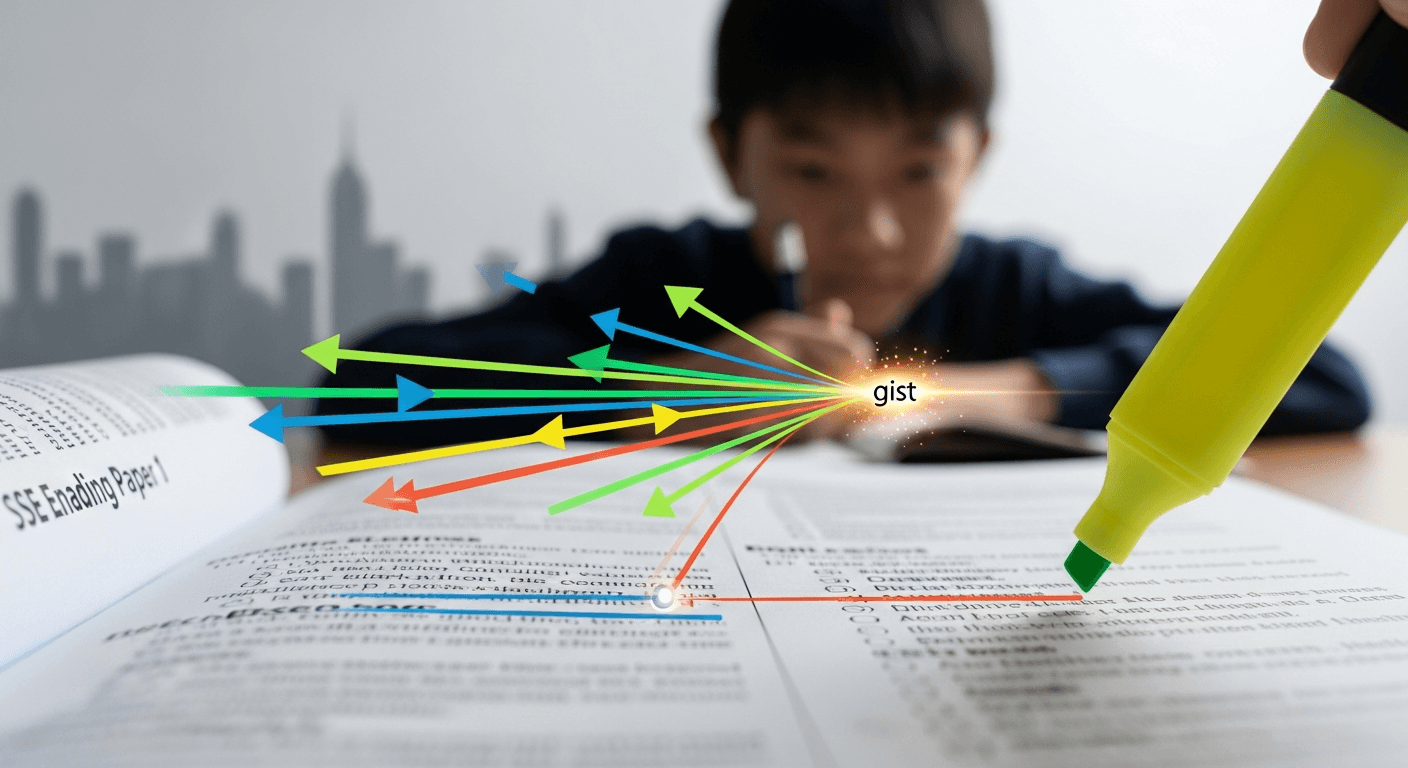
The 80/20 Rule of Reading: Why B2 Crushes "Completionists"
It is a scenario every HKDSE candidate fears: It is 9:45 AM on exam day. You have 25 minutes left on the clock. You ambitiously chose Section B2 (the difficult section) to secure a Level 5 or 5**, but you are staring at a dense, 900-word article about the socio-economic impacts of synthetic biology or the nuances of 19th-century architecture. Your brain freezes. You start reading line by line, obsessing over every difficult word. You run out of time. Here is the hard truth about Hong Kong education and the DSE specifically: The exam does not test your ability to read every word; it tests your ability to extract value under pressure. Many students fall into the "Completionist Trap." They believe that to understand a text, they must process 100% of the vocabulary. However, in Section B2, which is designed to differentiate top-tier students, the text is intentionally overloaded with "vocabulary noise." The Gist-Extraction Hack is essentially an application of the Pareto Principle (the 80/20 rule): 80% of the marks come from understanding 20% of the text's core logic. If you can master the art of skimming for the "gist"—the central argument—you can answer questions with high accuracy even if you ignore half the adjectives on the page.Deconstructing the Hack: The "Skeleton Scanning" Technique
To conquer Section B2, you must stop reading horizontally (left to right, line by line) and start reading hierarchically. You are looking for the skeleton of the argument, not the flesh.1. The First and Last Sentence Protocol
In formal academic writing—the style favored by the HKEAA for Section B2—paragraphs follow a rigid structure.- The Topic Sentence (First Sentence): establishes the subject.
- The Concluding Sentence (Last Sentence): establishes the judgment or transition.
2. Spotting the "Pivot Points"
The HKEAA loves to test your ability to track changes in argumentation. They do this using adversative conjunctions (words that signal a shift). When skimming, your eyes should hunt for these signposts:However, Nevertheless, Conversely, Despite, Although, Yet.
If a paragraph says, "Traditional urban planning focuses on density (sentences 1-4)... However, post-pandemic models prioritize ventilation (sentences 5-8)," the gist is the shift. If you miss the "However," you miss the main idea.3. Vocabulary Noise Cancellation
This is the hardest psychological hurdle for HKDSE students. You will encounter words like "esoteric," "ubiquitous," or "obfuscate." Do not stop. If the sentence is: "The politician's speech was an esoteric collection of jargon intended to obfuscate the simple truth."Your Brain's Gist-Extraction: "Politician spoke clearly? No. Confusing speech -> Hid the truth." You extracted the meaning (negative, hiding truth) without needing to define "esoteric" or "obfuscate." This is strategic ignorance. You are focusing on the *polarity* of the sentence (positive/negative) rather than the definition.
AI-Powered Training: accelerating Your Skimming Speed
How do you practice this without burning through limited past papers? This is where AI-powered learning transforms exam preparation. Traditional revision involves doing a reading paper and checking the answers. This is passive. Modern study platforms use AI to make this process active and adaptive. Start Practicing in AI-Powered Practice Platform Thinka’s AI engine can help you master Gist-Extraction in three ways: 1. Summary Verification: After reading a complex text on Thinka, you can be asked to select the best 1-sentence summary. The AI analyzes your choice to see if you caught the main idea or got distracted by details. 2. Vocabulary Filtering: The platform can generate texts that dynamically adjust vocabulary difficulty, training you to guess meanings from context—a critical skill for B2. 3. Speed Drills: Unlike a static paper, an AI platform can time your reading speed and comprehension rate, pushing you to read faster while maintaining accuracy. This is the essence of personalized learning. Instead of just "reading more," you are training your brain's neural networks to process information more efficiently.The Math of Time Management: The "Marks-Per-Minute" Equation
To understand why skimming is non-negotiable, let’s look at the math. Paper 1 lasts 1 hour and 30 minutes (90 minutes). Part A is compulsory. Part B2 is optional but harder. If you spend too long on Part A, you cannibalize your time for B2. Let $T_{total}$ be total time (90 mins) and $M_{total}$ be total marks. Ideally, you want to spend roughly 1 minute per mark, but B2 requires more thinking time. $$ Efficiency = \frac{Reading Time}{Comprehension Level} $$ If your reading time is high because you are reading every word, your efficiency drops. By using Gist-Extraction, you reduce Reading Time significantly, allowing you to maintain a high Comprehension Level for the *questions* rather than the *text*. Actionable Advice: Allocate a strict 15-minute "Skim and Map" phase for Section B2. If you haven't answered a question in 2 minutes, skip it. The Gist-Extraction method ensures you have enough context to make educated guesses on difficult questions later.Case Study: Applying the Hack to a "Science Tech" Text
Let’s simulate a B2 paragraph about "Carbon Capture Technology." "While the theoretical underpinnings of Direct Air Capture (DAC) present a tantalizing panacea for our climate woes, offering a mechanism to scrub historical emissions from the troposphere, the thermodynamic realities impose a harsh economic penalty. The energy intensity required to sever the carbon-oxygen bond renders the current iteration of the technology cost-prohibitive for widespread municipal adoption, essentially relegating it to the realm of boutique pilot projects rather than a global solution." The Novice Reader: Gets stuck on "panacea," "troposphere," "thermodynamic," "relegating." Panics. The Gist-Extractor (You): 1. Scan Topic: DAC (Direct Air Capture). 2. Scan Pivot: "While... theoretical... tantalizing" (Sounds good). 3. Scan Reality: "cost-prohibitive," "boutique... rather than global." (Too expensive, not ready). Extracted Gist: DAC looks good in theory, but it's currently too expensive to use everywhere. You extracted the answer required for a typical DSE question ("Why is DAC not yet widely used?") in 10 seconds, skipping the complex science.From Passive Reader to Active Analyst
For Junior Secondary School (S1 - S3) students reading this: start practicing this now. Don't wait until S6. When you read news articles, ask yourself: "What is the one sentence that summarizes this whole paragraph?" For current S4-S6 students, the clock is ticking. You cannot memorize every word in the dictionary. You must upgrade your processing power. By shifting from passive reading to active Gist-Extraction, you are not just preparing for an exam; you are developing a critical skill for university and the modern workplace, where the ability to synthesize vast amounts of information quickly is the ultimate competitive advantage. Ready to test your skimming skills against an adaptive AI? Start Practicing in AI-Powered Practice Platform Don't let the vocabulary wall stop you. Read the skeleton, find the pivot, and secure your 5**.Further Resources: HKDSE Study Notes Junior Secondary School (S1 - S3) Study Notes
