AI Applications5 min read
The Verbal Performance Pilot: Mastering GCSE and A-Level Oral Exams with Multimodal AI Sparring
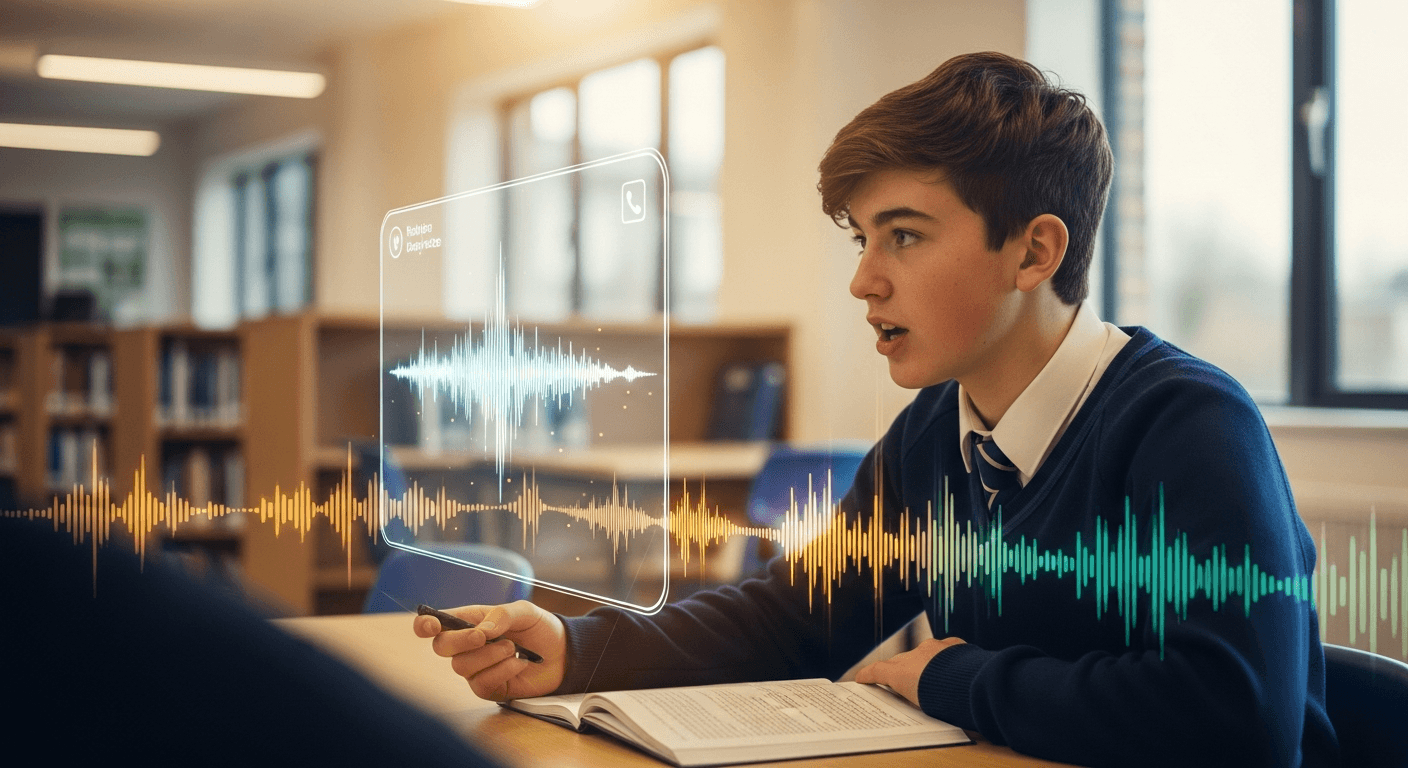
The Silent Crisis of the Oral Exam
For many secondary school students, the most daunting part of the academic year isn't the three-hour physics paper or the marathon English Literature essay. It is the 15-minute window in a quiet room, sat across from an examiner, where your grade depends entirely on your ability to think, react, and speak in real-time. Whether it is a GCSE French speaking assessment, an A-Level EPQ presentation, or a university interview for a Russell Group medical school, the 'verbal performance' is a unique beast.
Traditional revision is often static. We read, we highlight, and we write practice answers. But when the examiner throws a curveball question like, "How would you respond to the counter-argument that your research methodology is flawed?" or "¿Qué piensas de la influencia de las redes sociales en los jóvenes?", our brains often freeze. This is the 'fluency gap'—the distance between knowing the facts and being able to perform them under pressure. Fortunately, the rise of multimodal AI is turning the tide, allowing students to move from passive revision to active 'vocal sparring'.
Beyond the Chatbox: The Rise of Multimodal Sparring
Until recently, AI was a text-based tool. You typed a question, and it typed back. For a student preparing for a Spoken Language Endorsement or an MFL oral, this was only half-helpful. You could check your grammar, but you couldn't practice your delivery, tone, or the 'rebound' of a live conversation.
Multimodal AI, particularly voice-to-voice models, has changed the game. Students can now engage in near-instantaneous verbal dialogues that simulate the unpredictable environment of an examination room. By acting as a 'Simulation Pilot', you aren't just learning content; you are training your nervous system to stay calm while retrieving information. This is where practicing on an AI-powered platform becomes a competitive advantage, bridging the gap between the textbook and the viva.
Scenario 1: The MFL Speaking Test (GCSE & A-Level)
The biggest hurdle in Modern Foreign Languages (MFL) is the transition from prepared 'photocard' descriptions to the spontaneous conversation. Examiners are looking for 'interaction and spontaneity'—marks that are notoriously hard to secure if you have only ever practiced by reading notes aloud.
How to use AI sparring: Set the AI to act as a native-speaking examiner. Instruct it: "I am a GCSE Spanish student. We are going to practice the 'Theme 1: Identity and Culture' conversation. Ask me unpredictable follow-up questions and interrupt me if I speak for more than 30 seconds to simulate a real exam flow."
This forces you to move away from rote-memorised paragraphs. If you stumble, you can ask the AI to suggest a more sophisticated idiom or a 'filler phrase' (like "desde mi punto de vista") that buys you thinking time—a crucial skill for hitting those top-tier mark bands.
Scenario 2: The EPQ Presentation and English 'SLOP'
The Extended Project Qualification (EPQ) requires a presentation and a Q&A session. Many students lose marks here because they haven't 'stress-tested' their thesis. Similarly, the English Language Spoken Endorsement (often called SLOPs) requires students to handle questions from an audience.
By using AI as a 'Critical Friend', you can simulate a hostile or inquisitive audience. Feed your presentation script into the AI and ask it to: "Identify the three weakest points in my argument and ask me challenging questions about them in a formal academic tone." By rehearsing your verbal defences, you ensure that your 'Verbal Performance' reflects the depth of your written research.
Scenario 3: University Interviews and 'Viva-Style' Thinking
For Year 13 students aiming for Oxbridge, Medicine, or Law, the interview is essentially a high-stakes viva. These interviews aren't about having the 'right' answer; they are about demonstrating a trainable mind—how you think out loud when presented with new information.
Multimodal AI can be programmed to simulate these tutorials. You can ask the AI to present a logic puzzle or a biological concept you haven't studied yet and then guide you through it verbally. This builds cognitive endurance. You can find more specialised study materials to ground these AI sessions in the specific curriculum requirements of your chosen field.
The 'Simulation Pilot' Protocol: A 3-Step Strategy
To master the art of verbal performance, don't just 'chat' with the AI. Use this structured protocol:
1. The Knowledge Foundation
Before you speak, you must know. Use Thinka's AI-powered tools to ensure your core facts are rock solid. You cannot be fluent in a language or a subject if you are constantly searching for basic vocabulary or dates. Use the platform to close your 'knowledge gaps' first.
2. The Reactive Sparring Session
Switch to voice mode. Start with a low-pressure 'warm-up' where the AI is encouraging. Then, increase the 'Difficulty Heuristic'. Instruct the AI: "Be a strict examiner. If I use a basic word like 'good' or 'bad', stop me and ask for a more sophisticated synonym. Do not let me hesitate for more than three seconds."
3. The Post-Match Analysis
One of the greatest benefits of AI is the transcript. After your verbal session, review the text. Where did your grammar fail? Where did your logic loop? Use this feedback to refine your next attempt. Teachers can also generate practice papers and prompts that feed into this verbal practice, ensuring the AI sparring remains aligned with the specific AQA, Edexcel, or OCR mark schemes.
Addressing Performance Anxiety
Perhaps the most transformative aspect of 'Verbal Sparring' is its impact on anxiety. Most exam nerves stem from the 'unseen' and the 'unheard'. By simulating the exam environment fifty times before the actual day, the 'fear of the unknown' evaporates. You aren't just a student walking into a room; you are a 'Simulation Pilot' who has already flown this mission in a dozen different weather conditions.
As the UK education system moves towards 2025 and 2026, there is an increasing emphasis on authentic assessment—verifying that the knowledge inside a student's head is truly theirs. Verbal assessments are the ultimate proof of this. By mastering multimodal AI now, you aren't just passing an exam; you are developing the high-level communication skills that will define your career in the 2030s.
Related posts
- Oct 13, 2026
Can ChatGPT Grade Essays Accurately? We Tested It Against GCSE and A-Level Mark Schemes
Can ChatGPT grade essays reliably? We tested AI against AQA and Edexcel mark schemes to expose mark inflation, blind spots, and how to calibrate prompts.
- Oct 3, 2026
How to Cite AI in Coursework: JCQ and IB Rules, Prompt Logs, and Turnitin Proofing
Master how to cite AI in coursework for GCSE, A-Level, and IB. Learn official JCQ and IBO rules, referencing templates, and how to keep an audit-proof prompt log.
- Sep 23, 2026
How to Use ChatGPT for Revision: The 4-Step Specification Prompt Blueprint for GCSE and A-Level
Learn how to use ChatGPT for revision without hallucinations. Master our 4-step prompt framework calibrated for AQA, Edexcel, and OCR GCSE and A-Level success.
- Sep 12, 2026
Can ChatGPT Grade Essays Accurately? Calibrating AI for GCSE and A-Level Mark Schemes
Can ChatGPT grade essays accurately for GCSE and A-Level? Learn why AI inflates marks and how to calibrate strict Level of Response grading for AQA, Edexcel, and OCR.