Learning Insights8 min read
How to Get a 9 in GCSE Maths: Higher Tier Tactics, Mark Traps, and the Paper 1–3 Blueprint
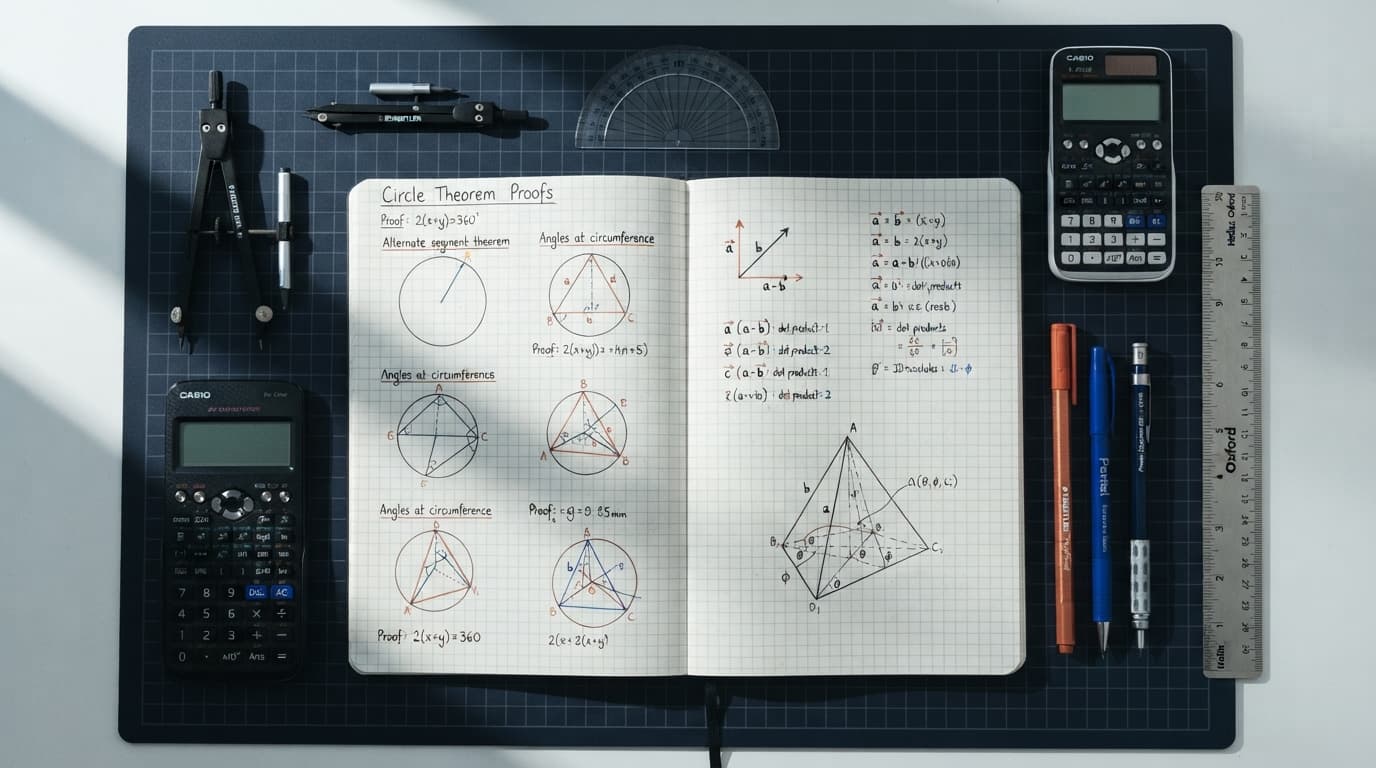
The Reality of Securing a Grade 9 in GCSE Mathematics
Learning how to get a 9 in GCSE maths requires shifting your focus from general revision to target the final 15% to 20% of marks on the Higher tier paper. According to Ofqual data, a Grade 9 is strictly rationed to approximately the top 3% to 4% of entries across the country. It is not awarded for simply getting the standard questions right; it is awarded to candidates who reliably navigate complex, unstructured questions that bridge multiple syllabus topics under tight exam conditions.
Across Edexcel, AQA, and OCR, the Higher tier assessment comprises three equal papers of 80 marks each (or 100 marks each for OCR), totaling 240 or 300 raw marks. Paper 1 is non-calculator, while Papers 2 and 3 permit an approved scientific calculator. While achieving a solid Grade 7 or 8 requires a grasp of standard methods and typical fluency questions, jumping to a Grade 9 hinges entirely on 4-mark to 6-mark synoptic questions positioned towards the final third of each paper. These questions deliberately mask the underlying mathematical tools, forcing students to formulate their own problem-solving pathways.
Deconstructing the Grade 8 to Grade 9 Threshold
To cross the barrier into Grade 9, you must understand raw mark dynamics. Historically, the boundary for a Grade 9 sits roughly between 78% and 83% of the total raw marks across all three papers, though this fluctuates slightly depending on national cohort performance and paper difficulty. In contrast, Grade 8 frequently sits between 65% and 70%. That critical 12% to 15% buffer represents roughly 30 to 36 marks across the entire exam series—or just 10 to 12 marks per paper.
Winter mock exams in Year 11 typically serve as the decisive checkpoint where secondary schools finalise tier entries and set UCAS predicted reference ceilings. If your mock scores are plateauing at Grade 7 or 8, the reason is rarely a lack of factual recall. Instead, marks slip away on final-step accuracy, partial proofs, inefficient working out, and unforced algebraic errors. Reviewing curated revision materials in our GCSE and A-Level study guides reveals that candidates aiming for the top bracket must treat working out as a rigorous mathematical argument rather than informal scratch work.
The 5 Higher-Tier Question Traps Where Grade 8 Students Drop Marks
Examiner reports from Edexcel and AQA consistently highlight recurring failure points on the back pages of Papers 1, 2, and 3. Mastering these five specific question frameworks will protect the marks that separate Grade 8 from Grade 9:
1. Geometric Vector Proofs and Collinearity
Questions requiring candidates to prove that three points lie on a straight line or that two vectors are parallel are classic 4-mark to 5-mark traps. Students often correctly find vector pathways such as x = \vec{AB} or \vec{BC} , but fail to secure the final communication mark. To earn full marks, your concluding statement must explicitly state that \vec{AB} = k\vec{BC} , showing that the vectors are scalar multiples, followed by the explicit phrase: "therefore parallel, and because they share the common point B, they lie on a straight line." Without both components, examiners will deduct the final mark.
2. Algebraic and Geometric Circle Theorems
Standard circle theorem questions ask for an angle using direct rules like the alternate segment theorem. Grade 9 circle theorem problems, however, embed coordinate geometry or algebraic equations. You might be given the equation of a circle, \(x^2 + y^2 = r^2\), and asked to find the equation of a tangent at a given point \((a, b)\). This requires three distinct conceptual steps: finding the gradient of the radius (\(m_1 = \frac{b}{a}\)), applying the perpendicular gradient rule (\(m_2 = -\frac{a}{b}\)), and finding the linear equation \(y - y_1 = m_2(x - x_1)\). A minor arithmetic sign error at step one invalidates the subsequent calculation.
3. Quadratic Sequences and Second Differences
While finding the \(n^{\text{th}}\) term of a linear sequence is straightforward, quadratic and geometric sequences in unfamiliar contexts are common differentiators. For a sequence with constant second difference \(2a\), students frequently confuse the values of \(3a + b\) and \(a + b + c\). In contextual modeling questions—such as counting geometric tile patterns—the challenge lies in deducing the sequence from diagrammatic patterns before setting up the quadratic formula \(an^2 + bn + c\).
4. Non-Right-Angled 3D Trigonometry and Bearings
Combining the sine rule, cosine rule, and \(\text{Area} = \frac{1}{2}ab\sin(C)\) within a three-dimensional pyramid or prism challenges spatial reasoning. Grade 8 candidates often identify the wrong right-angled triangle when projecting an edge onto a base plane. To eliminate this mistake, sketch the extracted two-dimensional triangle separately, clearly labeling vertices, right angles, and known lengths before applying standard trigonometric ratios.
5. Conditional Probability with Algebraic Tree Diagrams
Problems that involve dependent events without replacement where counters or items are denoted algebraically (for instance, \(n\) counters with \(x\) yellow counters) lead directly to quadratic equations. The danger here lies in algebraic manipulation when multiplying probabilities: \(\frac{x}{n} \times \frac{x - 1}{n - 1}\). Students frequently drop marks during cross-multiplication or by failing to discard negative solutions when interpreting physical quantities.
Paper 1 vs. Papers 2 and 3: Strategic Pacing and Methods
Achieving top results requires distinct approaches tailored to non-calculator and calculator papers.
Paper 1 (Non-Calculator) Demands Exact Values and Clean Arithmetic
Paper 1 tests raw numeracy, surd manipulation, exact trigonometric values, and fractional indices. Pacing must be deliberate: spend no more than 40 minutes on the first 50 marks, banking at least 50 minutes to tackle the final multi-step questions. When dealing with surds, always look to rationalise denominators systematically: \(\frac{a}{\sqrt{b} + c} = \frac{a(\sqrt{b} - c)}{b - c^2}\). Never leave fractions unsimplified, and memorise your standard exact values for \(\sin\), \(\cos\), and \(\tan\) at \(0^\circ, 30^\circ, 45^\circ, 60^\circ,\) and \(90^\circ\).
Papers 2 and 3 (Calculator) Demand Full Working and Efficiency
Calculator papers are not simply arithmetic exercises; they feature heavier problem-solving narratives. A common error is writing down only the final rounded figure from the calculator screen. If your final value is incorrect due to a keystroke slip, you forfeit all intermediate method marks unless your intermediate equations are written out explicitly. Make full use of the calculator's memory functions to store exact values between steps rather than writing down prematurely rounded decimals, which cause costly accuracy errors at the end.
The Statutory Formula Sheet: What Is Provided vs. What You Must Know
The Department for Education (DfE) and Ofqual have confirmed that statutory formula sheets remain provided for GCSE Maths through the 2027 exam series across Edexcel, AQA, and OCR. The Summer 2027 JCQ exam series commences on May 10, 2027. However, relying on the formula sheet as a substitute for revision is a dangerous strategy.
The provided sheet typically includes formulas such as the quadratic formula \(x = \frac{-b \pm \sqrt{b^2 - 4ac}}{2a}\), the curved surface area and volume of cones and spheres, and the sine and cosine rules. However, it does not supply many foundational concepts tested on Higher tier papers, including:
- Circle equations \(x^2 + y^2 = r^2\)
- Geometric sequence formula terms
- Angle sum rules and interior/exterior angle formulas for polygons: \((n - 2) \times 180^\circ\)
- Direct and inverse proportionality setups (\(y = kx\) or \(y = \frac{k}{x^n}\))
- Exact trigonometric ratios for non-calculator calculations
- Compound interest multipliers: \(P \times (1 \pm r)^t\)
Understanding what is missing ensures you do not waste time searching for derivations during the exam.
AI-Powered Error Auditing and Targeted Practice
Doing past paper after past paper without reflective feedback rarely moves a student from an 8 to a 9. The most effective way to eliminate the mark gap is an error audit that categorises every dropped mark into one of three buckets: conceptual misunderstanding, misreading the question stem, or algebraic execution errors.
This is where intelligent technology accelerates your progress. Using an interactive AI-powered practice platform enables students to upload or complete Higher-tier problems, instantly identify hidden flaws in their multi-step working, and generate targeted question variations that test the exact same mathematical mechanism. Rather than spending hours marking full papers manually, adaptive tools diagnose whether an error stems from an improper sign expansion or a misunderstanding of perpendicular gradients. For educators seeking to construct differentiated, mark-targeted papers for their top sets, explore how our tools support automated practice generation for maths departments.
The 4-Step Revision Protocol to Secure a 9
Step 1: Topic-Specific Deep Dives
Begin by working through the highest-tariff topics in isolation: functions (composite and inverse), algebraic fractions, transformation of graphs (\(y = f(-x)\), \(y = -f(x)\), \(y = f(x + a)\)), and velocity-time graphs involving area approximations using the trapezium rule.
Step 2: Timed Multi-Paper Sittings
Complete Papers 1, 2, and 3 under strict exam conditions in single sittings. Grade 9 candidates do not just solve problems; they solve them efficiently under cognitive fatigue. Practise tracking your mark rate: you should be securing approximately one mark per minute, preserving a 15-minute buffer at the end of each paper for methodical cross-checking.
Step 3: Rigorous Mark Scheme Scrutiny
Examine official exam board mark schemes for the distinction between M (method) marks, A (accuracy) marks, and B (unconditional independent) marks. Learn the specific conditions required to secure communication marks in mathematical explanations.
Step 4: Systematic Weakness Elimination
Keep a dedicated "Mistake Journal" containing every question where you dropped a single mark. Re-attempt each problem from scratch four days later without looking at the solution. Discover how personalised study support from Thinka can automate this review process, diagnosing weak areas and delivering the exact question styles you need to turn borderline marks into a secure Grade 9.
Related posts
- Oct 14, 2026
Difference Between AS and A-Level: Linear Decoupling, UCAS Tariffs, and the A2 Shift
Understand the true difference between AS and A-Level. Unpack UK linear decoupling vs modular IAL, UCAS tariffs, synoptic A2 jumps, and when to drop a 4th subject.
- Oct 4, 2026
GCSE Grade Boundaries Decoded: Raw Mark Conversions, Grade 9 Benchmarks, and the Mark Buffer Blueprint
Demystify GCSE grade boundaries across AQA, Edexcel, and OCR. Learn raw mark cut-offs for Grade 9, component scaling, and our 8% mark buffer revision rule.
- Sep 24, 2026
The Hardest A-Levels Ranked: Ofqual Data, GCSE-to-A-Level Jump, and Workload Matrix
Discover the hardest A-Levels ranked using official Ofqual data, cognitive load, and the GCSE jump. Learn how to balance your Sixth Form workload and secure top grades.
- Sep 13, 2026
Is It Worth Getting a GCSE Remarked? Costs, Grade Change Probabilities, and the Autumn Resit Protocol
Wondering if it is worth getting a GCSE remarked? Explore JCQ grade change statistics, downgrade risks, Access to Scripts tactics, and autumn resit planning.