Professional Certifications6 min read
PMP Brain Dump Rules: Proctoring Pitfalls, ECO Reality and Lean Note Tactics
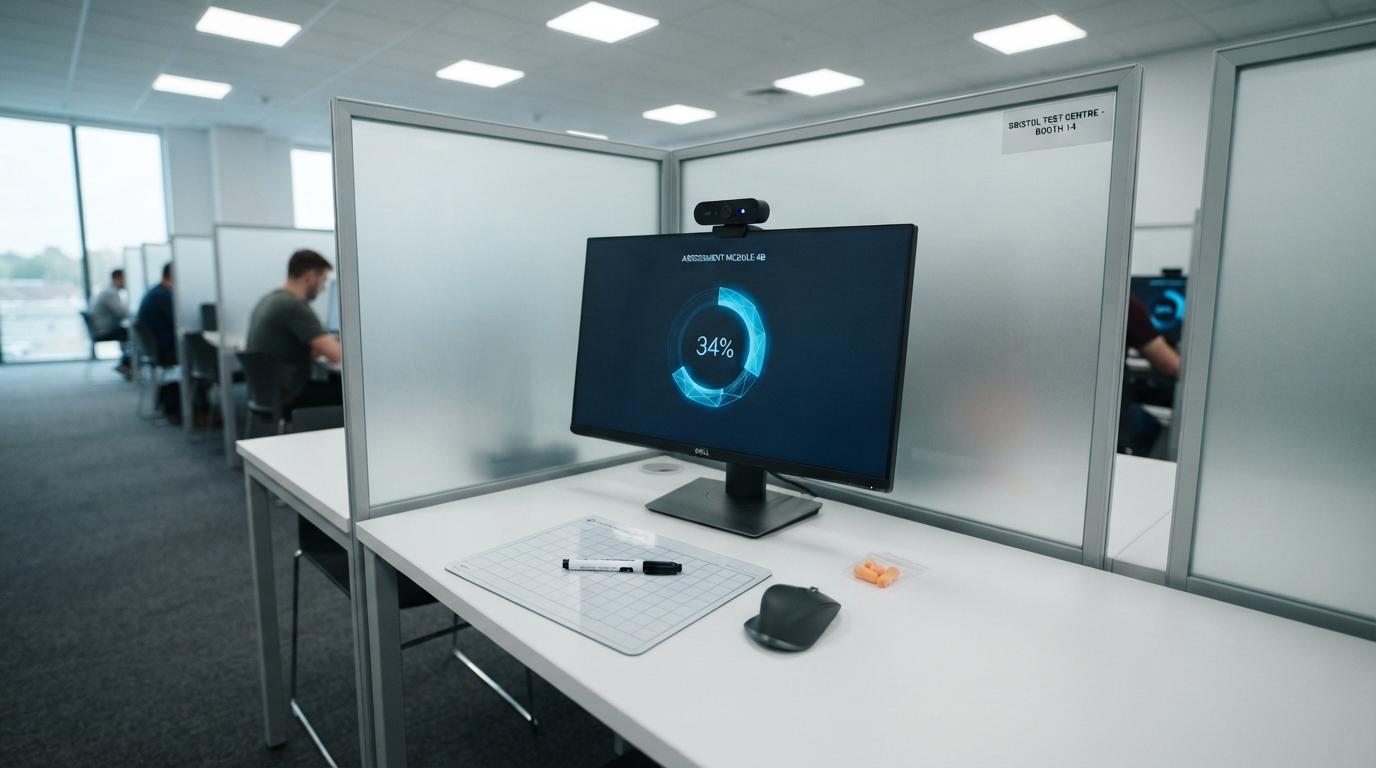
Is the Classic PMP Brain Dump Permissible Under Current Proctor Rules?
If your preparation plan involves sitting down during the initial 15-minute tutorial to sketch out 49 predictive processes and dozens of mathematical formulas, you must stop immediately. Under current Project Management Institute (PMI) testing policies, a traditional pmp brain dump performed before the first question timer commences is treated as a security violation. Pearson VUE test centre invigilators across the UK and remote OnVUE online proctors are strictly instructed to intervene or terminate your sitting if you write on physical scratch sheets or open the digital whiteboard prior to clicking past the tutorial.
You are only permitted to make notes once question one appears and the official 230-minute exam timer begins counting down. For project professionals familiar with the UK market—where candidates frequently weigh PMI qualifications alongside PRINCE2 Practitioner credentials—this procedural detail catches dozens off guard. With the modern PMP Examination Content Outline (ECO) allocating roughly 41% to Process, 33% to People, and 26% to Business Environment, spending ten minutes reproducing obsolete predictive matrices is not merely a compliance risk; it is a profound waste of testing time.
Pearson VUE In-Person vs OnVUE Remote: Physical Pad vs Digital Whiteboard
How and when you can record quick reference reminders depends heavily on your testing medium. In the UK, most candidates sit their exams either at a physical Pearson VUE testing suite (such as in London, Birmingham, or Manchester) or from home via OnVUE online proctoring.
1. Pearson VUE Test Centre Protocol
At an authorised test centre, the administrator provides an erasable plastic notepad and fine-tip dry-erase markers. You are strictly forbidden from writing on this pad while completing the non-scored system tutorial or reading through the initial non-disclosure agreement (NDA). Invigilators monitor candidates through physical walk-throughs and continuous CCTV. If you uncap your marker before question one displays on screen, the invigilator will enter the room, confiscate your sheet, wipe it clean, and log a procedural incident report with PMI.
2. OnVUE Online Remote Proctoring Protocol
When testing remotely from home or your office, physical scratch paper, notebooks, and pens are banned entirely from your desk perimeter. You are restricted solely to the integrated OnVUE digital whiteboard tool. Attempting to use the digital whiteboard to transcribe extensive charts before the exam clock starts is flagged instantly by real-time proctor monitoring software. Furthermore, typing or drawing onto a clunky digital whiteboard with an awkward mouse interface consumes excessive time compared to physical handwriting.
3. International Context: CBT vs Mainland China CIETP
It is worth noting that while computer-based testing (CBT) across Pearson VUE centres globally enforces these strict digital-start regulations, candidates sitting paper-based administrations in mainland China under the China International Exchange Committee for Talents (CIETP) face separate proctoring protocols where exam booklets and scrap sheets remain sealed until collective timing begins. Regardless of geography, the standard holds: no pre-exam transcribing is authorised.
Why the 49-Process Grid Is Dead Under the Modern ECO
Legacy advice from PMBOK 5th and 6th Edition eras instructed candidates to spend their first 10 minutes drawing a complete matrix of 5 predictive process groups, 10 knowledge areas, and 49 processes, alongside hundreds of Inputs, Tools, Techniques, and Outputs (ITTOs). In modern sittings, this tactic carries near-zero utility.
Today's PMP assessment reflects hybrid delivery, servant leadership, stakeholder psychology, and organisational governance. Over half of the scenarios you encounter test agile ceremonies, Kanban bottlenecks, and hybrid handoffs rather than rigid predictive phase transitions. Modern items also introduce emerging operational themes, including generative AI tooling for project scheduling and Environmental, Social, and Governance (ESG) compliance metrics. Memorising mechanical ITTO lists provides negligible leverage for situational questions asking how an agile coach should handle conflict between a Product Owner and an architect.
If you wish to explore how cross-framework governance differs between predictive bodies of knowledge and product delivery structures, consult our comparison guides on professional exam preparation.
The Lean Retrieval Strategy: High-Yield Triggers Only
Rather than transcribing bloated charts, adopt a lean retrieval approach. Once your exam timer officially ticks down from 230 minutes, you should spend no more than 60 to 90 seconds jotting down only the items that cause cognitive fatigue under timed stress.
1. Core Earned Value Management (EVM) Baseline
Do not write out all 14 variants of EAC. Focus strictly on interpretation baselines to resolve situational questions rapidly without re-deriving the mathematics:
\[\text{CV} = \text{EV} - \text{AC} \quad (\text{positive is under budget, negative is over budget})\]
\[\text{SV} = \text{EV} - \text{PV} \quad (\text{positive is ahead of schedule, negative is behind schedule})\]
\[\text{CPI} = \frac{\text{EV}}{\text{AC}}, \quad \text{SPI} = \frac{\text{EV}}{\text{PV}} \quad (> 1.0 \text{ is favourable}, < 1.0 \text{ is unfavourable})\]
For estimate calculations under typical past performance conditions: \[\text{EAC} = \frac{\text{BAC}}{\text{CPI}}\]
2. Communication Channels Formula
A frequent point of simple arithmetical panic when a question asks how many pathways open when a team expands: \[C = \frac{n(n - 1)}{2}\]
3. Agile & Hybrid Decision Rules
Instead of process names, scribble three tactical principles that resolve servant-leadership dilemmas:
A. Assess Before Action: Always evaluate root causes before updating logs or escalating to the steering board.
B. Empower the Team: Servant leaders remove external blockers and facilitate collaboration rather than assigning tasks.
C. Transparency First: In hybrid projects, never hide variance behind change requests; surface sprint metrics openly.
Replacing Rote Memorisation with Instinctive Retrieval
The candidate who relies heavily on a lengthy physical brain dump is usually compensating for an unconditioned mental framework. Under the pressure of 180 questions across 230 minutes—split across two optional 10-minute breaks after questions 60 and 120—stopping to cross-reference a scratch sheet breaks your reading cadence.
You can train far higher exam speed by testing situational mechanics under adaptive pressure. Through AI-powered practice drills, candidates can isolate ambiguous hybrid scenarios, agile team dysfunctions, and complex EVM narrative traps. Instead of referencing an artificial list on scrap plastic, adaptive scenario questions build reflexive recall, allowing you to recognise the correct course of action within 40 seconds.
To explore how active recall outperforms traditional cramming methodologies across professional credentials, visit Thinka's exam preparation framework.
Exam-Day Execution Checklist
To avoid compliance disqualification and conserve cognitive energy on exam day, implement this disciplined routine:
Before Entering the Suite
Leave all notes, revision books, and smart watches in your allocated Pearson VUE locker. Wash your hands thoroughly—dry-erase markers smudge easily on plastic test boards when exposed to skin oils.
During the 15-Minute Tutorial
Keep your dry-erase markers capped and placed flat on the desk. Do not touch the board. Use the tutorial time to adjust your screen brightness, verify mouse sensitivity, calibrate your seating posture, and complete steady breathing exercises to lower your resting pulse.
Upon Display of Question One
Verify that the master 230-minute countdown has commenced. If you feel compelled to record key formulas, limit your notations to EVM ratios and channel calculations. Cap your pen by minute 228 and begin your first block of 60 questions with complete focus.
Related posts
- Nov 15, 2026
CFA Level 1 vs Level 2: Vignette Mechanics, Topic Weight Surges and 350-Hour Study Transition
Compare CFA Level 1 vs Level 2 difficulty: navigate item set vignettes, prepare for the 350-hour workload, and master FSA and Equity weighting shifts to pass.
- Nov 9, 2026
CFA Salary by Level: Remuneration Benchmarks from Level 1 Pass to Charterholder Pay
Explore CFA salary by level across the UK and global hubs. Discover compensation bands, bonus splits, and role progression from Level 1 through to charterholder status.
- Nov 6, 2026
PMP Passing Score Explained: Psychometric Equating, Domain Ratings & Mock Benchmarks
Demystify the PMP passing score: decode PMI's psychometric Angoff model, 175 scored items, AT/T/BT rating bands, and the 70–75% mock benchmark for UK candidates.
- Nov 3, 2026
FRM Pass Rates 2026: Part I and II Window Trends, Hidden Passing Scores & Mock Benchmarks
Analyse FRM pass rates 2026 across May, August, and November windows. Decode GARP quartile scoring, Part I vs Part II trends, and mock benchmarks.