Latest News5 min read
The Cognitive Lockdown: Turning School Smartphone Bans into an A* Competitive Edge
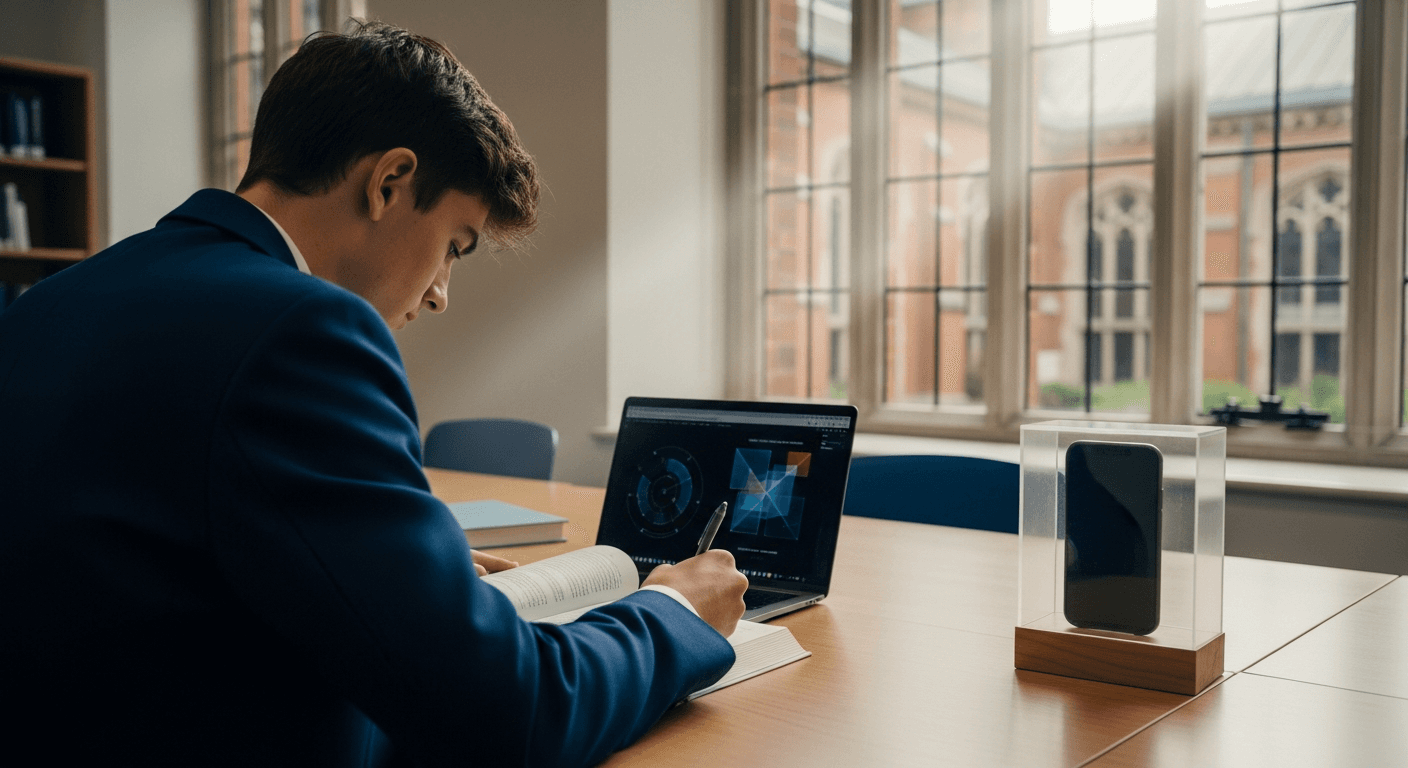
The Silence of the Sixth Form: Navigating the New Focus Era
If you have walked into your school common room recently, you might have noticed something unusual: students actually looking at each other. Following the Department for Education’s (DfE) 2024 guidance to prohibit mobile phone use throughout the school day, the UK educational landscape has undergone a radical shift. For many IGCSE and A-Level students, this 'digital lockdown' felt, at first, like a restriction. However, as we approach the 2025 exam cycle, it is becoming clear that this policy is not a punishment—it is a competitive gift. For those willing to embrace it, the absence of the smartphone is the first step toward mastering the 'Deep Work' necessary to secure top marks in increasingly rigorous assessments.
The 'Focus Shock': Why Your Brain Feels Brittle
Modern A-Level papers, particularly in subjects like Further Maths, English Literature, or Physics, require sustained cognitive output for up to three hours. Yet, the average student’s attention is conditioned by the 'micro-distraction' cycle of social media. When schools remove phones, many students experience what psychologists call 'focus shock'—a period of restlessness and cognitive withdrawal. The reality is that your brain has been trained to seek a dopamine hit every 30 seconds, making the prospect of a 90-minute essay feel impossible. By removing the phone from the equation during school hours, the DfE has effectively created a mandatory training camp for your prefrontal cortex. The students who thrive in 2025 will be those who use this time to close the 'concentration gap' that has widened since the pandemic.
Architecting the 'Deep Work' Protocol for A-Levels
To turn this restriction into a grade-boosting advantage, you must move beyond simply 'not using your phone' and toward 'Deep Work.' This term, coined by Cal Newport, refers to professional activities performed in a state of distraction-free concentration that push your cognitive capabilities to their limit. For an A-Level student, this means simulating the exact mental environment of the exam hall long before you sit your mocks.
You can start by treating your free periods as 'Deep Work' sprints. Instead of half-hearted revision while chatting, set a timer for 50 minutes of absolute silence. Use free study materials and resources to map out specific, high-intensity goals for these blocks. When the 'phantom vibrate' sensation occurs, acknowledge it as your brain recalibrating its focus threshold. By the time you reach your summer exams, a three-hour paper will feel like a natural extension of your daily routine rather than an exhausting marathon.
Using AI to Simulate Cognitive Endurance
One of the hardest parts of the new phone-free reality is knowing how to fill the silence effectively. This is where AI-powered practice platforms become essential. While your phone is in your locker, your laptop or tablet remains a tool for precision learning. You can use AI to architect study blocks that mimic the 'unseen' nature of modern 2025 exam papers.
For example, an A-Level Biology student can use Thinka to generate a suite of questions specifically targeting their weakest areas within a strict time limit. This creates a 'closed-loop' environment where the challenge level is high enough to keep you in a 'flow state'—the holy grail of productivity where time seems to disappear. By using AI to improve your grades through targeted, high-intensity practice, you are replacing low-value scrolling with high-value cognitive growth. This is the difference between 'passive revision' (highlighting notes) and 'active mastery' (solving complex problems).
The Competitive Edge: Escaping the 'Concentration Gap'
The 2024 UNESCO Global Education Monitoring Report highlighted a significant surge in smartphone-free school legislation worldwide, noting that even the mere presence of a phone nearby reduces a student’s cognitive capacity. In the UK, the move toward phone-free schools creates a 'Concentration Gap.' On one side are students who spend their evenings making up for lost 'scroll time'; on the other are those who use the school day to build an elite level of focus stamina.
Think of your focus as a muscle. If your competitors are only capable of 15-minute bursts of study before checking a notification, and you have trained yourself to work for 90 minutes without a break, you have a massive structural advantage. This stamina is exactly what examiners are looking for in the 'AO3' evaluation sections of your papers—the parts that require complex, multi-layered reasoning that cannot be faked or rushed.
Practical Tips for the Phone-Free Transition
1. The Analogue Morning: Try to keep your phone off for the first 60 minutes after you wake up. This prevents your brain from starting the day in a 'reactive' mode and prepares you for the focused atmosphere of the school day.
2. The 'Monk Mode' Common Room: If your school has a common room, advocate for a 'Quiet Zone.' Use this space to practice your Deep Work sprints, using practice papers generated via AI to ensure your work is always at the right level of difficulty.
3. The Evening Detox: When you get home, don't immediately binge on your phone. Set a 'digital sunset' and use the calm you’ve built during the school day to tackle your hardest homework first.
Conclusion: Making the Ban Work for You
The smartphone ban isn't about taking away your social life; it’s about giving you back your edge. As the 2025 IGCSE and A-Level specifications become more demanding, the ability to focus will be the most valuable asset in your academic toolkit. By reframing the 'digital withdrawal' as a 'cognitive detox,' you can use this period of change to outpace the competition. Start using the tools at your disposal to build a high-intensity study habit that doesn't rely on the crutch of a screen. The A* isn't just about what you know—it's about how long you can stay focused on the problem in front of you.
Related posts
- Oct 9, 2026
CIE IGCSE Results Day Time: UK Release Schedule, Candidate Portal Login, and Sixth Form Clearance Guide
Wondering about the exact CIE IGCSE results day time? Discover 07:00 BST release schedules, Candidate Results portal logins, grade boundaries, and Sixth Form entry steps.
- Sep 29, 2026
AQA A Level Grade Boundaries: Raw Mark Matrix, Subject Weightings, and A* Scaling
Master AQA A Level grade boundaries across STEM and humanities. Decode raw mark cut-offs, linear component weightings, and A* scaling targets for exam success.
- Sep 19, 2026
CIE A-Level Exam Dates: Master Timetables, Administrative Zones, and Timetable Clash Protocols
Master CIE A-Level exam dates, Key Time zone rules, and official timetable clash supervision protocols. Build your backwards revision schedule for exam success.
- Sep 8, 2026
Missed A-Level Grades Protocol: The Results Morning Triage for UCAS Clearing, Priority Remarks, and Resit Pathways
Missed your firm university offer? Follow our step-by-step results morning protocol to navigate UCAS Clearing, priority reviews of marking, and autumn resits.