Professional Certifications5 min read
PMP Brain Dump Policy: Pearson VUE Rules, Whiteboard Limits & 230-Minute Time Strategy
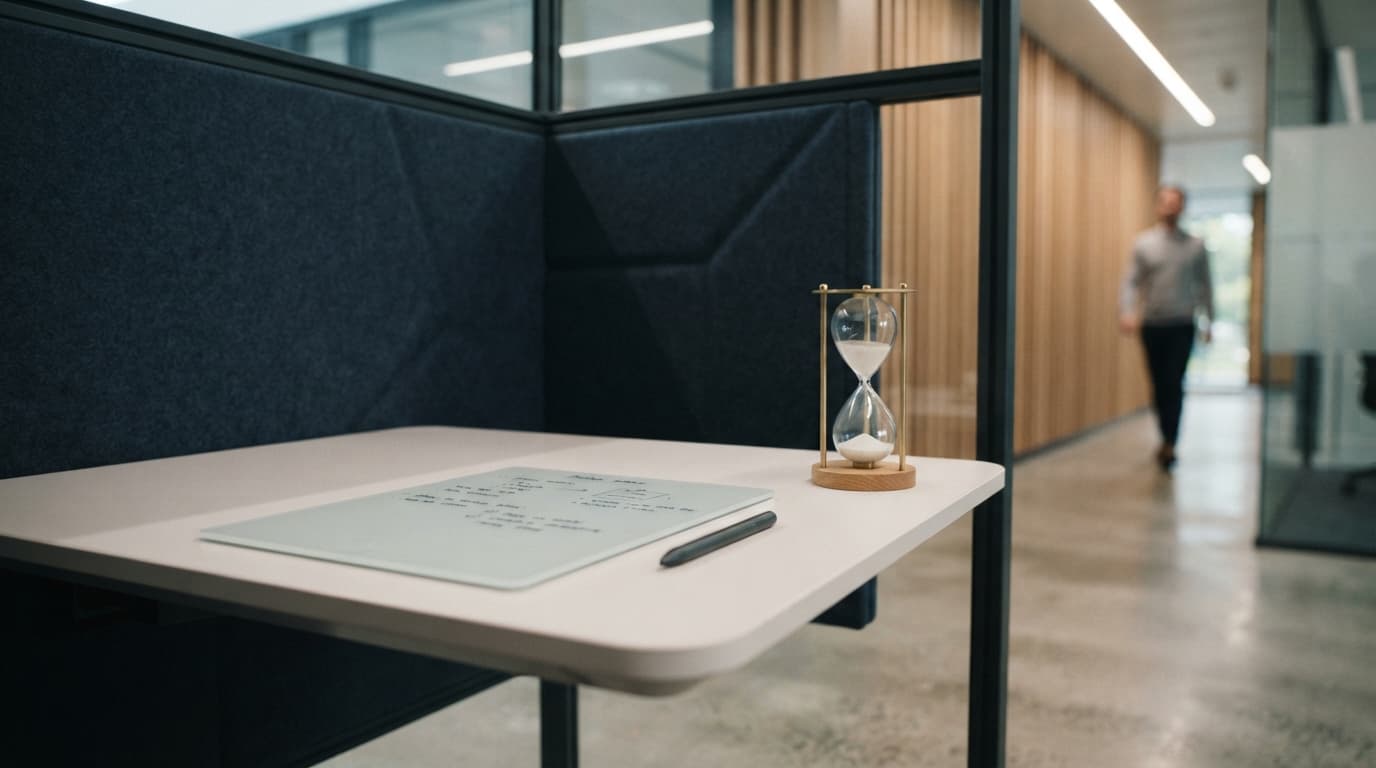
Understanding the Official PMP Brain Dump Policy
If you are preparing to sit the Project Management Professional (PMP)® examination in the UK, you have likely encountered advice recommending a 'brain dump'—the tactic of rapidly writing down Earned Value Management (EVM) formulas, critical path calculations, and mnemonic frameworks the instant you sit at your exam desk. However, falling foul of the strict PMP brain dump policy enforced by the Project Management Institute (PMI) and Pearson VUE can lead to immediate test termination and result invalidation.
Under current Pearson VUE security protocols, candidates are strictly prohibited from writing any notes, formulas, or diagrams on their provided scratch booklet or digital whiteboard during the 10-to-15 minute pre-exam software tutorial. The tutorial window is designed exclusively for testing your hardware, navigation controls, and interface familiarity. Your allocated writing materials may only be used once the official exam countdown timer begins for Question 1. Writing prior to the clock start is classified as an irregular testing procedure and security breach by exam invigilators.
In-Person Test Centres vs OnVUE Online Proctoring: The Rules Compared
Whether you book your sitting at a physical Pearson VUE testing centre in London, Manchester, Edinburgh, or sit remotely via OnVUE proctoring at home, your working materials and note-taking mechanics differ substantially.
1. In-Person Pearson VUE Test Centres
At a physical test centre in the UK, you will be issued:
- A spiral-bound, laminated dry-erase booklet (typically 4 to 5 double-sided grid sheets).
- Two fine-tip dry-erase pens.
- A physical handheld basic calculator (or access to the on-screen digital calculator).
Crucial Rule: You cannot wipe your own laminate sheets clean; if you fill the booklet, you must raise your hand to exchange it for a fresh one. Invigilators inspect sheets between candidates, and writing before clicking past the final tutorial confirmation screen will result in your session being flagged.
2. Online OnVUE Remote Proctoring
For candidates taking the PMP from home or an office, Pearson VUE implements zero-tolerance environmental restrictions:
- No physical paper or pens: Physical post-its, blank paper, notebooks, and dry-erase whiteboards are strictly banned within arm's reach. Having a pen on your desk is grounds for instant proctor cancellation without a refund.
- Built-in Digital Whiteboard: You are restricted entirely to the integrated OnVUE digital whiteboard tool. This canvas allows basic text boxes, line drawing, and geometric shapes, but typing complex formulas or drawing network diagrams using a mouse is clunky and slow.
- Gaze tracking: Looking away from the monitor to write on a hidden pad will immediately trigger an OnVUE proctor intervention.
Given the cumbersome nature of the digital whiteboard, relying on a manual formula sheet or diagrammatic brain dump online is practically counterproductive.
Why Manual Brain Dumps Are Obsolete on the Modern PMP Exam
The contemporary PMP syllabus reflects a massive shift toward Agile and hybrid project delivery. The examination is weighted across three core domains:
- Process (41%): Traditional predictive frameworks, governance, and hybrid tailoring.
- People (33%): Conflict management, servant leadership, emotional intelligence, and team dynamics.
- Business Environment (26%): Compliance, benefits realization, and organizational change.
Unlike previous legacy editions of the PMBOK® Guide, the modern 180-question paper features very few plug-and-chug formula calculations. You will rarely need to manually derive complex formulas such as Schedule Variance \(SV = EV - PV\), Cost Performance Index \(CPI = \frac{EV}{AC}\), or Variance at Completion \(VAC = BAC - EAC\). Instead, questions test situational interpretation—such as diagnosing project health when \(CPI = 0.82\) and \(SPI = 1.15\) and deciding how a servant leader should respond to key stakeholders.
Spending the first 10 minutes of your live exam clock scribbling 49 processes and 20 mathematical formulas consumes valuable minutes without improving your diagnostic accuracy. To explore complementary project methodologies used across UK industry, browse our insights on professional certification pathways and revision strategies.
The 230-Minute / 3-Block Pacing Strategy
The PMP exam presents 180 questions to be answered in 230 minutes, which equates to roughly 76 seconds per question. The exam is divided into three discrete 60-question blocks separated by two optional 10-minute breaks that do not deduct from your 230-minute pool.
Here is the proven block-by-block pacing schedule to keep your timing disciplined:
Block 1: Questions 1 to 60 (Pacing Target: 75 Minutes)
- Countdown Clock: Starts at 230:00 → Submit by 155:00.
- Focus: Settle your exam nerves, calibrate to the question phrasing, and flag difficult multi-response or drag-and-drop questions.
- Review & Break: Review flagged items for Section 1, submit the block, and take your full 10-minute scheduled break. Step away from the desk, hydrate, and stretch. Remember: once you submit Block 1, you cannot return to these questions.
Block 2: Questions 61 to 120 (Pacing Target: 75 Minutes)
- Countdown Clock: Starts at 155:00 → Submit by 80:00.
- Focus: Maintain steady momentum across situational hybrid scenarios. Avoid spending more than 90 seconds on any single question.
- Review & Break: Complete your final check of flagged questions in this section, lock in your submissions, and take your second 10-minute scheduled break.
Block 3: Questions 121 to 180 (Pacing Target: 80 Minutes)
- Countdown Clock: Starts at 80:00 → Submit by 0:00.
- Focus: Fatigue peaks in this final stretch. Allocate an extra 5 minutes of buffer time to manage dense, paragraph-long Business Environment scenarios without rushing your final choices.
How to Replace Brain Dumps with Instant Recall
Rather than relying on brittle, high-stress memory dumps at the start of your examination, the most effective approach is building active recall through spaced, scenario-based revision. You need to instantly recognize how principles such as iterative backlog refinement, risk mitigation, and stakeholder engagement apply within complex situational stems.
With Thinka's AI-powered learning platform, candidates train using targeted diagnostic drills that reinforce core project management concepts and EVM interpretations automatically. Instead of memorising static lists, you build rapid situational intuition that eliminates the need for scratch-paper crutches.
Ready to benchmark your readiness and master your timing before exam day? You can begin your tailored practice sessions on Thinka to build the speed, precision, and confidence needed to pass your PMP on the first attempt.
Related posts
- Sep 19, 2026
PMP Formulas Cheat Sheet: Earned Value, Critical Path & EVM Calculation Strategy
Master the essential PMP formulas cheat sheet: EVM metrics, critical path float, PERT estimation, and situational calculation shortcuts for your Pearson VUE exam.
- Sep 16, 2026
PMP Domain Weightings Guide: ECO Breakdown, Agile-Predictive Split & Revision Tactics
Master the PMP domain weightings: Process (41%), People (33%), and Business Environment (26%). Tackle situational questions, hybrid delivery, and AI tools.
- Sep 13, 2026
CFA vs FRM Comparison: Syllabus Overlap, UK Career ROI & Dual-Charter Roadmap
Compare CFA vs FRM: explore syllabus overlap across Derivatives and Quants, exam difficulty, City salary trajectories, and our dual-charter sequencing strategy.
- Sep 10, 2026
FRM Pass Rates Decoded: Part I vs Part II Trends, Quartile Scoring, and Study Strategy
Understand FRM pass rates across Part I and Part II. Decode GARP's quartile scoring system, diagnostic pass/fail combinations, and build a 200-hour study plan.