Secondary School Selection for Primary Students8 min read
Secondary School Interview Questions: The 5-Tier Framework and Independent 11+ Prep Guide
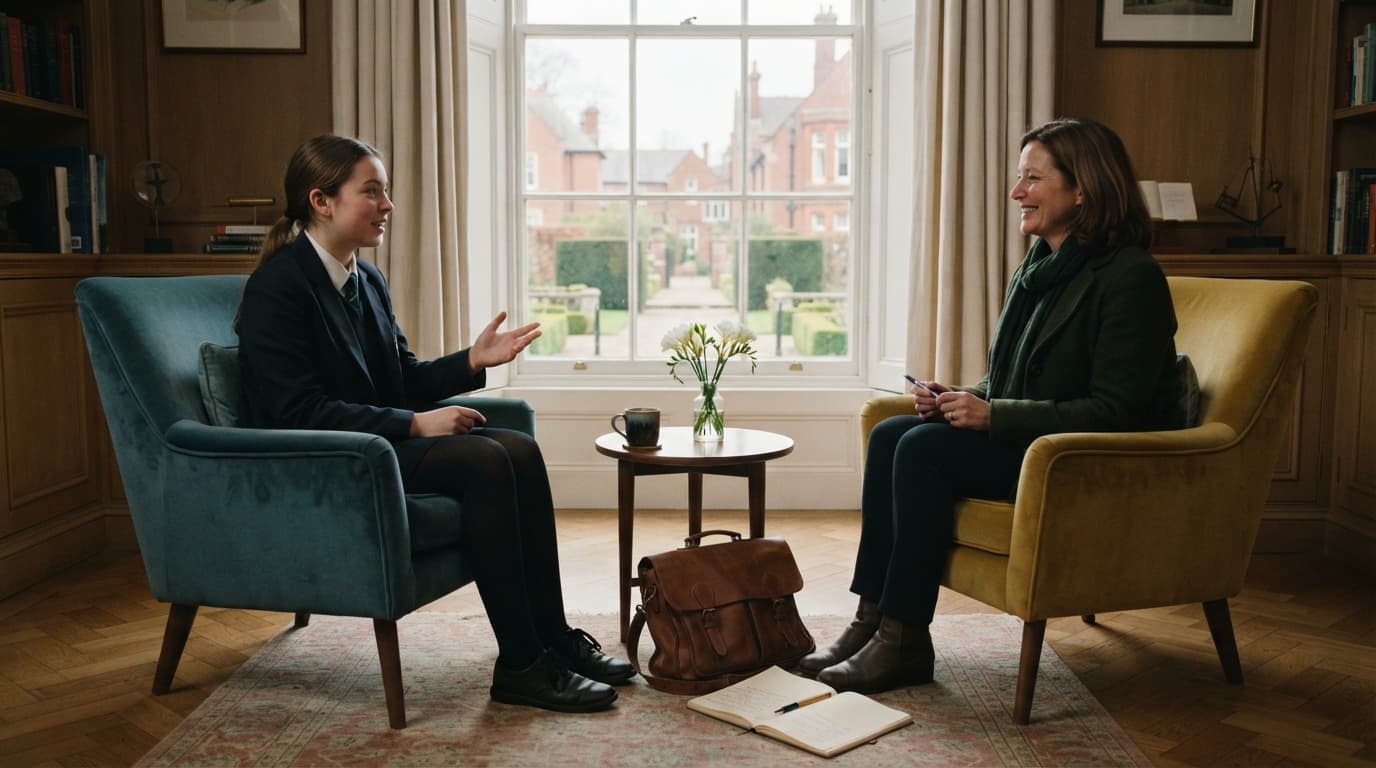
Demystifying the 11+ Admissions Interview
For parents navigating 11+ admissions across leading UK independent day schools, boarding schools, and partially selective grammar schools, the interview stage often induces far more anxiety than the written entrance tests. By the time your child receives an invitation to interview—typically scheduled between December and February of Year 6—the admissions office already knows they possess the requisite academic baseline in English and Mathematics. The interview exists to answer a different question entirely: how does this child think on their feet, interact with peers, and assimilate unfamiliar ideas?
Facing secondary school interview questions is not an exercise in reciting pre-packaged speeches or trying to second-guess the "correct" political opinion. Admissions directors at top-tier schools such as St Paul's, King's College Wimbledon, or the London Consortium consortium schools openly caution against over-rehearsed candidates. What interview panels genuinely evaluate is intellectual elasticity, teachability, conversational authenticity, and poise under gentle scrutiny. Below, we break down the five core question tiers, expose the marking criteria admissions tutors rely on, and outline a child-friendly communication framework that keeps your 10- or 11-year-old confident without sounding like a miniature executive.
The Admissions Rubric: How Interviewers Grade Your Child
While each independent school keeps its exact marking sheet confidential, most selective panels grade pupils across four shared assessment criteria, scoring each band from 1 (hesitant/rehearsed) to 4 (exceptional conversational maturity):
1. Articulation and Conversational Presence: Does the child maintain eye contact, speak in full, coherent sentences, and engage in genuine dialogue rather than giving curt, one-word replies? Do they show warmth and listen attentively when the interviewer speaks?
2. Intellectual Curiosity and Lateral Agility: How does the candidate react when presented with a counter-intuitive premise or an unsolved puzzle? Do they shut down or light up? Top marks go to children who think aloud and relish wrestling with ambiguity.
3. Teachability and Responsiveness to Prompting: If an interviewer challenges an assumption or provides a small hint, can the pupil absorb that feedback and adjust their reasoning? Admissions tutors look for flexible learners who will thrive in a rigorous Key Stage 3 classroom.
4. Cultural and Community Contribution: Beyond grades, will this child participate eagerly in house drama, music, robotics, or cross-country? Do they exhibit empathy, self-awareness, and resilience when recounting past setbacks?
The 5-Tier Secondary School Interview Question Bank
Tier 1: Personal Motivation, Self-Awareness, and School Fit
These questions serve as gentle icebreakers, but they also assess whether your child has genuine ownership of their school preferences or is simply echoing dinner-table conversations.
Typical Questions:
• "What is something you have failed at recently, and how did you handle it?"
• "If you could redesign your Year 6 timetable, which subject would you double and which would you remove?"
• "Tell me about a project or hobby you pursue purely because you love it, without any teacher or parent asking you to."
• "Why this school specifically, beyond the fact that it achieves excellent GCSE results?"
The Evaluator's Focus: Panels immediately discount generic flattery ("Your science labs are wonderful"). They listen for specific, idiosyncratic details: a pupil mentioning an ambition to join the school's specific debating league or work in the school garden shows authentic curiosity.
Tier 2: Academic Lateral Thinking and Unseen Puzzles
Instead of testing syllabus recall, Tier 2 assesses how a child manages cognitive friction. The interviewer may show a surreal photograph, present a strange physical artefact, or offer a short numerical puzzle.
Typical Questions:
• "How many footballs could fit inside this interview room? Walk me through your estimate."
• "Look at this line of poetry: 'The sea is a hungry dog.' Why might the poet describe water as an animal?"
• "If every clock in the country stopped tomorrow, how would our daily lives change over the first 48 hours?"
The Evaluator's Focus: Interviewers do not expect the exact cubic volume of the room. They want to observe the estimation strategy—measuring an imaginary desk, multiplying across dimensions, and adjusting for empty air space. If your child accesses curated study notes and revision resources to sharpen their verbal and non-verbal reasoning, remind them that articulating their train of thought is far more crucial than rushing to an arbitrary final number.
Tier 3: Everyday Ethics and Situational Judgement
These scenarios examine moral empathy, situational discernment, and the ability to view an issue from multiple viewpoints.
Typical Questions:
• "You notice your best friend taking another pupil's pencil case without asking. They whisper that it is just a harmless prank. What do you do?"
• "Is it ever acceptable to tell a lie? Can you give an example of a good lie versus a bad lie?"
• "A new pupil joins your form in Year 7 who speaks very little English and appears isolated at break time. How would you welcome them without making them feel uncomfortable?"
The Evaluator's Focus: Avoid absolute, robotic statements like "Rules must never be broken." Admissions tutors reward pupils who can weigh competing tensions—for instance, distinguishing between compassionate white lies that preserve someone's feelings and dishonest lies that evade personal accountability.
Tier 4: Current Affairs and Global Awareness
Panels do not expect Year 6 children to parse complex macroeconomic fiscal policy. However, they frequently explore whether a child pays attention to the world around them, digests news headlines, or considers environmental and societal changes.
Typical Questions:
• "Should museums return historical artefacts to their countries of origin?"
• "If you were granted £1,000,000 to improve child wellbeing in your local council, where would you allocate it first?"
• "Do you believe smartphones should be banned for everyone under the age of sixteen? Why or why not?"
The Evaluator's Focus: The panel evaluates whether the child can articulate both sides of a civic debate before taking a reasoned stand. A strong candidate will recognise why a phone ban might curb cyberbullying, while acknowledging that it could hinder communication with parents on long commutes.
Tier 5: Paired Challenges and Group Dynamics
Many independent day schools incorporate a 30-minute collaborative task alongside individual interviews. Groups of four to six applicants are asked to design an eco-friendly town, build a bridge from dried spaghetti, or negotiate survival gear for a desert island.
The Evaluator's Focus: The panel penalises dominant pupils who talk over others just as strictly as they penalise passive candidates who retreat into silence. They seek the collaborative bridge-builder: the pupil who says, "That's a brilliant suggestion, Sam—how can we combine your idea with Maya's?"
The PER Framework: Structuring Clear, Unscripted Answers
When children get nervous, they tend to make one of two mistakes: giving abrupt three-word answers or rambling into incoherent stream-of-consciousness narratives. To help your child structure their thoughts without sounding coached, teach them the simple PER Framework: Point, Example, Reflection.
• P (Point): Answer the question directly in the opening sentence.
• E (Example): Anchor the point in a concrete, lived experience from school, home, or reading.
• R (Reflection): Conclude with what was learned, what changed, or why it matters.
Example Question: "Tell me about a book that made a strong impression on you."
Candidate Response:
(Point) "One book that challenged how I view history was Goodnight Mister Tom by Michelle Magorian.
(Example) Before reading it in Year 5, I thought the Second World War was purely about battles and Spitfires, but watching Willie Beech adapt to life as an evacuee in rural England showed me how quiet and frightening the war was for displaced children.
(Reflection) It made me realise that historical events aren't just dates in a textbook; they are personal stories about ordinary people overcoming enormous disruptions."
Three Dangerous Traps That Cost Pupils Offers
1. The "Parental Echo": Admissions directors spot scripted answers within seconds. Phrases like "I thrive in high-pressure academic environments" or "Your STEM enrichment matches my analytical disposition" scream adult coaching. Encourage your child to use their own vocabulary. Plain language delivered with authentic passion beats hollow adult jargon every time.
2. Fear of "I Don't Know": When confronted with an unfamiliar question (such as, "What caused the Great Plague?"), panicking children often guess wildly. Teach your child that it is perfectly acceptable to pause, smile, and say: "I haven't studied that period yet, but based on what I know about hygiene back then, could it have been linked to dirty drinking water?" This turns a knowledge gap into a demonstration of logical deduction.
3. Forgetting Questions for the Panel: Near the end of the interview, the panel will inevitably ask: "Do you have any questions for us?" Replying "No, everything was covered" misses an opportunity. A memorable inquiry shows true engagement: "What sort of community service initiatives do Year 7 pupils get involved with?" or "Do you have a lunch club for pupils who want to write for the school magazine?"
Using AI for Conversational Interview Practice
Conducting repetitive kitchen-table interrogations often stresses children out. An engaging, low-pressure alternative is to use conversational AI to run dynamic, gamified roleplay simulations. By logging into the interactive AI practice platform, you can prompt the platform to act as a warm, curious Year 7 admissions tutor.
Here is a sample prompt you can customise at home:
"Act as a friendly, supportive admissions interviewer at a selective UK secondary school interviewing a 10-year-old applicant for Year 7 entry. Ask me one question at a time from different categories: personal interests, academic lateral thinking, and ethical dilemmas. After I answer, do not give me a grade. Instead, ask a thoughtful follow-up question that challenges one of my points, just as a real tutor would, and keep the dialogue natural."
This approach trains your child to adapt to conversational shifts rather than clinging to scripted notes. At Thinka's personalised learning platform, we help primary pupils build intuitive, flexible problem-solving habits that translate seamlessly into the interview room. When children realise that an interview is simply a fascinating conversation with an adult who wants to see them succeed, natural confidence replaces nervous rehearsal every time.
Related posts
- Oct 10, 2026
Do Secondary Schools Use SATs Results for Sets? Year 7 Ability Grouping, CAT4 Tests, and GCSE Pathways
Do secondary schools use SATs results for sets? Discover how Year 6 scaled scores, CAT4 tests, and FFT targets shape Year 7 streaming and GCSE tier trajectories.
- Sep 30, 2026
Secondary School Cut Off Points Guide: Distance, Grammar Thresholds, and the 3-Tier CAF Strategy
Demystify UK secondary school cut off points. Learn how distance limits, grammar score thresholds, and Fair Banding work, plus build a 3-tier CAF shortlist.
- Sep 20, 2026
11 Plus Pass Marks by Region: SAS Benchmarks, Grammar Cut-Offs, and CAF Selection
Demystify 11 plus pass marks by region. Learn how Standardised Age Scores (SAS) work, compare regional cut-offs, and triage mid-October grammar school results.
- Sep 9, 2026
Secondary School Choice Ranking Strategy: Mastering the Equal Preference System on Your CAF
Master the secondary school choice ranking strategy on your Common Application Form (CAF). Learn how the Equal Preference System works, hedge allocation risks, and rank your 6 slots.