Primary School Education6 min read
The Conceptual Bridge: Using AI-Powered Analogies to Simplify Abstract KS2 Topics for Your Child
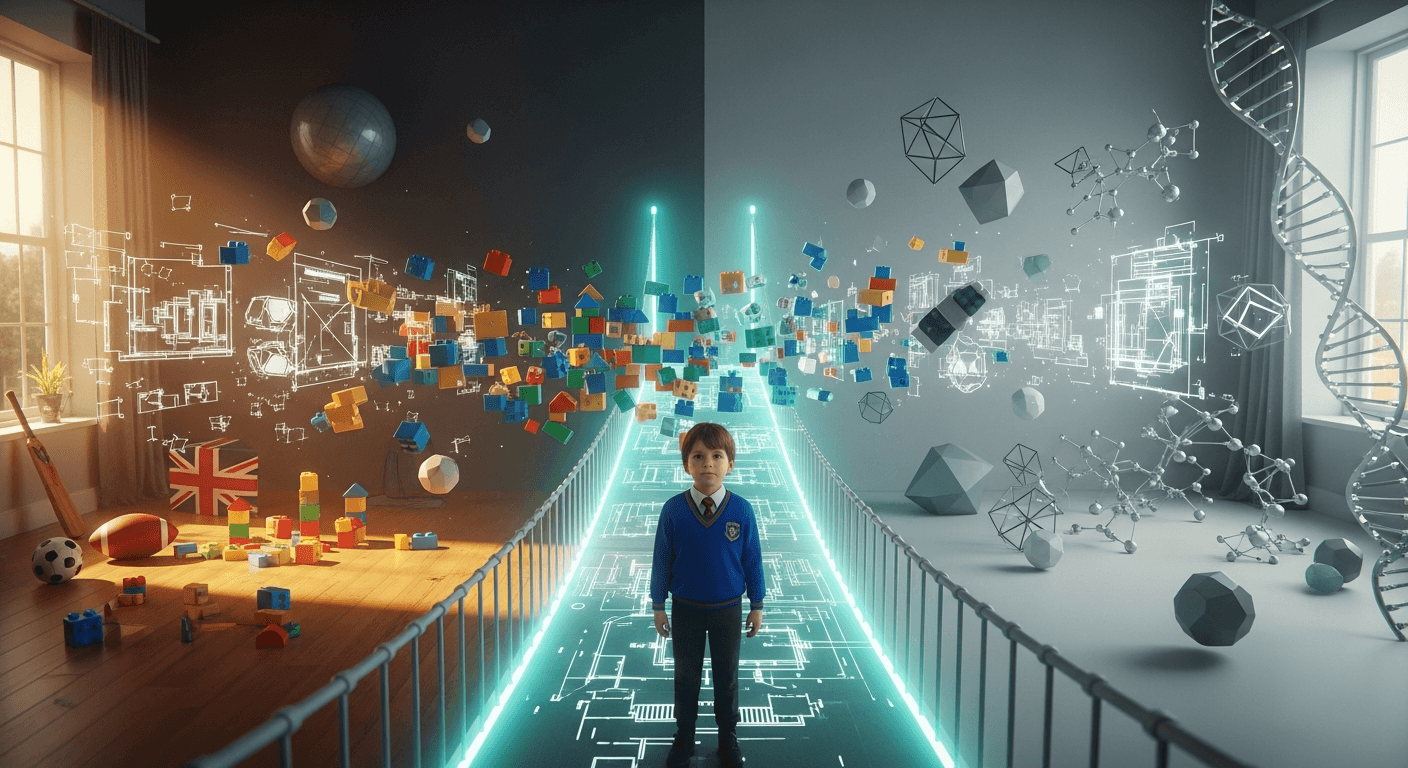
The 'I Don’t Get It' Wall: Why Year 5 and 6 Feel Different
Every parent knows the moment. Your child, who previously sailed through their schoolwork, suddenly hits a wall. Whether it is the logic of equivalent fractions, the invisible flow of electricity in a circuit, or the dizzying world of fronted adverbials, the frustration is palpable. In the UK primary system, this usually happens around the transition from Key Stage 1 to Key Stage 2 (KS2), particularly as pupils move toward Year 5 and Year 6.
Educators call this the 'abstraction gap'. For the first few years of school, learning is largely concrete—you can touch five apples, you can see a capital letter. But as the National Curriculum progresses, the concepts become invisible. They exist only in the mind. For many children, the leap from 'doing' to 'thinking' is where the love for a subject can start to fade. However, there is a powerful tool to bridge this gap: the personalised analogy, supercharged by AI.
What is the 'Abstraction Gap' in the UK Curriculum?
The UK’s shift toward 'Maths Mastery' and a more rigorous English grammar syllabus means that rote memorisation is no longer enough to secure a 'Greater Depth' score in SATs. Pupils are now expected to demonstrate a deep, conceptual understanding of why things work.
When a child struggles with a concept like \(\frac{3}{4} > \frac{2}{3}\), it is rarely because they cannot do the sum. It is because they haven't built a mental model for what those numbers represent in the real world. Without a bridge between what they already know (their hobbies and interests) and what they are learning (abstract theory), the information simply doesn’t 'stick'.
The Power of the 'Conceptual Translator'
An analogy is more than just a clever comparison; it is a 'conceptual translator'. It takes a foreign idea and explains it in a native language. Traditionally, teachers use standard analogies: 'fractions are like a pizza' or 'an electrical circuit is like a water pipe'.
The problem? Not every child cares about pizza or water pipes. This is where AI-driven personalisation changes the game. By using AI-powered practice platforms, parents can now generate bespoke analogies that map complex curriculum topics directly onto their child’s specific passions—be it Minecraft, Taylor Swift, football, or gymnastics.
Three Examples of AI-Powered Analogies for Primary Subjects
1. Fractions and Decimals (The 'Gaming Inventory' Model)
If your child is struggling with the idea that a whole can be divided into smaller, equal parts, stop talking about cake. If they play games like Minecraft or Roblox, use the 'Inventory' analogy.
The Analogy: 'Think of a whole Gold Block as 1. If you need to craft four smaller items, you have to split that block into four equal quarters. If you only have three quarters, your inventory shows 0.75 of a block. You have the same amount of gold, just in different shapes.'
2. Grammar and Syntax (The 'Football Manager' Model)
Explaining 'subordinate clauses' or 'fronted adverbials' to a Year 6 pupil can feel like a lost cause. But if they love football, the sentence structure becomes a team formation.
The Analogy: 'The main clause is your Star Striker—it can stand alone and score a goal (make sense) by itself. The subordinate clause is the Midfielder. It provides extra support and 'passes' information to the striker, but it can't score the goal on its own. If you put the Midfielder at the front of the pitch (a fronted adverbial), you need a comma to show they are out of their usual position.'
3. Science: Energy and Electricity (The 'Theme Park' Model)
Voltage and Current are notoriously difficult for KS2 pupils to visualise. If your child loves Alton Towers or Legoland, use the 'Queue' model.
The Analogy: 'The battery is the entrance gate. Voltage is how much 'push' or excitement the people have to get into the park. Current is the actual speed at which the people are moving through the turnstiles. If the path gets narrow (resistance), the flow of people slows down, just like electricity in a wire.'
How Parents Can Use AI to Build These Bridges
You don't need to be an expert in the National Curriculum to help your child. You just need to know what they love. Here is a simple framework for using AI as a study support tool at home:
- Identify the Friction Point: Ask your child, 'What part of this feels 'blurry'?' Is it the what, the how, or the why?
- Define the Interest: Choose a hobby they are currently obsessed with.
- Prompt the AI: Use a prompt like: 'Explain the concept of long division to a 10-year-old who loves baking. Use a step-by-step analogy involving a giant cake recipe.'
- Test the Model: Once they understand the analogy, move back to the textbook. Ask, 'In our cake story, what would the 'remainder' represent?'
By using specialised study resources, you can ensure that these analogies align with the specific terminology used in UK classrooms, preventing confusion during school hours.
Moving from 'Meaning-Making' to Exam Mastery
The goal of using personalised analogies isn't just to make homework more pleasant—it is to build 'Meaning-Making' skills. When a child understands the underlying logic of a subject, they stop fearing 'unseen' questions in their Year 6 SATs or 11-plus exams. They learn that every complex problem is just a simple concept wearing a different outfit.
As we move toward a future where AI-driven education becomes the norm, the role of the parent shifts. You are no longer just a homework checker; you are a facilitator of curiosity. You are helping your child build a mental library of models that they will carry with them into secondary school.
Practical Tips for the KS2-KS3 Transition
As your child prepares for the jump to secondary school, the abstraction only increases. Subjects like Algebra and Chemical Bonding wait on the horizon. Starting the habit of 'analogy building' now ensures they have the metacognitive tools to handle more complex theories later.
Encourage your child to come up with their own analogies. When they can explain a scientific process back to you using a story about their favourite book, you know they haven't just memorised the facts—they have mastered the concept. For parents looking to streamline this process, tools designed for conceptual clarity can provide the structured practice needed to turn these moments of 'aha!' into long-term academic success.
Conclusion: Building a Lifelong Learner
The 'Analogy Architect' approach turns the kitchen table from a site of conflict into a laboratory of ideas. By bridging the abstraction gap with AI, we give children the confidence to tackle difficult topics head-on. We aren't just helping them pass a test; we are teaching them how to learn. And in an ever-changing world, the ability to translate the complex into the familiar is perhaps the most valuable skill they will ever acquire.
Related posts
- Oct 21, 2026
ISEE vs SSAT: Independent School Entrance Guide for Primary Parents
Comparing ISEE vs SSAT for primary and prep school pupils? Unpack guessing penalties, stanine versus percentile scores, paper formats, and the 5-point rubric.
- Oct 11, 2026
Year 4 Times Tables Test Pass Mark: MTC Score Benchmarks, the 6-Second Rule, and 25/25 Prep
Unpack the statutory Year 4 times tables test pass mark, DfE scoring standards, the strict 6-second rule, high-frequency tables, and proven strategies to reach 25/25.
- Oct 1, 2026
KS2 SATs Raw Score to Scaled Score Conversion: Benchmark Bands, Mark Schemes, and the 100-Point Target
Master KS2 SATs raw score to scaled score conversion. Explore mark thresholds for Expected Standard (100) and Greater Depth (110), plus paper-by-paper tactics.
- Sep 21, 2026
KS2 SATs 2027 Timetable: Daily Test Schedule, Paper Durations, and 12-Week Prep Plan
Master the KS2 SATs 2027 timetable for Year 6. Discover daily exam dates, paper durations, results day milestones, and a stress-free backwards revision plan.