Chinese & Japanese Language Tests7 min read
HSK Paper vs Computer: iBT vs PBT Differences, Pinyin Typing & Acoustic Edge
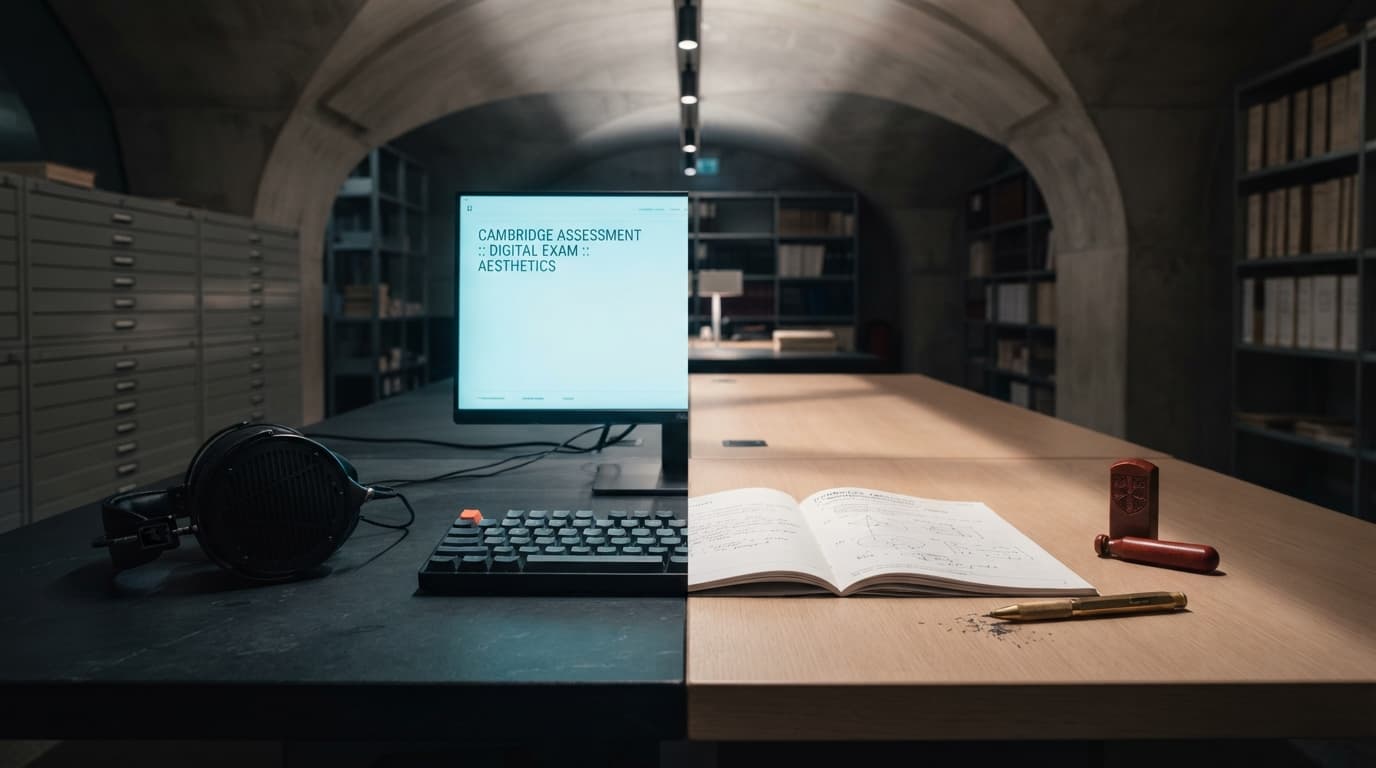
HSK Paper vs Computer: Which Format Delivers the Higher Score?
When booking your Chinese proficiency test at a UK testing centre, deciding between HSK paper vs computer (officially designated as the Paper-Based Test, or PBT, and the Internet-Based Test, or iBT) is the single most consequential tactical decision you will make. While both versions award the exact same credential issued by Chinese Testing International (CTI) and follow the identical syllabus, your choice directly governs your writing marks, listening clarity, and administrative flexibility.
For the vast majority of non-native learners in the UK, the computer-delivered HSK (iBT) offers an unmistakable scoring advantage. The primary driver is the Chinese character input method: sitting an iBT allows you to type characters using standard Pinyin input method editors (IME), completely bypassing manual stroke-order penalties and character memory lapses in the written production section. Combined with individual audio headsets for listening tasks and a compressed registration cutoff of just 10 days before the exam, the computer test mitigates the exact pain points that routinely trip up British test-takers.
1. Writing Section Mechanics: Pinyin IME vs Stroke-by-Stroke Handwriting
The writing portion (书写, shūxiě) represents the largest discrepancy between the two formats, particularly across HSK Level 3 to Level 6. In the paper-based examination, candidates must manually write every single Hanzi with a 2B pencil. An examiner assessing your physical script will deduct marks for missing radicals, imprecise hook angles, incorrect stroke counts, or messy handwriting caused by time pressure.
In contrast, the computer test equips candidates with a standardised Chinese Pinyin IME. The practical consequences for your target score are immense:
- Elimination of the "Character Amnesia" Trap: Non-native learners frequently experience receptive-active asymmetry—you instantly recognise a character like yíhàn (遗憾, regret) or bàoyuàn (抱怨, complain) when reading, but struggle to reproduce every radical from memory under exam conditions. On the iBT, entering the Pinyin prompt yields candidate characters on screen, shifting your cognitive task from active physical recall to visual recognition.
- Composition Speed and Word Count Targets: At HSK 5 and HSK 6, where candidates must craft 80-word and 400-word compositions respectively, typing speed vastly outpaces manual handwriting. Typing speeds using a standard QWERTY keyboard average 30 to 50 characters per minute with an IME, whereas neat handwriting rarely exceeds 15 to 20 characters per minute under timed stress.
- Editing and Syntax Restructuring: Computer input allows you to cut, delete, and reorganise subordinate clauses effortlessly without covering your answer sheet in eraser smudges. On paper, correcting a structural mistake in a 400-word narrative frequently requires messy crossings-out that risk presentation penalties.
If you are already balancing your Chinese studies alongside Japanese revision for certifications like the JLPT, exploring insights on language test preparation can help you evaluate how cross-script familiarity alters your baseline skills.
2. Listening Acoustics: Headsets vs Communal Room Speakers
Listening comprehension (听力, tīnglì) presents stark environmental contrasts between test centres across London, Manchester, Edinburgh, and other university hubs. Test conditions on paper exams depend heavily on the acoustics of the venue.
In the paper-based HSK exam, audio is typically broadcast across a lecture theatre or seminar room through communal speakers. Candidates seated near the rear, adjacent to drafty double-glazed windows, or beneath air conditioning units frequently contend with reverberation, echo, and ambient background noise. Furthermore, the audio track plays strictly once (at levels 4 through 6) or twice (at levels 1 through 3) through the central system, meaning an unexpected cough or dropped pencil in the room can obliterate an entire key dialogue clue.
The computer-delivered iBT equips every individual workstation with dedicated, closed-cup headphones. Candidates benefit from clear, direct binaural audio fed straight from the software, alongside on-screen volume sliders to match individual preferences. This isolation ensures that rapid tonal variations, retroflex finals, and whispered dialogues are audible with razor-sharp fidelity.
3. Administrative Timelines: Registration Windows and Results Turnaround
Booking windows and logistical timelines represent another critical differentiator between the two modes:
- Registration Cutoff Windows: PBT registration traditionally closes approximately four weeks (28 days) before the sitting date to allow physical test papers and answer sheets to be shipped from Beijing to overseas test centres. The computer-based iBT relies on digital test delivery, allowing UK Confucius Institutes and independent testing centres to keep candidate registration open until 10 days prior to test day.
- Score Release Schedules: Because physical PBT answer sheets must be collated, sealed, and posted internationally for centralised optical scanning, score reports generally require 30 calendar days to be uploaded online. Computer-based test results, including the automated marking of listening and reading objective items, are typically released within 14 calendar days.
For university applicants submitting language credentials for Confucius Institute Scholarships, Chinese Government Scholarships (CSC), or postgraduate degrees in Beijing or Shanghai, that two-week differential can mean the difference between meeting an admissions deadline or missing a funding cycle.
4. The HSK 3.0 Horizon: What Changes by December 13, 2026?
The global transition towards the updated HSK 3.0 standard places additional scrutiny on the paper vs computer debate. The official global implementation timetable culminates on Sunday, December 13, 2026, establishing rigorous benchmarks that will formally alter how characters are assessed worldwide.
Under the full HSK 3.0 framework, handwriting expectations are explicitly codified into standard bands, alongside the mandatory integration of the oral HSKK examination. While HSK 2.0 allowed candidates to circumvent almost all active character writing at lower levels, HSK 3.0 introduces a standardised list of basic handwriting characters (requiring candidates to reproduce 100 to 300 foundational Hanzi by hand in designated testing modules). For test-takers aiming to clear intermediate and advanced tiers before this shift cements stricter handwriting baselines, sitting the computer-based format during the transitional windows provides essential protection for writing subscores.
5. The Decision Matrix: When Does Paper Make Sense?
While the computer test is the superior default for 90% of candidates, specific profiles and circumstances may favour the paper test:
Scenario A: The Kanji-Fluent Learner
If you possess deep native or near-native fluency in Japanese Kanji (such as passing JLPT N1 or N2), your mechanical muscle memory for East Asian characters is already ingrained. For these candidates, manual handwriting does not carry the same cognitive penalty. Furthermore, Japanese learners may occasionally find Chinese Pinyin IMEs slower if they rely heavily on reading meaning rather than memorising the exact Mainland Mandarin Romanised pronunciation.
Scenario B: Screen Fatigue and Text Annotation
During the HSK Reading section (阅读, yuèdú), candidates must parse complex expository prose under strict time limits. The paper test allows direct tactile margin notes: you can underline connecting conjunctions (如, 即使, 从而), circle unfamiliar characters, and cross out eliminated multiple-choice options with a pencil. In the iBT, candidates cannot write directly onto the display, relying instead on provided scrap paper or visual scanning, which some learners find mentally taxing.
Scenario C: Pinyin Typing Inaccuracies
If your personal typing habits are prone to phonetic slips—such as routinely mixing up -n and -ng finals (e.g., typing jin instead of jing) or retroflex initials (z/c/s vs zh/ch/sh)—the Pinyin IME will generate irrelevant candidate characters, causing frustration. Candidates who lack familiarity with a standard computer keyboard under timed pressure may find the interface disorienting.
6. Practical Diagnostic Preparation with Thinka
Navigating the format choice requires objective empirical self-testing before committing funds to an official booking. You can benchmark your reading pacing, auditory recall, and vocabulary recognition with Thinka’s AI-powered learning system to identify your exact baseline weaknesses.
To confirm whether you are truly ready for the iBT format, log into the Thinka test prep workspace and execute a timed 15-minute diagnostic writing sprint:
- Test Your Input Cadence: Select an HSK composition prompt and type your draft using the standard Chinese Pinyin IME on a desktop keyboard. Calculate your error-correction rate. If you spend more than 20% of your time hunting through candidate character dropdown menus, dedicate daily 10-minute blocks to Pinyin-to-character touch-typing.
- Simulate Acoustic Distraction: Complete a high-level listening mock exam with headphones, then immediately repeat a section using open room audio. If your score drops by more than 10% on open audio, avoid booking the paper test.
- Audit Stroke Recall: Write ten Level 5 or Level 6 idioms (成语, chéngyǔ) on paper without digital prompts. If you suffer mental blocks on key components, the iBT remains your safest path to securing an unconditional pass mark.
By assessing your typing throughput, auditory sensitivity, and registration deadlines systematically, you can book the format that amplifies your linguistic strengths and safeguards your final score.
Related posts
- Oct 22, 2026
JLPT Score Calculator: Raw to Scaled Score Estimation & the IRT Method
Estimate your JLPT scaled score from raw mock marks. Learn how Item Response Theory (IRT) works, avoid the 19-point section fail, and check N5–N1 benchmarks.
- Oct 19, 2026
Mastering the JLPT Grammar List: High-Yield N5–N1 Patterns, Trap Pairs, and Star Ordering Tactics
Navigate the JLPT grammar list without rote memorisation. Master high-frequency N5–N1 structures, lookalike trap pairs, and tactical Star question ordering.
- Oct 13, 2026
How to Pass JLPT N2: The 6-Month Strategy, 105-Minute Paper Pacing, and Score Floor Defense
Learn how to pass JLPT N2 with our UK revision blueprint. Master 6,000 words, survive the 105-minute combined paper pacing, and clear the 19-point cutoff hurdle.
- Oct 10, 2026
How to Pass JLPT N5: Complete Beginner Blueprint, IRT Score Floors & Timed Exam Strategy
Learn how to pass JLPT N5 with our beginner roadmap. Master 100 kanji, 800 words, the 19-point IRT sectional cutoff, and exact paper pacing for the December exam.