Further Studies Guide5 min read
The Transdisciplinary Architect: Mapping Traditional A-Levels to the Rise of Hybrid Degrees
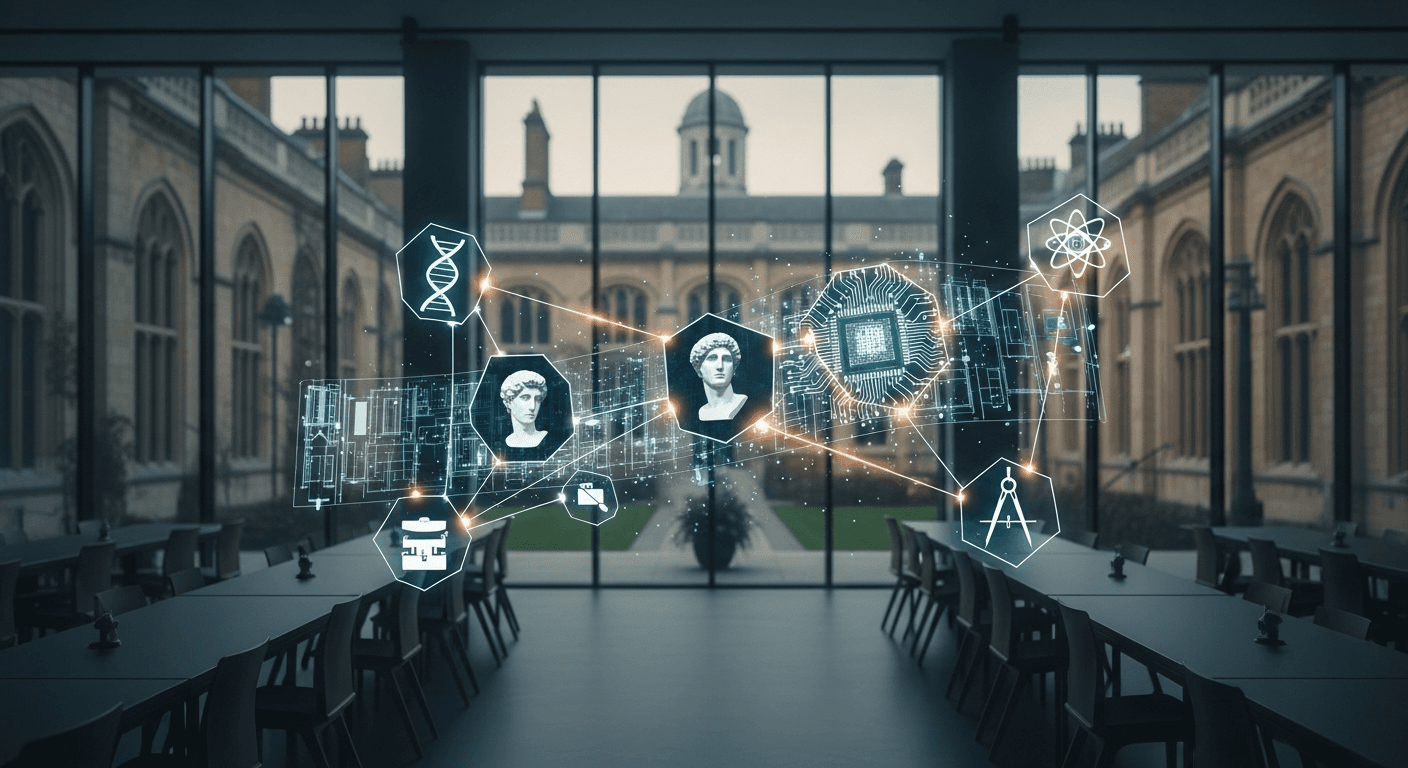
The Silo Trap: Why 'Traditional' Combinations Are No Longer Enough
For decades, the path to a top-tier university was linear. If you wanted to study Medicine, you took Biology and Chemistry. If you wanted Law, you took History and English. However, the academic landscape in 2025 has undergone a seismic shift. As elite global institutions—from the Russell Group in the UK to the College of Humanities and Sciences at NUS—pivot toward interdisciplinary excellence, the 'siloed' nature of A-Levels and GCSEs is becoming a hurdle for ambitious applicants.
Today’s most competitive degrees are no longer single-subject. We are seeing the rise of BASc (Bachelor of Arts and Sciences) programmes, CS + Philosophy, and Humanities + AI. The challenge for the modern student is that while the university world is merging, the secondary curriculum remains largely departmentalised. To bridge this gap, students must become 'Transdisciplinary Architects', using AI to map the logical links between their current subjects and these future-ready majors.
The Rise of the 'Hybrid' Degree
Universities like UCL, King’s College London, and Oxford are increasingly valuing students who can demonstrate 'cognitive flexibility'. A student taking A-Level Mathematics, Physics, and Philosophy is no longer seen as someone who 'couldn't decide', but as a prime candidate for the complex ethics of emergent technology. However, the burden is on the student to prove this connection in their UCAS Personal Statement and interviews.
This is where AI-powered study platforms become essential. Rather than simply using AI to check facts, students can use it as a Curriculum Architect to identify the 'conceptual bridges' that traditional textbooks ignore. For example, how does the statistical probability in your Maths syllabus inform the sociological trends in your Geography coursework? Identifying these overlaps is the key to a standout application.
Using AI to Architect Your 'Super-Curricular' Portfolio
To secure a place at a top university, you need more than just A* grades; you need evidence of super-curricular engagement. This refers to academic activities that go beyond the exam board specifications. For students aiming for hybrid degrees, the portfolio must demonstrate 'transdisciplinary competence'.
1. Identifying the 'Logical Connectors'
Start by using AI to audit your current subjects. If you are taking Biology, History, and Psychology, you might ask an AI tutor to: "Identify three historical precedents where biological discoveries fundamentally altered social psychology in the 19th century." This immediately elevates your understanding from simple rote learning to complex, interdisciplinary analysis. You can find more study materials and resources to help structure these deep-dives.
2. The EPQ as a Hybrid Bridge
The Extended Project Qualification (EPQ) is the perfect vehicle for this strategy. Instead of a standard topic, use AI to find a 'niche' that bridges two of your subjects. If you study Chemistry and Art, your EPQ could focus on the chemical degradation of historical pigments. This proves to admissions tutors that you possess the lateral thinking required for a BASc or a Liberal Arts degree.
Framing the 'Mismatched' A-Level Profile for UCAS
Many students worry that their A-Level choices are too disparate. In reality, a 'mismatched' profile is a goldmine for hybrid admissions, provided it is framed correctly. In the 2026 UCAS cycle, which moves toward more structured evidence, the ability to articulate why you chose specific subjects is vital.
The Strategic Pivot:
Instead of describing your subjects as separate entities, describe them as a toolkit. For example:
"My study of A-Level Further Mathematics provides the quantitative rigour necessary to model the economic theories explored in my History of Political Thought readings."
AI can help you improve your grades through targeted practice while simultaneously helping you draft these complex justifications. It acts as a mirror, reflecting how an admissions officer might view your unique subject combination.
Practical Steps: Becoming a Transdisciplinary Applicant
If you are currently in Year 11 or Year 12, here is how to start building your hybrid profile:
Step 1: Map Your 'Subject Overlap'
Take one topic from each of your A-Levels. Use AI to generate a question that requires knowledge from all three to answer. For instance, if you take Physics, Economics, and English Literature, you might explore the 'Entropy of Wealth'—applying thermodynamic laws to economic inequality as described in Victorian literature. This is the kind of 'super-curricular' depth that secures interviews at Oxford and Cambridge.
Step 2: Evidence the 'Process', Not Just the 'Product'
Hybrid degrees value the way you think. Document your research process. If you used practice papers to master a concept in one subject, try applying that same logic to a different discipline. Show that you can transfer skills across the 'Great Divide' of STEM and Humanities.
Step 3: Target the New Majors
Research the 'X + AI' or 'BASc' programmes early. These courses often have specific requirements for breadth. Use AI to check if your current GCSE or A-Level trajectory meets the 'interdisciplinary threshold' of your target universities.
Future-Proofing Your Academic Identity
The workforce of 2030 will not be looking for specialists who can only solve one type of problem. It will be looking for 'Interdisciplinary Translators'—people who understand the code behind the machine AND the human ethics behind the choice. By treating your A-Levels as a single, integrated project rather than four separate exams, you aren't just preparing for a degree; you are preparing for a career in the AI-driven economy.
As you move through your revision, remember that the most valuable skill you can develop is the ability to see connections where others see silos. Start your journey as a Curriculum Architect today and turn your traditional exams into a gateway for the next generation of university study.
Related posts
- Oct 17, 2026
How Many GCSEs Do You Need for A-Levels? Entry Gateways, Subject Prerequisites, and Retake Rules
Wondering how many GCSEs do you need for A-Levels? Discover UK sixth form admission tiers, STEM grade gatekeepers, and statutory GCSE resit requirements.
- Oct 7, 2026
How to Write a UCAS Personal Statement: The 3-Question Framework and Super-Curricular Blueprint
Master how to write a UCAS personal statement under the 3-question reform. Learn character breakdowns, the ARA evidence model, and super-curricular strategies.
- Sep 27, 2026
Best A-Level Combinations: The Degree Pathway Matrix and Overlap Traps to Avoid
Discover the best A-Level combinations for top UK universities. Explore our degree prerequisite matrix, blacklisted subject overlaps, and workload balancing blueprint.
- Sep 17, 2026
Hardest A-Level Exam Board? AQA vs Edexcel vs OCR Grade Boundaries and Paper Rigour Decoded
Is AQA, Edexcel, or OCR the hardest A-Level exam board? Unpack Ofqual comparable outcomes, mark scheme leniency, question styles, and raw mark thresholds.