Primary School Education5 min read
The Scaffolding Pivot: Moving from Homework Manager to Strategic Consultant for the KS3 Transition
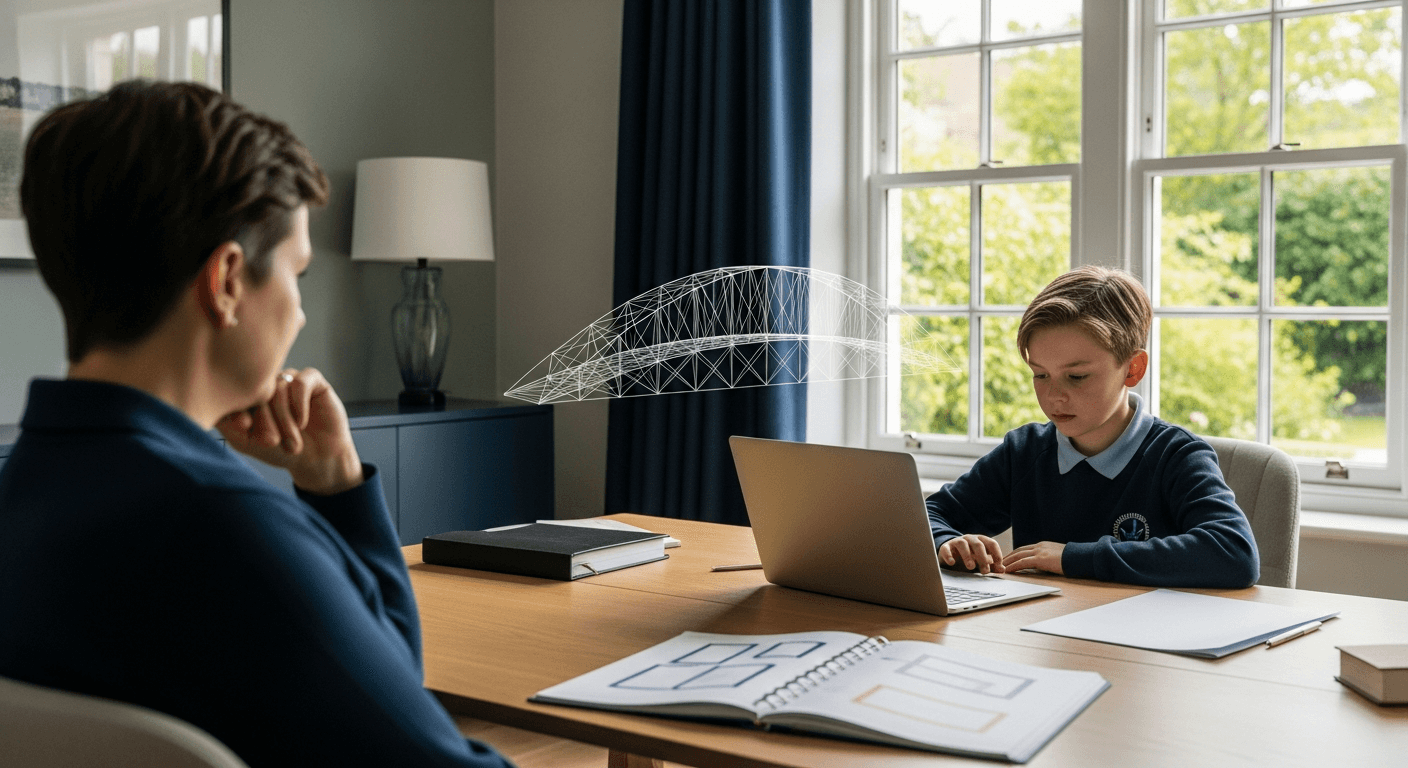
The Great Transition: Why the 'How' Matters More Than the 'What' in Upper Primary
For many UK parents, the final years of primary school—Years 5 and 6—feel like a countdown. We focus heavily on the 'content': the long division methods for SATs, the creative writing prompts for the 11 Plus, or the mastery of statutory spelling lists. However, there is a quieter, more significant shift happening beneath the surface. It is the transition from adult-led learning to self-directed study, often referred to in educational psychology as the development of Executive Function.
Executive function is the brain's 'air traffic control system'. It governs how a child manages time, initiates a boring task, and monitors their own progress. In Key Stage 1 and early Key Stage 2, parents often act as the 'Homework Manager'—we set the table, open the book, and sit beside them for every sentence. But as the jump to secondary school looms, this high-support model becomes a liability. The goal is the Scaffolding Pivot: moving from the person who does the managing to the 'Strategic Consultant' who coaches the child to manage themselves.
The Executive Function Gap in the UK Primary Curriculum
The UK education system is increasingly moving toward complex, multi-step assessments in Upper Primary. Whether it is a three-week independent project on the Vikings or the requirement to revise for end-of-year exams, children are suddenly expected to juggle multiple deadlines. Yet, while we teach them what to learn, we rarely teach them how to organise that learning.
Recent search trends among UK parents show a sharp rise in queries like 'how to get my child to start homework without a row' and 'Year 6 independence skills'. This reflects a growing realisation: the academic pressure of the Year 7 transition is often less about the difficulty of the subjects and more about the sudden loss of the parental safety net. To bridge this gap, we must intentionally pivot our support.
Phase 1: From Taskmaster to Task-Initiator
The biggest hurdle for most primary students is task initiation—the ability to simply start. As a 'Homework Manager', you might say, 'Sit down now and do your English.' As a 'Strategic Consultant', you shift the cognitive load to them.
Instead of giving the command, ask the diagnostic question: 'Looking at this assignment, what is the very first physical action you need to take?' This helps the child identify the micro-step (e.g., 'I need to find my purple pen') rather than being overwhelmed by the 'macro-task' of a 500-word story. You can start practicing these self-regulation habits using interactive tools that encourage students to break down problems before they attempt to solve them.
Phase 2: Mastering Time-Estimation and the 'Planning Sandwich'
One of the most common study pain points in Years 5 and 6 is the 'Time Mirage'. Children either think a task will take five minutes (and it takes an hour) or think it will take all night (and they refuse to start). To fix this, introduce the Planning Sandwich:
1. The Estimate (The Top Bun)
Before they start, ask: 'How many minutes do you think this maths sheet will take?' Write it down.
2. The Deep Work (The Filling)
They complete the task with a visible timer (like a sand timer or a digital countdown) to help them feel the passage of time.
3. The Reflection (The Bottom Bun)
Afterward, compare the actual time to the estimate. This builds the 'internal clock' necessary for the timed conditions of SATs and future GCSEs.
Phase 3: Leveraging AI as an Executive Function Partner
In the past, parents had to be the ones to provide the structure. Today, we can use AI-powered platforms to help students improve by acting as a 'Logic Mirror'. Rather than using AI to get the answer, Year 6 students can use it to build their own study scaffolds. For example, if a child is set a project on 'Local Geography', the Strategic Consultant parent might suggest using AI to:
- Generate a checklist: 'Help me list the five steps I need to take to research and write this report.'
- Simplify instructions: 'Explain what this homework prompt is asking me to do in three bullet points.'
- Create a 'low-stakes' quiz: Using a tool like Thinka to test their own knowledge before a formal assessment, which builds self-monitoring skills.
By using AI as a research and organisation partner, the child learns to find their own 'how' rather than relying on a parent to dictate the next step. This is a vital part of developing the study rigour required for the transition to independent secondary school life.
The 'Consultant' Vocabulary: Changing Your Language
The pivot is most successful when we change the way we speak about schoolwork. Move away from 'I' statements ('I want you to finish this') and towards 'Consultant' questions:
- 'Which part of this looks like the biggest challenge today?' (Encourages Prioritisation)
- 'What tools or resources do you need to get this done?' (Encourages Resource Management)
- 'How will you know when this work is "good enough" to hand in?' (Encourages Standard-Setting)
Preparing for the Year 7 Reality
In secondary school, the scaffolding is largely removed. A student might have six different teachers, each giving homework with different deadlines and platforms. The children who thrive are not necessarily the ones with the highest IQs, but the ones with the most robust executive functions. They are the ones who can look at a messy planner and say, 'I need to do the science first because it's due tomorrow, and I'll need the laptop for it.'
By intentionally 'pivoting' your support in the final years of primary school, you are giving them something far more valuable than a high mark on a single test. You are giving them the cognitive infrastructure to handle the independence of adulthood. If you are a teacher looking to support your pupils in this transition, you can explore how AI helps generate practice materials that focus on these reasoning and organisational skills.
Final Thoughts for the Primary Parent
It is tempting to keep managing the homework to ensure the marks stay high, especially with the pressure of school league tables and admissions. However, a 'B' grade earned independently is often a better predictor of future success than an 'A' grade managed by a parent. Start the pivot today: step back, ask the strategic questions, and let the AI tools be the scaffold while your child builds the building.
Related posts
- Oct 1, 2026
KS2 SATs Raw Score to Scaled Score Conversion: Benchmark Bands, Mark Schemes, and the 100-Point Target
Master KS2 SATs raw score to scaled score conversion. Explore mark thresholds for Expected Standard (100) and Greater Depth (110), plus paper-by-paper tactics.
- Sep 21, 2026
KS2 SATs 2027 Timetable: Daily Test Schedule, Paper Durations, and 12-Week Prep Plan
Master the KS2 SATs 2027 timetable for Year 6. Discover daily exam dates, paper durations, results day milestones, and a stress-free backwards revision plan.
- Sep 10, 2026
Year 4 Multiplication Tables Check Pass Mark: Demystifying the 25/25 Benchmark and 6-Second Recall Tactics
Wondering about the Year 4 multiplication tables check pass mark? Decode the 25-question format, high-frequency tables (6, 7, 8, 9, 12), and proven 6-second recall tactics.
- Aug 31, 2026
Primary Assessment Weighting Matrix: How to Calculate Scaled Scores, Composite Aggregates, and Year 7 Placement Bands
Master the mechanics of KS2 SATs scaled scores, 11+ standardised scores, and secondary fair banding. Learn how raw marks convert to placement thresholds.