Secondary School Selection for Primary Students5 min read
The Smart Nation School Search: Auditing AI Integration and Digital Ethics in Singapore Secondary Schools
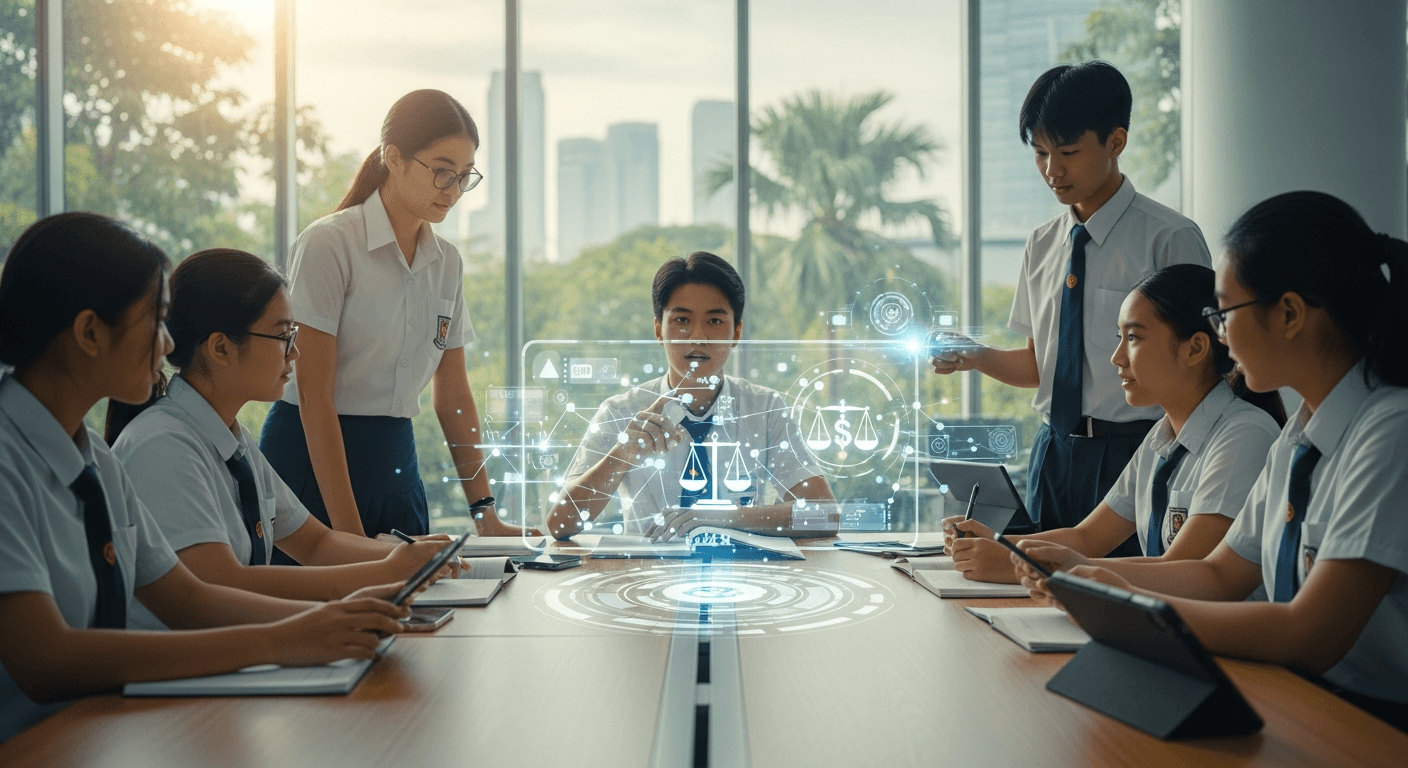
The New Frontier of Secondary School Selection
In Singapore, the tradition of choosing a secondary school has long revolved around PSLE Cut-Off Points (COP), CCA niche areas, and proximity to home. However, as we enter 2025, a new criterion has emerged that is arguably more critical for long-term career resilience: the AI Integration and Digital Ethics Roadmap. With the Ministry of Education (MOE) progressively integrating AI into the national curriculum, parents must look beyond the mere presence of Personal Learning Devices (PLDs) and ask how schools are shaping the ethical and intellectual framework of the next generation.
As your child prepares for the transition from Primary 6, the goal is no longer just to find a school that produces top GCE O-Level or Integrated Programme (IP) results. It is about finding an environment that bridges the gap between traditional academic rigour and the 'Smart Nation' realities of a human-AI hybrid workforce.
Moving Beyond the National Digital Literacy Programme (NDLP)
While every secondary school student in Singapore now has access to a device through the NDLP, the depth of integration varies significantly. A school’s 'AI Roadmap' is not about how many iPads or Chromebooks they have; it is about their pedagogical approach to generative tools. When attending Open Houses or reviewing school prospectuses, parents should look for signs of active rather than passive technology use.
A future-ready school doesn’t just use AI to automate administrative tasks; it uses AI to enhance critical inquiry. Look for schools that encourage students to use AI-powered practice platforms to identify personal learning gaps, rather than those that treat technology as a digital textbook. The best schools are those that teach students to treat AI as a 'sparring partner' for their thoughts, helping them refine arguments for English situational writing or explore complex variables in Lower Secondary Science.
The Ethics Gap: Character and Citizenship Education (CCE) in the AI Era
Digital literacy is often mistaken for technical proficiency. However, in the era of deepfakes and algorithmic bias, digital ethics is the more vital currency. A secondary school's stance on digital citizenship should be a core pillar of their CCE curriculum. Parents should investigate how a school addresses the 'grey areas' of AI.
Key Ethical Markers to Look For:
1. Academic Integrity Frameworks: Does the school have a clear policy on the use of Generative AI in projects? The ideal school doesn’t simply ban it; they teach students the 'Human-in-the-Loop' protocol, ensuring that the student remains the primary architect of their work while using AI for brainstorming or verification.
2. Algorithmic Awareness: Does the ICT or Infocomm curriculum cover how algorithms shape our worldviews? Understanding how social media feeds and AI models operate is crucial for preventing the echo chambers that often lead to social fragmentation.
3. Verification and Fact-Checking: With the rise of AI-generated misinformation, a school must prioritise research rigour. This involves teaching students how to cross-reference AI outputs with vetted study materials and academic resources, ensuring they develop a healthy level of skepticism toward automated answers.
Fostering High-Level 'Human' Skills
The paradox of the AI era is that as technology becomes more sophisticated, 'soft' human skills become more valuable. When evaluating a secondary school, look for an emphasis on Transdisciplinary Thinking. This is the ability to connect concepts across different subjects—such as applying mathematical logic to Geography or ethics to Science. In the GCE O-Level and A-Level landscape, the highest marks are increasingly awarded to students who can demonstrate this kind of holistic synthesis.
Ask if the school provides opportunities for Inquiry-Based Learning (IBL). These programmes often allow students to use AI to gather data, which they then must interpret through a human lens of empathy and social impact. Schools that offer niche programmes in Data Science or Applied Learning Programmes (ALP) in STEM are often better positioned to teach these skills, but even humanities-focused schools should be showing how they adapt to the digital shift.
Practical Questions for the Open House Circuit
When you visit schools during the post-PSLE result window or consider how schools leverage new educational tools, consider asking these specific questions to the HOD of ICT or the Year 1 Level Coordinator:
"How is the school evolving its homework policy in response to Generative AI?"
A school that has thought deeply about this will likely mention a shift toward more in-class assessments, oral presentations, or 'process-reflected' assignments where students must explain how they arrived at an answer.
"Are students taught 'Prompt Engineering' as a core literacy?"
Prompting is the new coding. Students need to know how to interact with AI to get precise, useful results. This skill is foundational for the higher-order thinking required in secondary school and beyond.
"How does the school manage digital well-being alongside device use?"
As students spend more time on their PLDs, the school must have robust mental health supports and guidelines on screen-time management and cyber-wellness.
Thinka: Supporting the Transition to Secondary Rigour
At Thinka, we understand that the leap from Primary 6 to Secondary 1 is not just about harder math or more science subjects; it is about a total shift in how a student learns. Our AI-driven learning approach is designed to mirror the digital ethics we advocate for. We don’t just give students the answers; we provide a scaffolded experience that encourages deep questioning and logical audit, perfectly complementing the curricula of Singapore's most forward-thinking secondary schools.
By choosing a school that views AI not as a threat to be managed, but as a tool to be mastered ethically, you are giving your child the best possible start in the GCE years. The goal is to move from being a consumer of technology to being an orchestrator of it—a skill that will define success in the 2030s and beyond.
Related posts
- May 31, 2026
The Niche Navigator: Strategic Talent Mapping for Your Child’s DSA-Sec Journey
Transform your child’s hobbies into a winning DSA-Sec portfolio. Learn how to map unique talents to Singapore’s top secondary schools using AI-driven insights and strategy.
- May 21, 2026
The Curricular Compass: Using AI Cognitive Profiles to Navigate Full SBB and IP Pathway Selection
Stop choosing secondary schools based on brand alone. Learn how to use AI learning data to match your child’s cognitive profile with Singapore’s Full SBB and IP pathways.
- May 11, 2026
The Secondary Transition Audit: Evaluating Schools on Executive Functioning and Independent Study Readiness
Moving from PSLE to Sec 1 requires a shift from dependence to autonomy. Learn how to evaluate Singapore secondary schools based on their executive function support systems.
- May 1, 2026
The Digital Handshake: Auditing AI Ethics and Screen-Time Autonomy in Your Singapore Secondary School Search
As primary students transition to 1:1 devices in Secondary 1, parents must evaluate schools on digital wellness and AI ethics. Learn what to look for beyond the tech hardware.