Latest News5 min read
The Concentration Command: Navigating the Focus Shock of Singapore’s Smartphone-Free School Era
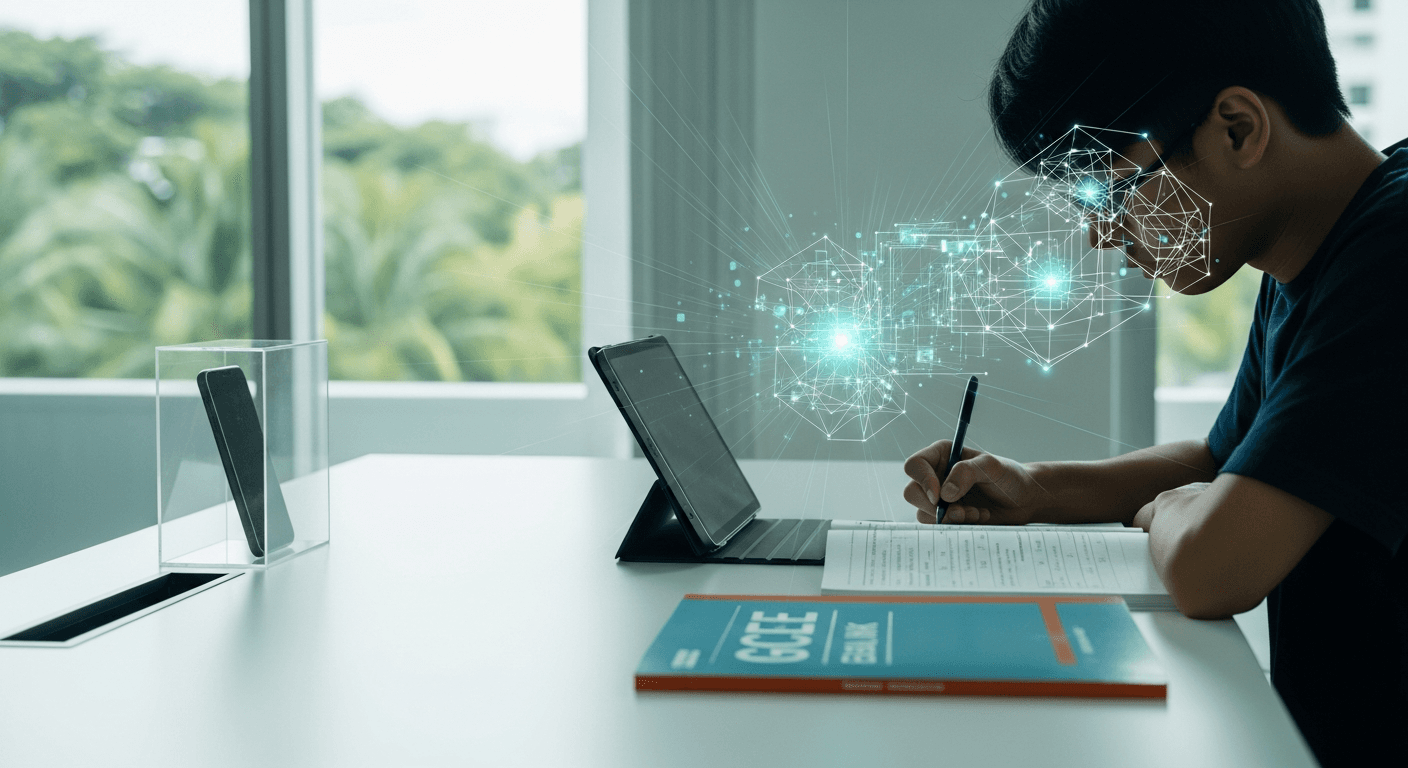
The Silent Revolution in Singapore Classrooms
If you have walked through a secondary school or Junior College (JC) recently, you might have noticed something unusual: the silence of the lockers. Following global trends and a growing push from the Ministry of Education (MOE), more Singapore schools are implementing stricter smartphone policies. From 'phone hotels' in the general office to total bans during school hours, the era of the 'always-connected' student is being replaced by a mandatory distraction-free environment. For many O-Level and A-Level students, this shift has triggered a 'focus shock'—a sudden realization that their brains have been conditioned for 15-second TikTok rhythms rather than the three-hour cognitive marathons required by the SEAB examinations.
The 'Concentration Gap': Why 15-Second Reels Don't Prepare You for Paper 2
The transition from scrolling through social media to tackling a complex H2 Physics derivation or a nuanced General Paper (GP) essay is more than just a change in task; it is a change in neurological demand. Educational psychologists are increasingly identifying a 'concentration gap' among students in Singapore. While students are faster than ever at processing fragmented information, their ability to sustain 'Deep Work'—the state of distraction-free concentration that pushes cognitive capabilities to their limit—has noticeably dipped.
In 2025, the standard for A-Level and O-Level papers remains rigorous. A typical H2 Mathematics Paper 1 requires 3 hours of unbroken logical sequencing. If your brain is accustomed to a dopamine hit every few minutes from a notification, you will likely hit a 'mental wall' at the 90-minute mark. This is where the smartphone-free school environment becomes a vital training ground rather than a restriction. It forces you to recalibrate your attention span to match the actual demands of the national exams.
Architecting 'Monk Mode': A Survival Guide for the SG Student
To turn these new school restrictions into a grade-boosting advantage, you must move beyond 'compliance' and toward 'mastery.' You aren't just following school rules; you are training like an elite academic athlete. Here is how to architect a 'monk mode' study routine that works within the Singapore system.
1. The 'Analog Morning' Ritual
Most students check their phones within seconds of waking up, immediately fracturing their attention before they even reach the school gate. Try the 'Analog Morning'—no screens until you reach school and deposit your phone. This preserves your 'attentional capital' for your most difficult subjects during the first few periods of the day, such as Chemistry or Higher Mother Tongue.
2. High-Intensity Interval Studying (HIIS)
Since you cannot access your phone during recess or lunch breaks in many schools, use this time to socialize or rest your eyes. When you return to the library or a study pod for self-study, employ HIIS. This involves 50 minutes of absolute focus on a single Ten Year Series (TYS) topic followed by 10 minutes of active rest (walking or stretching)—not digital rest. Digital rest is an oxymoron; it continues to drain your cognitive resources.
Leveraging AI to Replicate the Smartphone-Free Environment
While schools are removing phones to reduce distraction, the goal isn't to abandon technology—it's to use it with intention. The most successful students are using AI-powered learning tools to bridge the gap between classroom theory and exam-day performance. Instead of passively reading notes, you can use AI to stress-test your knowledge under simulated exam conditions.
For instance, when you are at home and have regained access to your device, the temptation to stray is high. This is where you must pivot. Use the Thinka practice platform to set specific, timed challenges. By engaging with an AI that provides immediate, granular feedback on your responses, you maintain the high-intensity focus required for 'Deep Work' while benefiting from modern technology. This turns your screen time into a productive extension of your school’s distraction-free zone, rather than a disruption of it.
The A* Endurance: Training for the 3-Hour Marathon
Consider the mathematical complexity of a problem involving integration: \(\int_{0}^{\pi} x \sin(x) dx\). Solving this requires multiple steps of integration by parts, careful sign management, and precise evaluation. A single micro-distraction can break the chain of logic, leading to a 'careless' error that costs you an 'A' grade.
The move toward smartphone-free schools is designed to prevent these cognitive breaks. By embracing these rules, you are practicing the exact 'mental stamina' needed for your Prelims and the actual GCE examinations. You can find more specialized study materials and focus guides that help you structure these long-form study blocks effectively.
From Digital Withdrawal to Competitive Advantage
Initially, you might feel a sense of 'digital withdrawal'—the urge to check a ghost notification or the anxiety of missing out on a group chat. However, within 14 to 21 days, your brain begins to rewire. You will find that your 'reading stamina' increases. You will notice that you can get through a 2,000-word Economics case study without your mind wandering to what’s trending on X (Twitter).
In the competitive landscape of Singapore’s education system, where every mark counts, this 'Focus Advantage' is your secret weapon. While others are struggling with shortened attention spans, you are building the capacity for deep, sustained inquiry. Teachers are already seeing the benefits; many are using AI tools to generate customized practice papers that specifically target these longer-form cognitive skills, ensuring that the time you spend in school without your phone is used for maximum academic gain.
Closing the Loop: The 2025 Strategy
The global shift toward smartphone restrictions isn't about being 'anti-tech'; it's about being 'pro-focus.' As an O-Level or A-Level student, your job is to adapt faster than the curve. Treat the school day as a sanctuary for your mind. Use the phone-free hours to do the heavy lifting—the difficult math proofs, the complex essay outlines, and the deep memorization of Biology pathways.
When you do return to your digital tools at the end of the day, use them with precision. Don't just browse; engage in targeted practice. By combining the distraction-free environment of the school with the high-octane support of AI-driven study, you aren't just preparing for an exam—you are mastering the most valuable skill of the 21st century: the ability to focus in a world designed to distract you.
Related posts
- Jul 9, 2026
The Graphicacy Strategist: Mastering Data Interrogation for the 2025 O-Level and A-Level Humanities and Sciences
Learn how to master 'Graphicacy' for the 2025 Singapore O and A-Level exams. Move beyond description to deep data interrogation in Economics, Geography, and Biology.
- Jun 29, 2026
The Provenance Protocol: Navigating 2025 SEAB AI Guidelines for O-Level and A-Level Coursework
Learn how to navigate the 2025 AI transparency mandates for O-Level and A-Level coursework. Master the Provenance Protocol to ensure your SEAB submissions remain compliant.
- Jun 19, 2026
The 2025 Admissions Pivot: Why Singaporean Students Need More Than Just H2 Distinctions
Elite global universities are reinstating mandatory entrance exams. Discover how O-Level and A-Level students can master these gatekeeper tests using AI-powered logic.
- Jun 9, 2026
The Digital Exam Frontier: Mastering the 'Screen-to-Script' Workflow for SEAB e-Exams in 2025
As SEAB expands e-exams for O and A-Levels, learn how to adapt your study habits for 2025. Master digital annotation and screen stamina with AI-powered strategies.