Primary School Education5 min read
The Logic Mirror: How Error-Mapping Transforms PSLE Preparation from Rote Practice to Cognitive Mastery
Beyond the 'Careless Mistake': Decoding the Logic of Learning
In the high-stakes environment of the Singapore Primary School Leaving Examination (PSLE), the phrase "careless mistake" is perhaps the most common lament heard across dining tables and tuition centres alike. Whether it is a misapplied heuristic in Math Paper 2 or a misinterpreted nuance in English Comprehension Open-Ended, we often treat these errors as anomalies—momentary lapses in focus that more practice papers will eventually solve.
However, recent educational research, including studies from the Education Endowment Foundation (EEF), suggests that treating mistakes as mere accidents misses a massive opportunity for growth. Metacognition—the ability to think about one's own thinking—has been shown to provide an average of seven months’ additional academic progress. For a Primary 5 or 6 student in Singapore, this is the difference between struggling with the transition to Secondary School and thriving within it. The key lies in shifting the focus from 'task completion' to a process we call The Error-Mapping Protocol.
The Error-Mapping Protocol: What It Is and Why It Matters
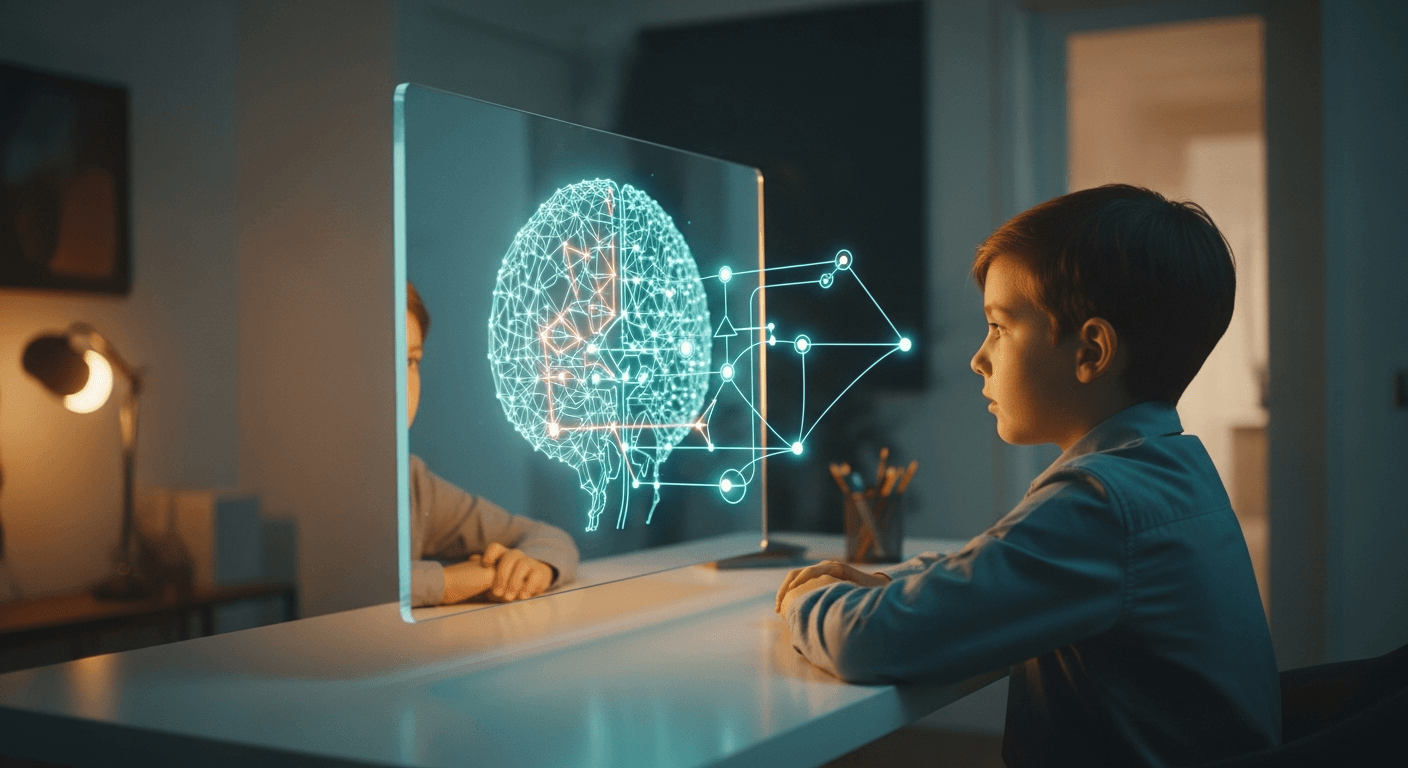
Most students in Singapore are conditioned to check their answers against a solution key, write the correct answer in green pen, and move on to the next page of their 10-year series. This is 'passive correction.' Error-mapping, conversely, is an active 'debugging' of the cognitive process. It involves using a 'Logic Mirror'—often facilitated by AI—to reflect on where exactly the reasoning deviated from the required path.
When a child uses an AI-powered practice platform, the goal isn't just to get a green tick. It is to use the AI as a Socratic partner that asks: "You used the 'Repeated Identity' method here, but the question mentions a change in the total parts. Why did you choose that approach?" This forces the student to look into the mirror of their own logic.
The Three Categories of 'Bugs' in Primary Learning
To effectively debug a child’s homework, parents and students must first categorise the error. Most mistakes in the Singapore curriculum fall into three buckets:
1. The Conceptual Gap
This occurs when the fundamental 'why' is missing. In Science, this might look like a student memorising that 'darker surfaces absorb more heat' without understanding the underlying energy transfer. When the PSLE question introduces a non-standard experimental setup, the student falters because they lack the conceptual flexibility to adapt.
2. The Procedural Glitch
Common in Math heuristics, this happens when a student knows the concept but misapplies the steps. For instance, in a 'Units and Parts' question, the student might successfully find the value of 1 unit but fail to account for the 'remainder' mentioned in the second half of the problem. This isn't 'careless'; it’s a failure in procedural sequencing.
3. The Executive Function Oversight
These are the true 'careless' mistakes—misreading "not true" as "true" or forgetting to include units like cm² in the final answer. While these seem minor, they are often symptoms of a student working at their cognitive limit, leaving no 'bandwidth' for final verification.
How AI Acts as a Logic Mirror for Singaporean Students
Traditional assessment books provide the 'what' (the answer), but they cannot provide the 'why' (the reasoning). This is where AI-powered personalized study support changes the game. Instead of a parent hovering over a child's shoulder—which often leads to 'performance anxiety'—the AI acts as a neutral, third-party auditor.
Practical Step: The 'Explain-Back' Technique
When your child gets a challenging Math Word Problem wrong, ask them to prompt the AI: "I thought this was a 'Constant Difference' question, but the answer key says 'Total Change'. Can you show me the exact sentence in the question that proves it's 'Total Change'?"
By engaging in this dialogue, the student isn't just fixing a number; they are recalibrating their internal 'logic compass.' They are learning to spot the linguistic cues—the 'keywords' that Singapore examiners use to signal specific heuristics.
Applying Error-Mapping to English and Mother Tongue
While error-mapping is intuitive for Math, it is equally vital for languages. In English Synthesis and Transformation, for example, students often lose marks because they fail to maintain the 'tense' or 'meaning' of the original sentence.
Instead of simply rewriting the sentence, a student can use AI to audit their attempt: "My answer was 'Despite being ill, John went to school.' The model answer is 'Despite his illness...'. Why is the noun form preferred here?" This level of granular feedback helps students bridge the 'fluency gap,' moving from basic communication to the sophisticated register required for AL1 and AL2 grades.
From Primary 6 to the Future: Building Self-Regulated Learners
The transition from Primary to Secondary school in Singapore is often jarring because of the sudden increase in subject volume and the demand for independent inquiry. Students who rely on rote-memorising 'model answers' often see their grades dip in Secondary 1.
By mastering error-mapping now, your child develops Self-Regulated Learning (SRL) frameworks. They stop seeing mistakes as failures and start seeing them as data points. They become the 'architects' of their own revision. Teachers can also benefit from this shift; by using AI to generate targeted practice papers based on a class's specific error-maps, the entire feedback loop becomes more efficient.
A Checklist for Parents: Transforming Tonight’s Homework
If you want to move away from the 'drilling' culture and toward metacognitive growth, try this three-step protocol tonight:
- Stop the Eraser: Don't let your child erase the wrong working immediately. Circle the exact line where the logic broke down.
- Identify the 'Why': Ask: "Was this a Concept, a Procedure, or a Careful-Check error?"
- The 'Variant' Test: Once the error is understood, use free study materials or AI to generate one similar question with different numbers or a slight twist. If they can solve the variant, the 'bug' is truly fixed.
The goal of primary education is not to produce children who never make mistakes. It is to produce young thinkers who are courageous enough to look at their errors in the mirror, understand them, and 'debug' their way to a deeper level of intelligence. In the age of AI, the ability to analyze a process is far more valuable than the ability to calculate a result.
Related posts
- Jun 11, 2026
The Reasoning Edge: How to Master Non-Routine PSLE Math Heuristics in the AI Era
Unlock your child's PSLE Math potential. Learn how to move beyond rote calculation to master heuristics and non-routine problem-solving with AI-powered scaffolded practice.
- Jun 1, 2026
The Verifiable Inquiry Framework: Teaching Primary Students to Fact-Check AI in the Age of PSLE Science and Projects
Transform AI from a ghostwriter into a research partner. Learn how to guide your primary school child through AI literacy and verification for the MOE syllabus.
- May 22, 2026
The Inquiry Architect: Cultivating the 'Why' Mentality for PSLE Success and Beyond
Learn how to shift your child from memorizing model answers to mastering inquiry-led learning using AI as a Socratic tutor for PSLE and secondary school transitions.
- May 12, 2026
The Schema Secret: Why World Knowledge (Not Just Vocabulary Drills) Is the Key to PSLE Reading Mastery
Discover why building background knowledge is more effective than repetitive drills for PSLE English comprehension success. Learn how to bridge the context gap with AI.