Career Pathways6 min read
The Green Competency Blueprint: Decoding Your A-Level Syllabus for Singapore’s Sustainability-Driven Economy
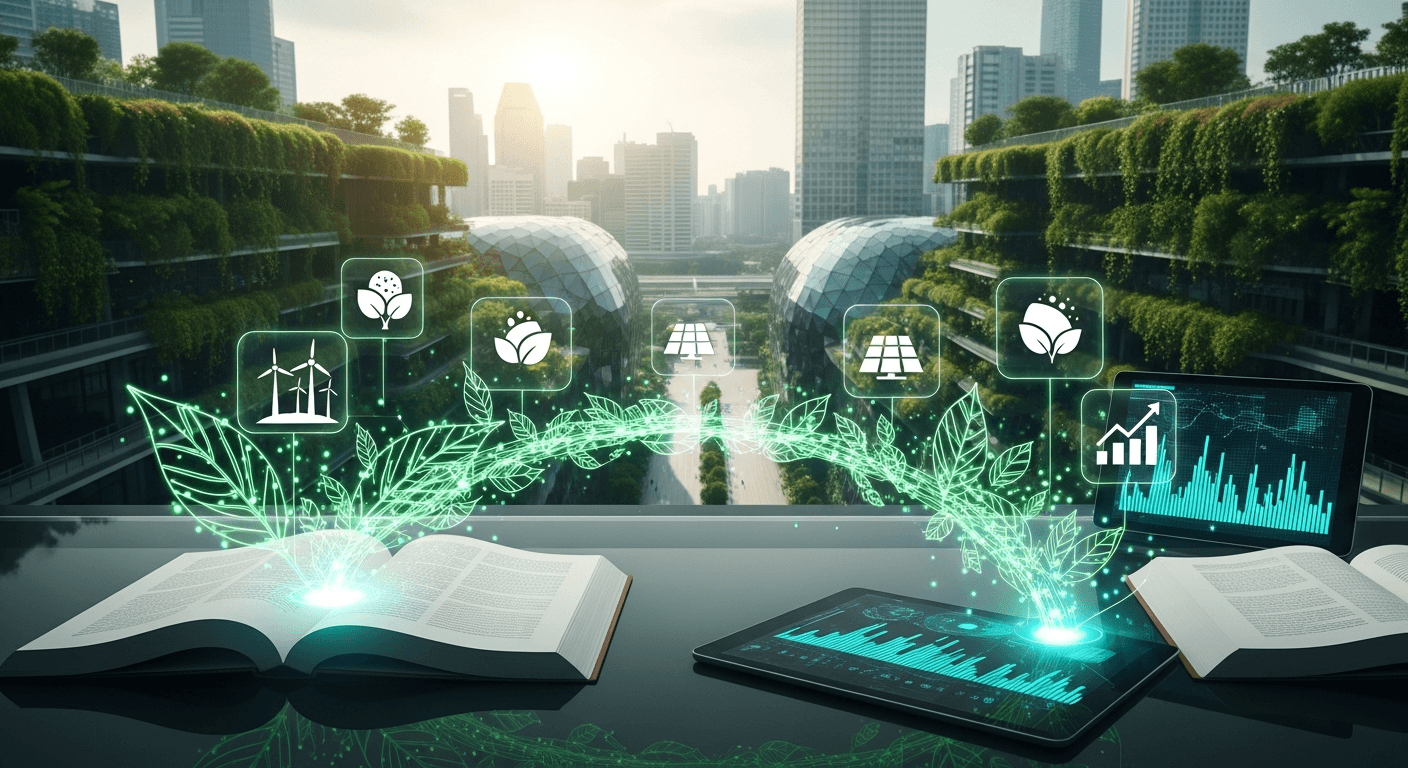
The Hidden Green Economy: Why Your Subject Combination Matters More Than You Think
In the high-pressure environment of a Singapore Junior College (JC), the focus is often laser-fixed on the ‘Rank Point’ and securing a spot in a prestigious course at NUS, NTU, or SMU. However, a significant shift is happening in the global and local job market that many students are overlooking. According to the 2024 Global Green Skills Report, the demand for green talent is outstripping supply at an unprecedented rate. In Singapore, as the nation pushes toward the Singapore Green Plan 2030, every sector—from high finance in the CBD to engineering in Jurong—is hungry for workers who understand sustainability.
The common misconception among A-Level students is that a ‘green career’ requires a specialized degree in Environmental Science or Ecology. The reality is far more interesting. The modern economy requires a ‘Green Intelligence Bridge’: the ability to apply traditional academic rigor to sustainability challenges. Whether you are taking PCMe, BCMe, or a Humanities-leaning combination, your H2 and H1 subjects are already teaching you the foundational competencies required for these high-paying, high-impact roles. The challenge lies in identifying and articulating them.
The Green Skills Gap: A Strategic Opportunity for JC Students
Recent data indicates that while 1 in 3 job postings now require at least one green skill, only 1 in 8 workers actually possess them. This ‘skills gap’ is a massive strategic advantage for students who can prove their ‘Green Literacy’ early. Major exam boards and universities, including those in the UK via UCAS and our local autonomous universities, are increasingly looking for candidates who can demonstrate ESG (Environmental, Social, and Governance) awareness.
By using AI as a bridge, you can stop viewing your A-Level syllabus as a collection of facts to be memorized and start seeing it as a toolkit for the future economy. You can start practicing high-level application today to ensure you aren't just scoring an A, but building a career-ready profile.
Mapping Your Subjects: The Sustainability Vertical
1. H2 Economics: The ESG and Carbon Finance Foundation
If you are studying H2 Economics, you are already halfway to becoming a sustainable finance expert. The syllabus focus on Market Failure and Negative Externalities is the exact theoretical framework used in carbon pricing and emissions trading schemes. When you discuss the Carbon Tax in Singapore or the use of subsidies for renewable energy, you are engaging with the core of corporate sustainability strategy.
AI-Powered Mapping Hint: Use AI to help you connect the concept of ‘Social Marginal Cost (SMC)’ with ‘ESG Reporting Standards.’ Ask an AI tool to explain how a firm’s internalizing of externalities impacts its long-term valuation in the stock market. This depth of understanding will not only help your GP essays but also your university personal statements.
2. H2 Geography: Urban Resilience and Supply Chain Sustainability
H2 Geography students in Singapore are uniquely positioned to lead in Sustainable Urban Development. Topics like the Urban Heat Island effect and Sustainable Development in the Tropics are no longer just academic headings; they are the daily challenges faced by the Urban Redevelopment Authority (URA) and private developers. Understanding the hydrological cycle and climate change mitigation strategies translates directly into roles in climate risk assessment for insurance and real estate firms.
3. H2 Biology & Chemistry: The Bio-Circular Economy
For the Science stream, the transition is even more direct. H2 Biology’s focus on Energy and Equilibrium and Genetic Basis for Variation provides the groundwork for innovations in sustainable food systems (like lab-grown meat) and biofuels. H2 Chemistry, particularly the study of Polymers and Nanomaterials, is the bedrock of the ‘Green Chemistry’ movement, which seeks to design products that minimize hazardous substances.
Using AI to Build Your 'Green Intelligence' Profile
To bridge the gap between your A-Level syllabus and the professional world, you need to move beyond rote learning. This is where AI-powered study support becomes a game-changer. Here is how you can use AI to map your competencies:
Step 1: The Syllabus Deconstruction
Take a specific Learning Outcome from your SEAB syllabus (e.g., H2 Bio Core Idea 4: Transformation of Energy and Matter). Feed it into an AI tool with the prompt: ‘Identify five high-growth sustainability career paths in Singapore that require a deep understanding of this biological concept.’ This transforms a dry exam requirement into a tangible career goal.
Step 2: Technical Register Mastery
The difference between a B and an A* often lies in the Technical Register—the specific, high-level vocabulary used in the industry. For example, instead of saying a company is ‘trying to be eco-friendly,’ a sustainability professional talks about ‘Decarbonization Pathways’ or ‘Circular Value Chains.’ Use AI to help you refine your academic writing so that it reflects this professional maturity.
Step 3: Scenario-Based Practice
Sustainability is about problem-solving in ‘unseen’ contexts. Use AI to generate case studies based on current Singaporean green initiatives, such as the Tuas Nexus or Sembcorp’s floating solar farms. Practicing your H2 physics or chemistry principles against these real-world scenarios makes your learning sticky and your university applications much more compelling.
The Career Pathways of 2030: Where You Fit In
By mapping your traditional subjects to green skills, you open doors to several emerging ‘high-growth verticals’:
• Sustainable Finance & Law: Merging H2 Economics and H1/H2 History/Literature to navigate the complex legal frameworks of international climate agreements.
• Green Building & Infrastructure: Combining H2 Physics and Geography to design the next generation of energy-efficient smart buildings in the Asia-Pacific.
• Agri-Tech & Food Security: Using H2 Biology and Chemistry to solve Singapore’s ‘30 by 30’ goal (producing 30% of nutritional needs locally by 2030).
Practical Steps for JC1 and JC2 Students
1. Update Your Portfolio Strategy: When choosing your Project Work (PW) topic or writing your EPQ, intentionally select a sustainability-linked problem. This allows you to document your ‘Green Skills’ officially.
2. Leverage AI for Depth: Don't just rely on textbooks. Use AI to find the latest white papers on ESG in Singapore. Teachers can also utilize AI tools to help generate more contemporary, sustainability-focused practice questions for their classes.
3. Cross-Disciplinary Thinking: The A-Levels are often taught in silos. Break those silos by asking how your Economics knowledge affects your Biology practicals (e.g., the cost-efficiency of enzyme production). This ‘Synoptic Thinking’ is exactly what top-tier universities like Oxford, Cambridge, and Yale-NUS (and its successors) value most.
Final Thoughts: From Exam Success to Future Impact
The ‘Green Intelligence Bridge’ is not an extra subject you have to study; it is a new way of looking at the subjects you are already working hard on. By recognizing the sustainability competencies hidden within the A-Level syllabus, you position yourself as a rare ‘green-literate’ candidate in a world that is desperate for them. Success in the 2025 and 2026 exam cycles will belong to those who can prove they are ready for the economy of 2030. Start mapping your bridge today.
Related posts
- May 19, 2026
The Vertical Specialist: Precision-Mapping Your A-Levels to Singapore’s Future Economy
Stop being an academic generalist. Learn how Singapore JC students can map H1/H2/H3 subjects to emerging micro-niches like Climate-Fintech and Agri-Tech to stay ahead.
- May 9, 2026
The Iterative Architect: Designing an AI-Native Creative-Tech Portfolio for 2025 University Admissions
Grades are no longer enough for top Creative-Tech degrees. Learn how Singapore JC students can use AI to document their design process and ace 2025 university admissions.
- Apr 29, 2026
Decoding the Syllabus: Mapping Your GCE A-Level Subjects to Singapore’s Skills-First Economy
Stop obsessing over Rank Points alone. Learn how to map your H2 subjects to high-growth career clusters and build a skills-first portfolio for the future of work.
- Apr 19, 2026
The Quantum Leap: Targeting Elite Deep-Tech University Programmes With Hard Science A-Levels
Ditching overcrowded generalist degrees? Discover how A-Level students can leverage hard sciences to unlock high-barrier deep-tech careers in robotics and quantum computing.