Professional Certifications6 min read
PMP Brain Dump Strategy: Proctor Rules, Tutorial Traps & ECO Tactics
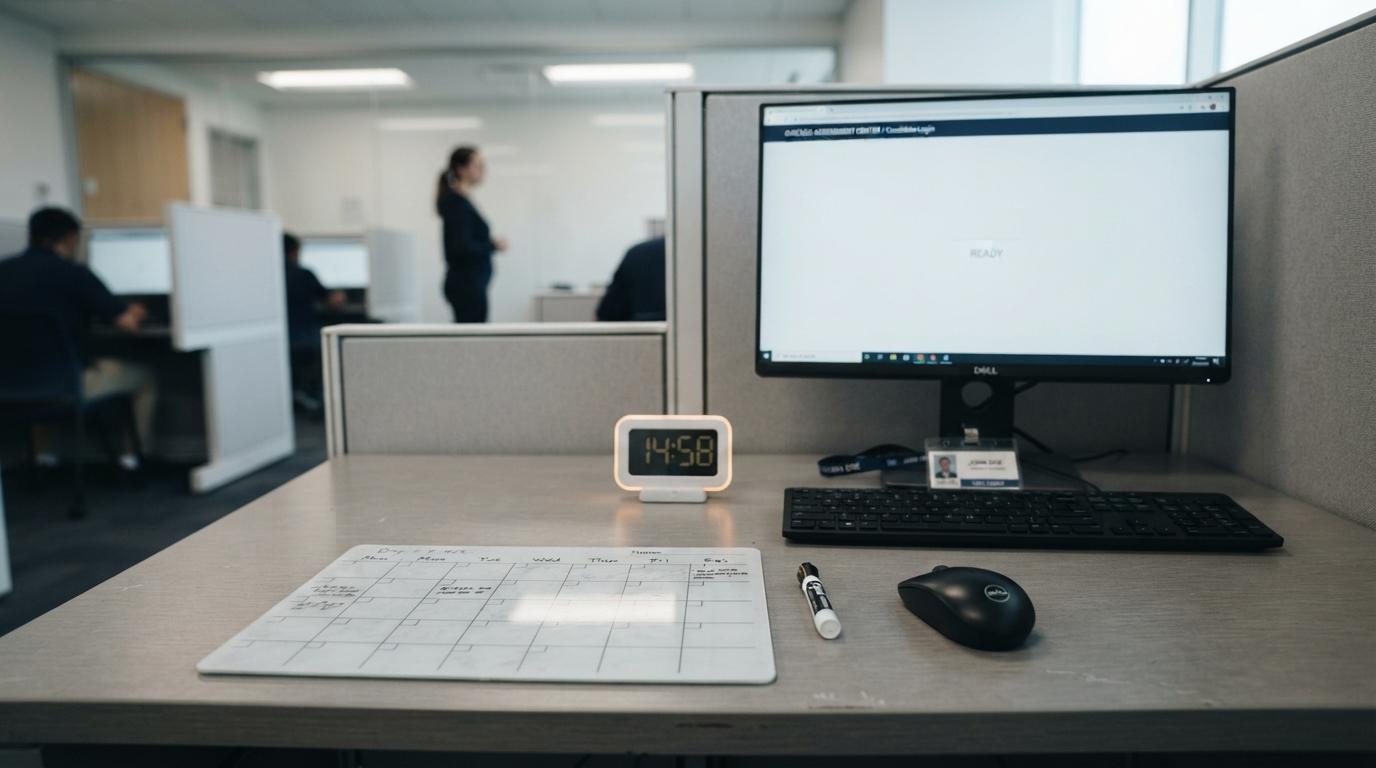
The Modern PMP Brain Dump: What Actually Works Today
If you have been browsing legacy project management forums or Reddit threads from five years ago, you have likely seen advice telling you to sit down on test day, breeze through the introductory tutorial, and spend the initial 15 minutes scribbling a massive PMP brain dump containing 49 processes, hundreds of ITTOs, and dozens of earned value formulas onto your scratch pad. If you attempt this strategy today at an official Pearson VUE testing center or via the OnVUE online proctored system, you risk having your exam canceled immediately and your test fees forfeited.
The Project Management Institute (PMI) strictly enforces security rules regarding candidate note-taking: writing is forbidden until the official 230-minute exam timer starts counting down. In this guide, we break down Pearson VUE physical scratch rules, OnVUE virtual whiteboard constraints, the Exam Content Outline (ECO) domain weight reality, and how to construct a lean, high-yield retrieval sheet that takes under two minutes to deploy without burning valuable exam time.
The 15-Minute Tutorial Trap: Proctoring Rules Explained
Both in-person Pearson VUE test centers and OnVUE remote proctors operate under clear, uniform PMI conduct guidelines regarding brain dumps. Understanding these boundaries ensures you avoid procedural disqualifications.
Pearson VUE In-Person Test Centers
When testing at a physical Pearson VUE facility in the United States, you receive a double-sided laminated scratch booklet and fine-point dry-erase markers. Proctor regulations explicitly state that the preliminary 15-minute software tutorial is intended solely to orient you with question navigation, flagging, strikethrough, and highlighting tools. Writing on your scratch pad during the tutorial—or during scheduled 10-minute breaks—is classified as a security infraction. Proctors monitoring via live CCTV will intervene, confiscate your booklet, and may report an unsanctioned pre-test brain dump to PMI.
OnVUE Online Remote Proctoring
Taking the exam from home or an office introduces even tighter scrutiny. Under OnVUE rules, no physical paper, pens, or external writing surfaces are permitted on your desk. You are provided an integrated digital whiteboard built into the testing application. Just like the in-person testing protocol, typing or drawing on the virtual whiteboard before question 1 appears on your active timer is strictly prohibited. Online proctors will interrupt your exam via audio or chat, wipe the whiteboard, and can revoke the testing session on the spot for unauthorized preparation activities.
Contrast: Mainland China Paper-Based Administrations
It is worth noting the operational difference compared to mainland China administrations managed through CIETP (China International Exchange Committee for Tallent and Technical Professionals). Those paper-based testing cohorts operate under distinct paper distribution protocols where booklets and answer sheets are handled concurrently. However, for all Western computer-based testing (CBT) candidates, the digital countdown is your only permissible starting signal.
Aligning Your Notes with the Modern ECO Weights
The legacy practice of memorizing the entire PMBOK Guide 6th Edition process matrix (5 Process Groups by 10 Knowledge Areas) is obsolete. The current PMP Exam Content Outline focuses on three core domains:
1. Process (41%): Emphasizes predictive, agile, and hybrid methodologies, procurement governance, change control, and integration.
2. People (33%): Focuses on servant leadership, conflict management, team empowerment, emotional intelligence, and stakeholder engagement.
3. Business Environment (26%): Tests organizational compliance, benefits realization, environmental/social governance (ESG) practices, and AI tool integration in project delivery.
With roughly 50% of modern exam scenarios reflecting agile or hybrid delivery models, memorizing all predictive inputs, tools, techniques, and outputs (ITTOs) yields negligible return on time invested. Instead, your cognitive retrieval sheet should contain only the formulas, triggers, and situational rules that your brain might struggle to recall under time-induced stress.
The Lean PMP Brain Dump: What to Write in Under 2 Minutes
Once question 1 appears and your 230-minute timer begins, do not spend 15 minutes mapping out complex tables. Take 90 to 120 seconds to jot down this targeted checklist:
1. Essential Earned Value Management (EVM) Formulas
Modern PMP calculation questions typically ask you to interpret indexes situationally rather than perform complex multi-step math. Jotting these baseline definitions down eliminates cognitive fatigue:
\(\text{Cost Variance (CV)} = \text{EV} - \text{AC}\)
\(\text{Schedule Variance (SV)} = \text{EV} - \text{PV}\)
\(\text{Cost Performance Index (CPI)} = \frac{\text{EV}}{\text{AC}}\)
\(\text{Schedule Performance Index (SPI)} = \frac{\text{EV}}{\text{PV}}\)
Quick Interpretation Anchors:
- Index \(> 1.0\) = Under budget / Ahead of schedule (Favorable)
- Index \(< 1.0\) = Over budget / Behind schedule (Unfavorable)
- Variance \(> 0\) = Favorable; Variance \(< 0\) = Unfavorable
2. Agile Estimation and Empirical Cycles
Agile questions rely heavily on the empirical pillars of Scrum: Transparency, Inspection, and Adaptation. Note down these quick memory anchors:
- Velocity vs. Capacity: Velocity is historical output (story points completed per sprint); Capacity is available team hours for the upcoming iteration.
- Sprint Ceremonies: Planning (Sprint Backlog created), Daily Standup (15 mins, impediment tracking), Review (Increment demonstrated to customer), Retrospective (Internal process improvement).
- Servant Leader Rule: Never solve problems by directing team actions; facilitate collaboration, remove blockers, and protect the team from external interference.
3. Conflict Management Matrix (Thomas-Kilmann Framework)
Scenario questions frequently test which conflict resolution mode suits a specific project impasse. Jotting down the five modes prevents confusion when answer choices use interchangeable terms:
- Collaborating / Problem Solving: Win-Win (Consensus, high assertiveness & cooperativeness).
- Compromising / Reconciling: Lose-Lose or Give-and-Take (Temporary middle ground).
- Forcing / Directing: Win-Lose (Emergency decisions, power assertion).
- Smoothing / Accommodating: Emphasizes agreement over disagreement (Preserves relationship).
- Withdrawing / Avoiding: Postponing issue resolution until more data is available.
4. Critical Path & Float Anchors
- \(\text{Total Float} = \text{Late Start} - \text{Early Start} = \text{Late Finish} - \text{Early Finish}\)
- Activities on the Critical Path have \(\text{Total Float} = 0\).
- Crashing adds cost (e.g., overtime, additional resources); Fast-tracking introduces risk (overlapping sequential phases).
Physical Scratch Pad vs. OnVUE Whiteboard Mechanics
Navigating the mechanics of your testing environment is just as crucial as knowing the material itself. Each platform presents specific operational challenges:
OnVUE Whiteboard Challenges
The built-in digital whiteboard in OnVUE features basic drawing tools, a text box feature, and shape generators. Trying to sketch an elaborate Network Diagram with a mouse or laptop trackpad wastes precious minutes. If you take the exam remotely, use the text tool exclusively. Type single-line formula reminders rather than trying to sketch tabular diagrams. You can test your setup on Pearson VUE's practice whiteboard ahead of time to develop smooth keyboard shortcuts.
Physical Booklet Management
At a Pearson VUE center, your markers can dry out if left uncapped. Test both markers immediately after logging in at your terminal. If your booklet fills up with scratch work during calculations or critical path diagrams, raise your hand to request a replacement; proctors will swap booklets out on a 1:1 basis, meaning you will lose whatever notes were written on the original.
Instinctive Recall vs. Mechanical Memorization
Spending excessive prep time memorizing an extensive PMP brain dump yields diminishing returns on modern PMI exams. Today's 180 questions are overwhelmingly situational vignettes requiring you to determine what a project manager should do first or do next when faced with ambiguous stakeholder challenges, scope creep, or remote team misalignments.
Instead of relying on written crutches, candidates who succeed build intuitive problem-solving reflexes. Interactive platforms like Thinka let you drill timed questions and get instant feedback, so you build reflexes instead of leaning on notes.
Related posts
- Nov 15, 2026
CFA Level 1 vs Level 2: Vignette Mechanics, Topic Weight Pivots & The 350-Hour Plan
Evaluate CFA Level 1 vs Level 2: decode item set vignettes, 350+ study hour requirements, heavy FSA and Equity weighting, and high-yield passing strategies.
- Nov 9, 2026
CFA Salary by Level: Realistic Compensation Bands from Level 1 to Charterholder
Discover realistic CFA salary by level progression. Explore Wall Street compensation bands, Level 2 promotional bumps, and sector pay in research and asset management.
- Nov 6, 2026
PMP Passing Score Decoded: Psychometric Equating, Rating Bands & Mock Benchmarks
What is the true PMP passing score? Learn how psychometric equating, 175 scored items, domain rating bands (AT/T/BT/NI), and the 75% mock benchmark determine a pass.
- Nov 3, 2026
FRM Pass Rates 2026: Part I vs Part II Window Benchmarks, Curve Mechanics & Mock Targets
Analyze FRM pass rates 2026 across Part I and Part II exam windows. Explore historical GARP benchmarks, grading curve mechanics, quartile thresholds, and diagnostic targets.