Latest News5 min read
The Concentration Edge: Leveraging New School Phone Bans for AP and SAT Success
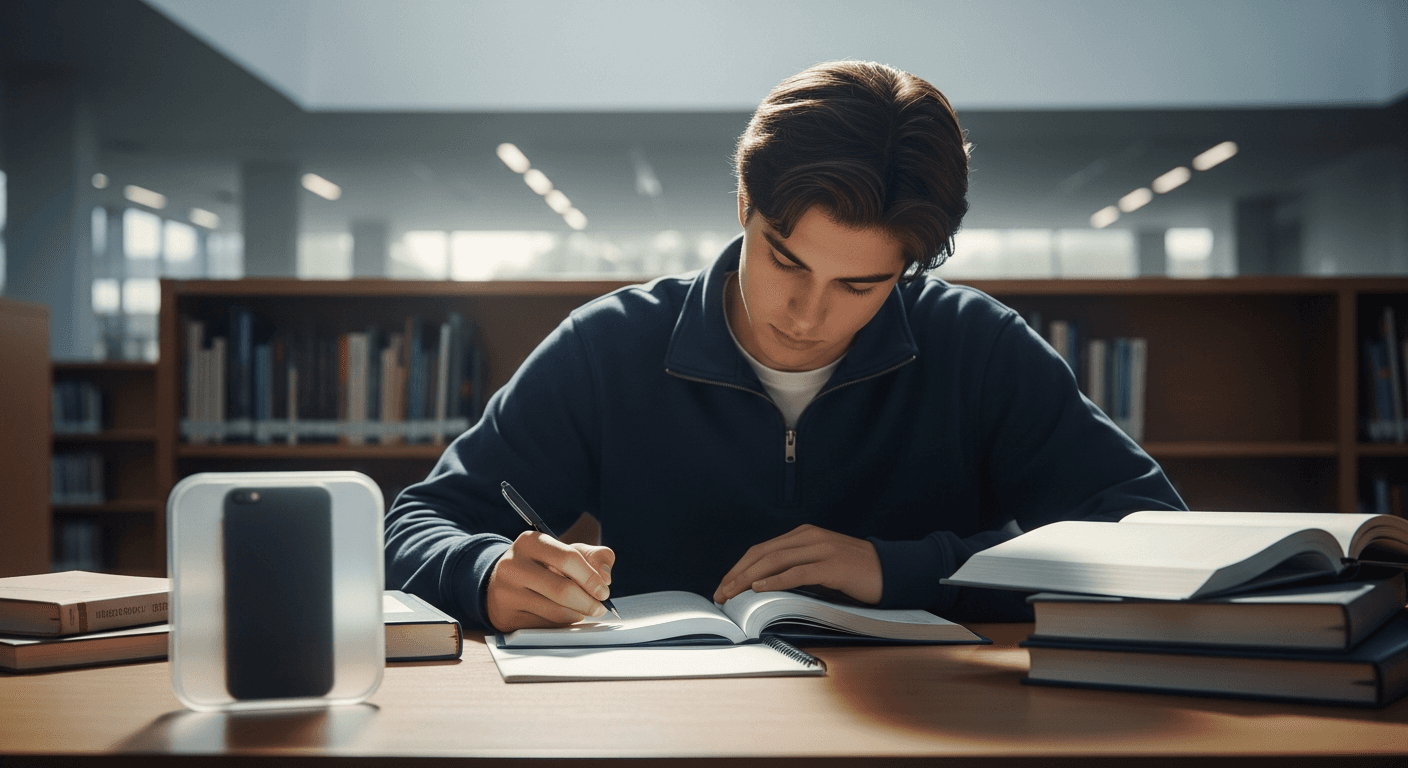
The Great Reconnection: Navigating the Smartphone-Free High School Era
The 2024-2025 academic year marks a historic turning point in American education. From California’s Phone-Free Schools Act to state-wide restrictions in Florida and Indiana, the 'ping' of a notification is increasingly being replaced by a silence that many students find jarring. For the average high schooler, this shift represents more than just a change in rules—it is a fundamental restructuring of their cognitive environment. While many see these bans as a hurdle, the most ambitious students are viewing them as a unique opportunity to reclaim their attention span and build the 'Concentration Edge' required for elite academic performance.
The timing of these restrictions is not accidental. As the Digital SAT becomes the standard and AP Exams continue to demand high-level synthesis of complex information, the ability to focus for sustained periods has become a scarce resource. Students who can successfully navigate this transition aren't just following school rules; they are training their brains to handle the rigorous cognitive demands of 2025-standard examinations.
The Focus Shock: Bridging the 15-Second Attention Gap
Educational psychologists have identified a phenomenon known as 'Focus Shock.' For years, the habitual use of short-form media and instant messaging has conditioned the teenage brain to seek a dopamine hit every 15 to 30 seconds. This is a direct conflict with the reality of an AP Biology or AP US History exam, which requires students to engage with dense texts and complex data sets for 90 minutes at a time.
When a smartphone is removed from the classroom, students often experience a form of 'digital withdrawal' that manifests as restlessness or an inability to start long-form tasks. However, this is exactly where the competitive advantage lies. By mastering the art of Deep Work—a term coined by Cal Newport—students can rebuild their neural pathways for sustained concentration. The goal is to move from 'fragmented attention' to a state of flow where complex problem-solving becomes second nature.
Why Concentration is the New IQ in College Admissions
In a world where generative AI can provide instant answers, the value of 'knowing' a fact has decreased, while the value of 'synthesizing' and 'applying' that fact has skyrocketed. College Board’s recent shifts reflect this. Whether it is the evidence-based reading on the SAT or the DBQ (Document-Based Question) on AP History exams, the assessment is no longer about speed—it is about the depth of analysis.
Consider the mathematical modeling required in AP Calculus. Success often depends on the ability to hold multiple variables in your working memory while navigating a multi-step problem. The formula for cognitive output is often cited as:
Quality Work Produced = (Time Spent) x (Intensity of Focus)
If your focus intensity is capped at 50% due to micro-distractions, you have to spend twice as much time to produce the same quality of work. By using specialized study materials that encourage long-form engagement, you can effectively double your study efficiency.
The 'Monk Mode' Protocol: A Practical Guide for AP Students
How do you transition from a phone-dependent study habit to a high-intensity focus block? The 'Monk Mode' protocol is gaining traction among top-tier students who want to maximize their GPA without burning out. Here is how to architect your distraction-free environment:
1. The 90-Minute Sprint
Human cycles of focus, known as ultradian rhythms, typically last about 90 minutes. Instead of 'studying all night,' break your work into two 90-minute blocks of absolute silence. During these blocks, your only goal is to solve 'hard' problems. Use an AI-powered practice platform to generate questions that push you just beyond your current comfort zone, forcing your brain to stay engaged.
2. Sensory Deprivation vs. Strategic Stimulation
Phone bans at school are great, but the real test is at home. Create a physical 'Focus Zone.' This means your phone isn't just face-down; it’s in another room. Research shows that the mere presence of a smartphone, even if it's off, reduces cognitive capacity. If you need background noise, opt for 'Brown Noise' or 'Alpha Wave' audio, which helps anchor the brain without providing lyrical distractions.
3. The 'Interleaving' Method
Don't spend four hours on just one subject. To mimic the mental agility required during finals week, 'interleave' your subjects. Spend 45 minutes on AP Physics, then 45 minutes on AP Literature. This prevents 'fluency illusions'—where you think you know the material just because you’ve been looking at it for a long time—and forces your brain to work harder to retrieve information.
Using AI to Architect High-Intensity Study Blocks
One of the biggest challenges of 'Deep Work' is knowing what to do once you’ve cleared the distractions. Staring at a blank textbook is the fastest way to lose focus. This is where AI-powered learning tools like Thinka become essential. Instead of passive reading, AI can act as a 'Focus Architect' by:
- Generating Tiered Difficulty: AI can start with foundational concepts and gradually increase the complexity, keeping you in the 'Goldilocks Zone' of focus—not too easy to be boring, not too hard to be frustrating.
- Simulating Exam Pressure: AI can generate time-pressured drills that mimic the exact pacing of the Digital SAT or AP free-response sections.
- Closing the Feedback Loop: In the past, you might wait days for a teacher to grade your essay. AI provides instant, granular feedback, allowing you to stay in the 'flow state' of learning and correcting in real-time.
For educators, these tools are equally transformative. Teachers can generate custom practice papers that specifically target the 'concentration gap' identified in their classrooms, ensuring that students are practicing the right level of rigor for the 2025 exam cycle.
The Result: Long-Term Academic Resilience
The transition to phone-free classrooms in the US is more than a disciplinary measure; it is a necessary intervention for the modern student's cognitive health. Those who embrace this change—rather than fighting it—will find themselves better prepared for the rigors of university life. When you sit down for your 3-hour AP Chemistry exam next May, the silence won't feel heavy; it will feel like your natural habitat. You will have the stamina to read the last paragraph as closely as the first, and the mental clarity to solve the final problem with the same precision as the first. In the end, the ability to focus is the ultimate competitive advantage in an increasingly distracted world.
Related posts
- Jul 9, 2026
The Data Cartographer: Mastering ‘Graphicacy’ to Bridge the Score Gap in 2025 AP Humanities and Sciences
Master data interrogation for your 2025 AP Exams. Learn how to transform basic graph reading into high-scoring analysis for AP Bio, AP Human Geo, and the Digital SAT.
- Jun 29, 2026
The Audit-Proof Essay: Mastering the New AI Transparency Mandates for the 2025 AP Cycle
Stay ahead of 2025 academic integrity rules. Learn how to use AI as a 'sparring partner' and document your process for AP exams and high school research papers.
- Jun 19, 2026
The Test-Mandatory Pivot: Mastering the New Logic of 2025-2026 College Admissions
Elite colleges are reinstating the SAT and ACT. Learn why test-optional is sunsetting and how to use AI to master the logic-first thinking required for top-tier admissions.
- Jun 9, 2026
The Digital Exam Frontier: Mastering the 'Screen-to-Score' Shift for 2025 AP and SAT Success
High school is going digital. From the Digital SAT to the 2025 AP exam cycle, learn how to adapt your study habits for computer-based testing with AI and precision practice.