Career Pathways7 min read
The Quantum Leap: Targeting Elite Deep-Tech University Programmes With Hard Science A-Levels
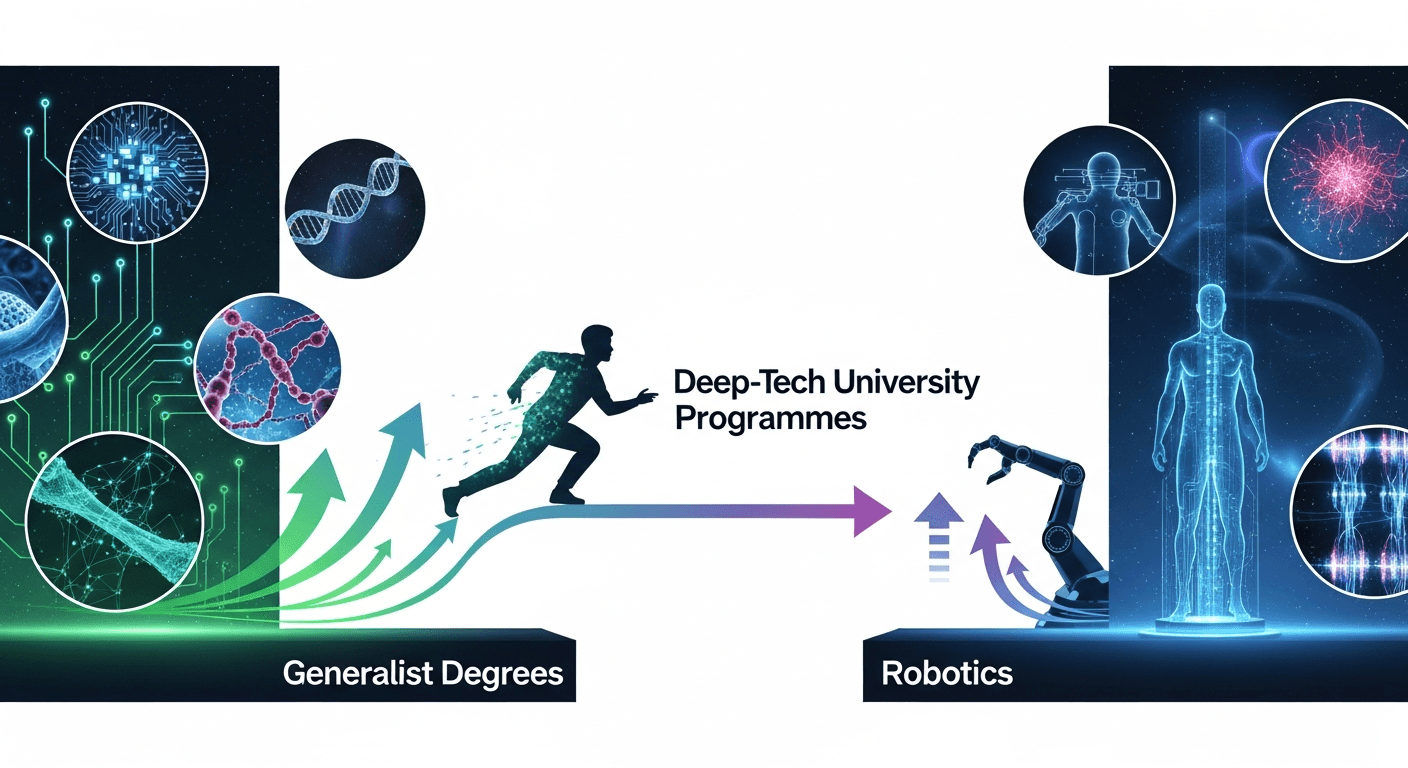
The Generalist Trap: Why Traditional Degrees Are Losing Their Edge
For decades, the standard playbook for ambitious A-Level students was relatively straightforward: secure top grades, enroll in a traditional Business, Economics, or general Engineering degree at a prestigious university, and step comfortably into the professional services sector. However, the global macroeconomic landscape is shifting rapidly. With the advent of advanced artificial intelligence automating routine cognitive tasks, generalist degrees are becoming increasingly overcrowded and, in some sectors, devalued.
Today, the most lucrative and secure career trajectories lie on the frontier of human innovation. We are witnessing a massive global pivot toward Deep-Tech—a category of technology based on tangible engineering innovation and profound scientific discovery. Governments and multinational corporations are locked in a race for technological sovereignty and the 'Net Zero' transition, creating an unprecedented global talent shortage in highly specialized 'Hard Science' hybrids. For A-Level students mapping out their future, pivoting away from saturated generalist pathways toward specialized deep-tech disciplines is the ultimate strategy for career future-proofing.
Decoding the High-Barrier Deep-Tech Disciplines
Deep-tech careers are characterized by high barriers to entry. They require a rigorous, specialized foundational knowledge that cannot be easily replicated by short coding bootcamps or on-the-job training. This is exactly why A-Level students, who have the opportunity to delve deeply into intensive subject syllabuses over two years, are uniquely positioned to capture these premium opportunities. Let us explore the three primary hybrid sectors dominating the future job market.
1. The Biological Data Revolution: Bio-Informatics
The days of biology being a purely observational or wet-lab science are over. The modern frontier of healthcare, agriculture, and synthetic biology is driven by massive datasets. Bio-informatics sits precisely at the intersection of biological sciences, computer programming, and statistical mathematics. Professionals in this field analyze genomic data to develop personalized medicine or engineer microbes capable of breaking down plastics.
Search trends show a massive spike in queries for Bio-informatics career paths, driven by the expanding synthetic biology sector. A-Level students aiming for this field should strongly consider combining Biology and Chemistry with Mathematics or Computer Science. The ability to understand the complex molecular structures of proteins while writing Python scripts to model their behavior is a rare, highly sought-after dual skill set.
2. The Architecture of Tomorrow: Quantum Computing and Semiconductors
As classical computing approaches its physical limits, the global tech industry is pouring hundreds of billions of dollars into quantum computing and advanced semiconductor fabrication. Geopolitical shifts have made domestic microchip production a matter of national security for many countries, leading to a surge in Semiconductor engineering scholarships and funding for Quantum computing undergraduate degrees.
These are perhaps the most mathematically and physically demanding fields to enter. A-Level Physics, Mathematics, and Further Mathematics form the non-negotiable trinity for students targeting these courses. Universities are looking for candidates who do not just memorize formulas, but who deeply understand the underlying principles of the universe. When you study the de Broglie wavelength \( \lambda = \frac{h}{p} \) or quantum phenomena in your A-Level Physics syllabus, you are directly interacting with the foundational mathematics that will power the next generation of supercomputers.
3. Physical AI: Robotics and Autonomous Systems
While generative AI focuses on software, the next massive economic leap will involve deploying AI into the physical world through robotics and autonomous systems. This encompasses everything from self-driving electric vehicles crucial to the 'Net Zero' transition, to precision agricultural drones and automated surgical arms.
A pure Mechanical Engineering degree is no longer sufficient. Modern robotics requires a hybrid understanding of mechanics, electronics, and artificial neural networks. A-Level candidates looking at this pathway should focus heavily on Mathematics, Physics, and Computer Science, building an early understanding of how physical hardware interfaces with algorithmic logic.
Aligning Your A-Level Arsenal for Deep-Tech Success
Unlike generalist degrees that often accept a wide variety of A-Level subjects, deep-tech university admissions are ruthlessly specific. Your A-Level subject combination is your first and most critical filter. Here are strategic recommendations for ambitious students:
Do Not Shy Away from Further Mathematics: If your school offers it and you are targeting elite institutions for fields like Quantum Engineering or Robotics, Further Maths is often the differentiator. It signals to admissions tutors that you have the quantitative resilience required for deep-tech.
Embrace the Hard Science Hybrids: The most successful future engineers will be those who cross traditional boundaries. A combination like Physics, Biology, and Computer Science might have seemed unusual ten years ago, but today, it is the exact blueprint for a pioneer in neural-interfacing robotics or advanced biomechanics.
Cultivate Interconnected Thinking: Deep-tech problems are not solved in isolation. You must train your brain to see how the calculus you learn in Maths applies to the kinematics in Physics, or how the logic gates in Computer Science mirror biological regulatory networks.
Building a Supercurricular Profile That Stands Out
To secure offers for these highly competitive, specialized programs, strong A-Level predictions are merely the baseline. Your university application must demonstrate a genuine, self-directed passion for deep-tech. This is known as your supercurricular profile.
Start by stepping outside the standard curriculum. If you are interested in semiconductor engineering, research the mechanics of photolithography and build a project around it. If bio-informatics is your goal, take an open-source biological dataset and write a rudimentary algorithm to search for specific genetic sequences. Documenting these projects on platforms like GitHub or presenting them at school science fairs provides tangible proof of your hybrid capabilities. Furthermore, to support your independent learning journey, you can always browse our free study materials and resources to discover supplementary reading and advanced conceptual guides.
Mastering the Rigor with AI-Powered Practice
The reality of pursuing the hard sciences at the A-Level standard is that the margin for error is incredibly thin. The cognitive load required to simultaneously master the abstract logic of Computer Science, the mathematical proofs of Further Maths, and the conceptual depth of Physics can be overwhelming.
This is where leveraging specialized educational technology becomes your greatest advantage. Rote memorization will not help you solve unseen, complex mechanics problems or trace intricate logic errors in an exam setting. You need dynamic, personalized practice that identifies the exact friction points in your understanding. By utilizing intelligent platforms, you can learn more about how our AI-powered study platform adapts to your weaknesses, providing targeted interventions exactly when you struggle with a specific module, such as quantum mechanics or organic synthesis.
It is not just about the students, either. Forward-thinking secondary schools are recognizing the need to elevate their STEM provisions to meet the demands of these new career pathways. Teachers looking to challenge their brightest A-Level cohorts can equip educators with the ability to instantly generate targeted practice papers, ensuring that students are constantly pushed slightly beyond their comfort zones, perfectly simulating the rigorous demands of elite university aptitude tests.
The Long Game: Career Resilience in the 2030s
Choosing to pursue specialized science and engineering pathways is undoubtedly the path of most resistance. It requires countless hours of grappling with difficult concepts, running failed code, and untangling complex mathematical proofs. However, this high barrier to entry is exactly what creates the premium value of these careers.
While graduates of overcrowded, generalist programs may find themselves competing with automated systems for entry-level professional roles, deep-tech graduates will be the architects building those very systems. By strategically selecting your A-Level subjects today and committing to the hard science hybrids, you are not just aiming for a university degree; you are securing a pivotal role in shaping the technological infrastructure of the future.
If you are prepared to build the quantitative foundation required for this quantum leap, do not leave your exam preparation to chance. Take control of your academic trajectory today and start practicing in our intelligent learning environment to secure the elite A-Level grades that will unlock your future in deep-tech.
Related posts
- Oct 18, 2026
Highest Paying Degrees Ranked: College Majors, Starting Salaries, and Career ROI
Discover the highest paying degrees ranked by starting and mid-career salary. Compare STEM, finance, and healthcare ROI, high school prerequisites, and AP credits.
- Oct 8, 2026
What A-Levels Do You Need to Be a Doctor? Entry Requirements, Science Prerequisites, and Grade Benchmarks
Planning to study medicine abroad or taking A-Levels? Discover mandatory subjects, chemistry and biology rules, grade cutoffs from AAA to A*A*A, and AP equivalents.
- Sep 28, 2026
Computer Science Major Prerequisites: The High School Course Matrix and Admissions Benchmarks
Discover the essential high school courses, AP prerequisites, and math benchmarks needed for competitive computer science and software engineering degree programs.
- Sep 18, 2026
What High School Classes Do You Need to Study Law? The Pre-Law AP Matrix and Admissions Guide
Discover what high school classes and AP subjects you need to study law. Explore the 3-tier pre-law course matrix, LNAT benchmarks, and top admissions strategies.