Career Pathways6 min read
What Classes Do You Need to Be a Doctor? The Complete Pre-Med Course Matrix and Admissions Timeline
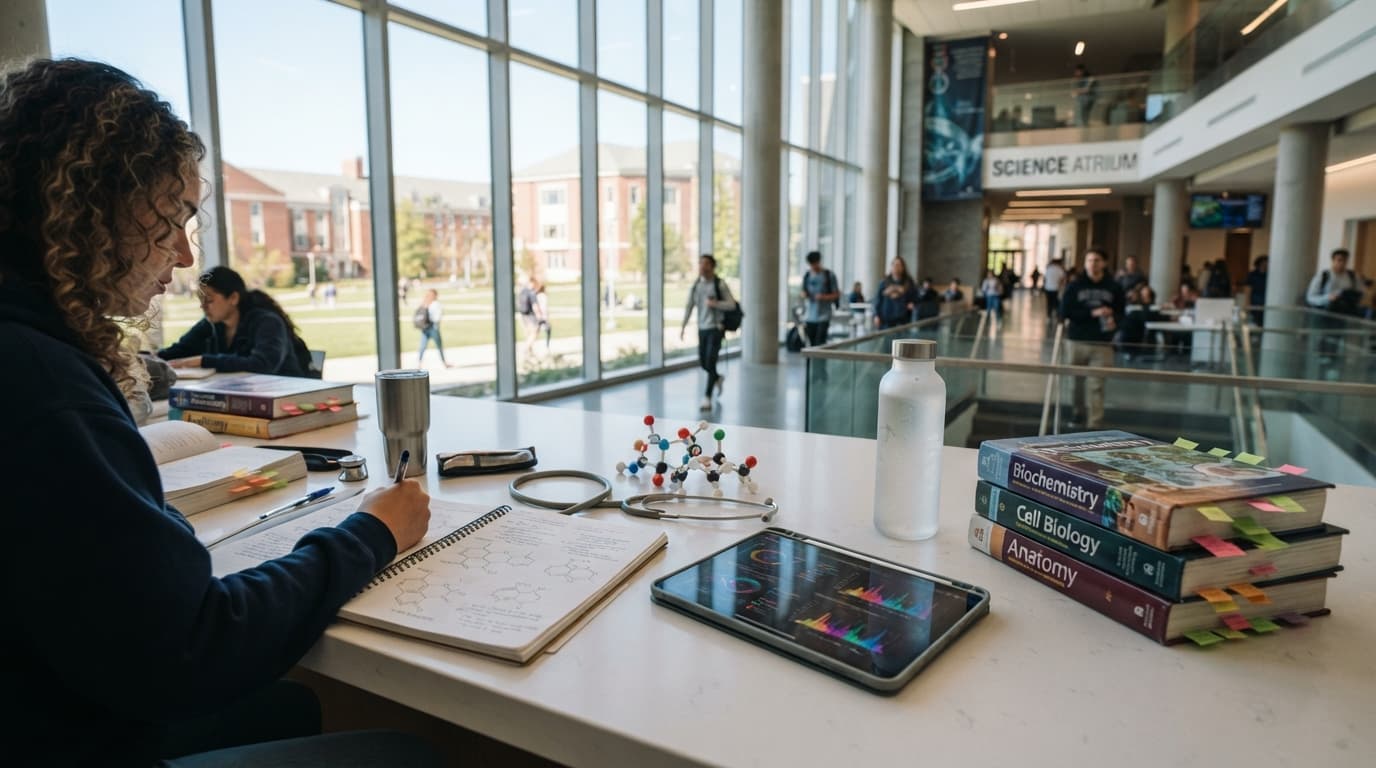
What Classes Do You Need to Become a Doctor in the US?
To get into medical school in the United States, you must complete a rigorous battery of undergraduate pre-medical coursework, maintain a competitive science GPA, and achieve a high score on the Medical College Admission Test (MCAT). Unlike direct-entry undergraduate medical degrees in other countries, the standard American path requires earning a four-year bachelor’s degree while satisfying specific core prerequisite courses in chemistry, biology, physics, mathematics, and humanities.
The non-negotiable core across nearly all MD (Allopathic) and DO (Osteopathic) programs includes one year of General Chemistry with lab, one year of Organic Chemistry with lab, one year of General Biology with lab, one semester of Biochemistry, one year of Physics with lab, and college-level Mathematics (typically Calculus and Statistics). For high school students eyeing competitive BS/MD dual-degree programs or preparing for a rigorous college STEM track, excelling in AP Chemistry, AP Biology, and AP Calculus is the single strongest foundational baseline you can build.
The Pre-Med Prerequisite Matrix: Required vs. Recommended
While medical schools do not require you to major in Biology or Pre-Med—you can major in English, History, or Computer Science—you must check every box on the prerequisite matrix. The table below outlines standard semester-hour benchmarks required across accredited US medical institutions:
1. The Chemistry Sequence (Strictly Non-Negotiable)
Chemistry represents the largest academic filter on the pre-med track, accounting for up to five distinct semesters of study:
- General Chemistry I & II (with labs): 8 semester credits covering stoichiometry, thermodynamics, equilibria, and atomic structure.
- Organic Chemistry I & II (with labs): 8 semester credits focusing on reaction mechanisms, synthesis pathways, stereochemistry, and spectroscopy.
- Biochemistry: 3 to 4 semester credits. Biochemistry has become an essential prerequisite for modern MCAT preparation, heavily tested on the Chemical and Physical Foundations as well as the Biological and Biochemical Foundations sections.
2. Biological Sciences
Medical admissions committees expect at least 8 semester credit hours of introductory biology with corresponding laboratory components. Beyond introductory coursework, admissions teams look favorably upon upper-division electives such as Genetics, Cell Biology, Microbiology, and Human Physiology.
3. Physics and Mathematics
You will need two semesters (8 semester credits) of General Physics with labs. While algebra-based physics fulfills prerequisites at most medical schools, calculus-based physics is common among engineering and physical science majors. For math, medical schools typically require one semester of College Calculus and one semester of Introductory Biostatistics or Statistics, which are essential for interpreting epidemiological literature and clinical trial data.
4. Behavioral Sciences and English
With the expanded focus on social determinants of health, competitive candidates complete one semester each of Introductory Psychology and Introductory Sociology. Additionally, two semesters (6 credit hours) of college-level English, expository writing, or intensive humanities coursework are required by nearly every admissions committee.
High School Strategy: AP Credits, Dual Enrollment, and BS/MD Pathways
If you are currently in high school, strategic course selection sets your trajectory for college pre-med success. Advanced Placement (AP) and International Baccalaureate (IB) courses demonstrate academic rigor, but they come with specific nuances for medical admissions:
Many elite medical schools (such as Harvard, Johns Hopkins, and Stanford) restrict or do not accept AP credits to satisfy core pre-med science requirements. If you use AP credit to place out of General Chemistry or Introductory Biology in college, you are usually expected to take an equivalent number of upper-level credits (such as Physical Chemistry, Immunology, or Molecular Genetics) to demonstrate collegiate-level mastery. You can review foundational concept summaries through curated study notes to reinforce core STEM principles before transitioning into university lecture halls.
For high school seniors applying to direct BS/MD or BS/DO programs (guaranteed medical school acceptance from high school), minimum academic thresholds are exceptionally steep:
- Unweighted GPA: Typically 3.85 to 4.0
- Standardized Tests: SAT scores generally at or above 1500 (with Math at 750+), or ACT composite scores of 34+
- STEM Rigor: Maximum available AP course load, specifically AP Chemistry, AP Biology, and AP Calculus BC
Grade Cut-Offs: Decoding BCPM GPA and the MCAT Threshold
Medical school admissions teams rely heavily on your BCPM GPA—the aggregate GPA calculated exclusively from your Biology, Chemistry, Physics, and Math courses via the American Medical College Application Service (AMCAS).
Understanding target metrics is critical for realistic planning:
- Competitive BCPM Science GPA: ext{Science GPA} imes 4.00 ext{ scale} o ext{Competitive: } 3.70 - 3.85+
- Competitive Cumulative GPA: 3.75 - 3.90+
- MCAT Scoring Benchmarks: The national average for matriculants into MD programs hovers around 511–512, with sectional scores balanced across all four sub-tests (ranging from 127 to 129 per section). DO programs feature average matriculant scores around 504–506 with cumulative GPAs near 3.55–3.65.
A single poor grade in Organic Chemistry does not disqualify an applicant, but upward grade trends in upper-division science coursework are essential to reassure admissions committees of your academic resilience.
The 4-Year Pre-Med Strategic Timeline
Navigating prerequisite courses while accumulating clinical shadowing, non-clinical volunteering, laboratory research, and MCAT preparation requires meticulous pacing.
Freshman Year (The Foundation)
Focus on GPA preservation. Take General Chemistry I & II with labs, General Biology I & II with labs, and Calculus. Begin exploratory shadowing (20–40 hours) and join campus pre-health organizations.
Sophomore Year (The Organic Chemistry Crucible)
Take Organic Chemistry I & II, introductory Psychology/Sociology, and Biostatistics. Secure a position in an academic research laboratory or begin clinical employment (e.g., EMT, Certified Nursing Assistant, medical scribe).
Junior Year (Biochemistry, MCAT, and Primary Application)
Complete Biochemistry, General Physics I & II, and English requirements. Dedicate 300 to 500 hours of study to the MCAT between January and April of your junior year. The AMCAS and AACOMAS application portals open in early May, with initial submissions opening in late May or early June. Submitting your primary application in June of your application cycle is vital for rolling admissions advantages.
Senior Year (Secondaries, Interviews, and Matriculation)
Complete secondary applications during July and August. Interview invitations roll out from September through February. Maintain your final undergraduate requirements and submit periodic update letters detailing ongoing clinical or research achievements.
Accelerating STEM Mastery with Intelligent Retrieval
Pre-med coursework tests conceptual depth and rapid problem deconstruction. Passive reading and flashcard memorization frequently fail when students encounter complex multivariable equilibrium problems or organic synthesis pathways.
Integrating smart retrieval and iterative problem sets helps bridge the gap between lecture concepts and exam-level performance. Educators and tutors can leverage tools like dedicated lesson and problem generators to build targeted practice scenarios. For students seeking personalized diagnostics and step-by-step problem deconstruction across chemistry and physics, AI-driven study support highlights hidden knowledge gaps before they impact your transcript. You can start practicing active synthesis problems directly on the interactive learning platform to sharpen analytical speed and lock in top-tier STEM marks.
Related posts
- Oct 18, 2026
Highest Paying Degrees Ranked: College Majors, Starting Salaries, and Career ROI
Discover the highest paying degrees ranked by starting and mid-career salary. Compare STEM, finance, and healthcare ROI, high school prerequisites, and AP credits.
- Oct 8, 2026
What A-Levels Do You Need to Be a Doctor? Entry Requirements, Science Prerequisites, and Grade Benchmarks
Planning to study medicine abroad or taking A-Levels? Discover mandatory subjects, chemistry and biology rules, grade cutoffs from AAA to A*A*A, and AP equivalents.
- Sep 28, 2026
Computer Science Major Prerequisites: The High School Course Matrix and Admissions Benchmarks
Discover the essential high school courses, AP prerequisites, and math benchmarks needed for competitive computer science and software engineering degree programs.
- Sep 18, 2026
What High School Classes Do You Need to Study Law? The Pre-Law AP Matrix and Admissions Guide
Discover what high school classes and AP subjects you need to study law. Explore the 3-tier pre-law course matrix, LNAT benchmarks, and top admissions strategies.