Further Studies Guide5 min read
The Circadian Strategist: Optimizing AP and SAT Revision Through AI Chrono-Mapping
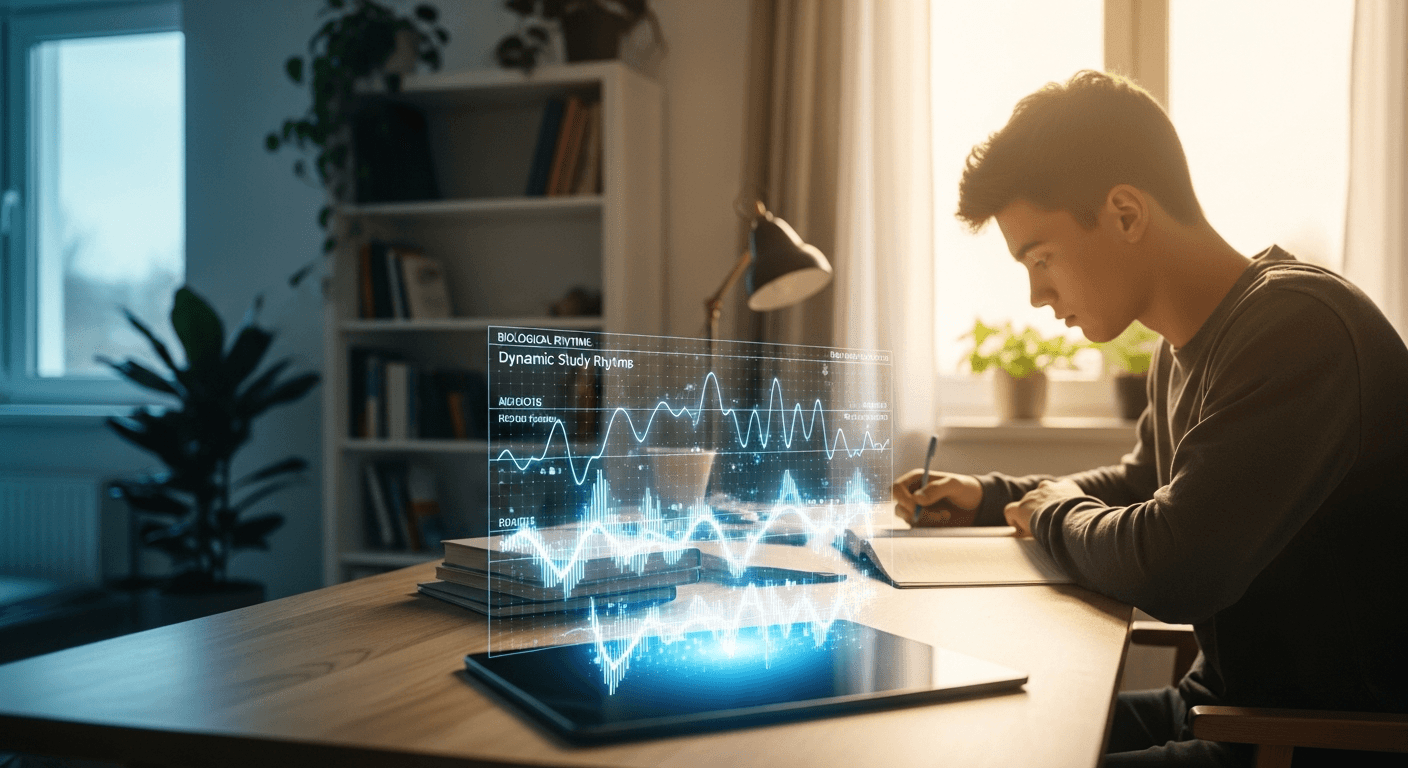
The Biological Mismatch in Traditional Study Planning
For decades, high school and college prep students have relied on rigid, linear study schedules. They map out revision blocks from 4:00 PM to 7:00 PM simply because that is when homework conventionally begins, or they force themselves into 6:00 AM cramming sessions because of the old adage that the early bird gets the worm. However, recent educational psychology and student wellness research reveals a glaring flaw in this approach: standard timetables routinely fail because they completely ignore individual biological chronotypes and ultradian fatigue cycles. With the rising academic pressures of Advanced Placement (AP) courses, rigorous dual-enrollment classes, and college entrance exams like the SAT and ACT, students are frequently suffering from acute cognitive fatigue.
When a nocturnal or intermediate student forces intense calculus problem-solving during an internal circadian slump, their brain operates at a fraction of its capacity. They spend three hours staring at a practice prompt, retaining almost nothing, while building deep academic frustration. To break this cycle, forward-thinking students are turning to AI-driven predictive modeling. By utilizing intelligent platforms like Thinka, learners can analyze their unique biological rhythms, track their daily cognitive highs and lows, and dynamically schedule revision slots that match subject difficulty with peak brain performance. Moving away from static timetables to precision biological timing is the ultimate upgrade for long-term memory retention and burnout prevention.
Decoding Your Chronotype for High-Stakes Exam Prep
Before an AI tool can optimize your revision workflow, you must understand the foundational biology of human chronotypes. Generally categorized into morning types (larks), evening types (owls), and intermediate types (hummingbirds), your chronotype is largely dictated by genetics and developmental biology. During high school and college prep years, adolescent and young adult circadian rhythms naturally shift toward later sleep-wake phases. Forcing a natural night-owl teenager into a high-intensity AP Physics study session at 7:00 AM is the biological equivalent of running a sophisticated computer on a low battery.
AI predictive modeling bridges this gap by ingesting data points on your alertness levels, task completion speeds, and retention check scores across different hours of the day. Instead of guessing when you feel 'focused,' an AI-powered practice platform maps your cognitive output over a two-week baseline. It identifies your ultradian rhythms—the 90-to-120-minute cycles of high and low alertness that occur throughout the day. By matching these biological cycles to specific academic domains, the system builds a dynamic schedule that places high-friction tasks, such as analytical essay drafting or complex algorithmic problem-solving, precisely during your cognitive peaks.
Dynamic Chrono-Mapping vs. Static Revision Timetables
The traditional study planner treats the human brain as a static container. It assumes that an hour spent studying organic chemistry at 8:00 PM yields the exact same results as an hour spent studying it at 10:00 AM. Cognitive science proves otherwise. Memory consolidation, neuroplasticity, and executive function fluctuate dramatically based on cortisol curves, body temperature, and adenosine buildup.
When you transition to AI chrono-mapping, your revision schedule becomes a living organism. If you slept poorly due to a late-night club meeting or a varsity sports game, the predictive model recalculates your cognitive capacity for the following day. It automatically defers high-demand conceptual synthesis to a later recovery window and swaps in lower-friction retrieval practice, such as flashcard review or vocabulary drills, during your slump hours. This agility ensures you never waste precious study hours fighting your own biology. To explore free tools and strategies that support this shift, check out our collection of free study materials and resources designed for rigorous academic prep.
Actionable Implementation: Building Your AI Chrono-Routine
Integrating biological chronotypes into your AP or SAT study routine does not require a degree in neurobiology. Follow this step-by-step framework to transform your daily study habits using intelligent workflow tools:
1. Log Your Baseline Energy and Accuracy
For one week, track not just what you study, but your subjective energy levels (on a scale of 1 to 10) and your error rates on practice problems every single hour. Feed this data into an adaptive learning environment to establish your unique cognitive baseline.
2. Match Difficulty to Peaks
Identify your primary cognitive peak—whether it is mid-morning for larks or late afternoon/early evening for owls. Lock this window exclusively for your hardest subjects, such as AP Chemistry reaction mechanisms, AP Literature close readings, or timed SAT math sections. Never waste your peak hours on administrative tasks or passive reading.
3. Leverage Adaptive Practice for Slump Windows
During your natural circadian dips, utilize interactive, gamified, or bite-sized practice modules that require less heavy lifting from your executive functioning centers. This keeps your momentum alive without inducing acute mental exhaustion.
4. Audit and Refine Weekly
Biological rhythms shift, especially during high school as stress levels and sleep schedules fluctuate. Regularly review your performance analytics to ensure your AI-driven schedule adapts in real time. If you want to learn more about how Thinka can help students improve grades through AI, explore our platform features built to customize your preparation journey.
The Long-Term ROI of Biological Optimization
Mastering your chronotype is more than just a clever trick for surviving midterms or hitting a target SAT score; it is a vital life skill that yields massive returns well into college and your professional career. By aligning your study habits with your biological reality, you eliminate the guilt of unproductive hours and drastically reduce chronic academic burnout. Stop fighting your natural wiring. Embrace AI-driven chrono-mapping, optimize your study revision schedules, and unlock your true cognitive potential for top-tier academic success.
Related posts
- Sep 17, 2026
AQA vs Edexcel vs OCR: Deciphering Exam Board Difficulty and Scoring Curves for US College Prep
Compare AQA, Edexcel, and OCR exam difficulty. Discover how question styles, mark schemes, and grade boundaries impact scoring for US applicants targeting UK admissions.
- Sep 6, 2026
How to Choose High School Classes: Strategic AP and Elective Matrix for Top College Pathways
Master high school course selection. Use our reverse-engineered AP and honors matrix to maximize academic rigor, satisfy college prerequisites, and protect your GPA.
- Aug 27, 2026
AP Course Selection Matrix: Strategic Subject Clusters for STEM, Pre-Med, Law, and Finance
Master high school course selection for top US colleges. Explore strategic AP combinations, prerequisite matrices, and GPA workload balancing for competitive majors.
- Aug 16, 2026
The Evidence-Driven Candidate: Navigating Structured Admissions and Ethical AI in College Applications
Master the shift to structured college prompts. Discover how American high schoolers use ethical AI scaffolding to turn AP coursework into authentic admissions proof.