AI Applications4 min read
The Simulation Tactician: Mastering Practical Lab Exams and Experimental Design with AI-Powered Sandboxes
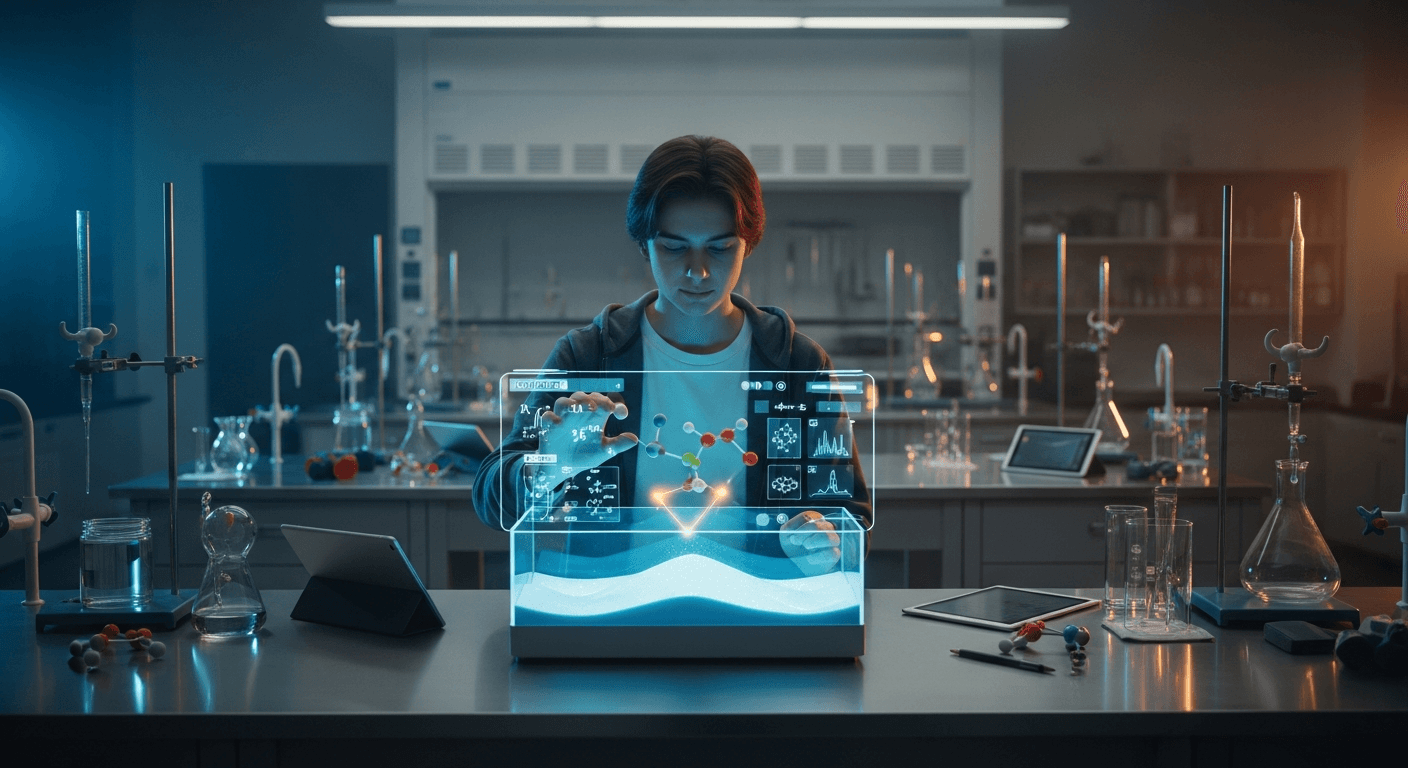
Bridging the Gap Between Textbook Theory and Lab Reality
Every high school student taking Advanced Placement Chemistry, Physics, or Biology knows the sinking feeling of stepping into a high-stakes lab practical or facing unscripted experimental design free-response questions (FRQs) on the AP exam. You have memorized reaction mechanisms, kinetic formulas, and cellular respiration pathways word for word. Yet, when the prompt asks you to design a protocol to determine an unknown activation energy or troubleshoot an unexpected titration endpoint, textbook memorization suddenly falls short.
Modern science assessments are shifting rapidly. Standardized testing boards increasingly prioritize inquiry-based competencies and methodological critique over simple recall. Students are routinely expected to predict how an uncontrolled variable will skew data, modify procedures on the fly, or evaluate the validity of a complex setup. Unfortunately, high school science labs are often constrained by tight class periods, limited budgets, and safety regulations. These constraints rarely allow for the iterative trial-and-error process required for genuine scientific intuition. This is where high school students are turning to an entirely new study methodology: AI-powered simulation sandboxes.
The Problem with Static Study: The 'Understanding Illusion' in Science Labs
When studying for a multiple-choice test, rereading notes or flipping through flashcards creates a comforting sense of mastery known as the understanding illusion. In practical science, this illusion shatters the moment you have to decide whether a spectrometer needs recalibrating or how an ambient temperature shift will affect enzyme denaturation rates.
Traditional prep relies on static lab manuals that tell you exactly what steps to follow. Real experimental design, however, is messy. It requires anticipating errors before they happen. If you never experience a failed titration, a contaminated culture, or a miscalibrated circuit in a controlled, risk-free environment, you will struggle to analyze those exact anomalies when they appear in a novel AP exam scenario. To truly master inquiry-based questions, you need a way to run dozens of virtual experiments in minutes, tweaking variables and instantly observing the cascading effects on your data.
Deploying AI Simulation Sandboxes for Experimental Stress-Testing
An AI-powered simulation sandbox acts as a reactive virtual laboratory. Instead of passively reading about how changing concentration affects reaction rates, you prompt an advanced learning engine to simulate a specific chemical system under variable conditions. You can instruct the AI: 'Act as a simulated AP Chemistry laboratory environment. I am testing the effect of varying catalyst surface area on hydrogen peroxide decomposition. Give me raw data with a randomized experimental error margin of five percent, and let me test three different procedural modifications.'
By treating the AI as an interactive lab partner, you can systematically break your own hypotheses. This iterative dry-run process builds what scientists call procedural fluency. When you interact with our AI-powered practice platform, you can generate customized lab scenarios tailored specifically to the latest AP Science rubrics, testing your ability to identify systematic versus random errors on demand.
A Step-by-Step Framework for Virtual Lab Mastery
To turn AI simulation sandboxes into top-tier exam scores, high school students should follow a structured, four-phase protocol:
1. The Baseline Run
Start by asking the AI to present a standard, textbook-compliant experimental setup for a core concept, such as determining Planck's constant using LEDs or measuring photosynthetic rates via floating leaf disks. Walk through the standard protocol step-by-step, ensuring you understand the purpose of every control variable.
2. The Variable Disruption Test
Introduce deliberate chaos. Ask the AI to simulate what happens if the ambient temperature increases by ten degrees Celsius midway through your titration, or if your chromatography paper is touched with bare fingers, leaving oil residue. Analyze how these disruptions alter the resulting graphs and calculations. This directly prepares you for the dreaded 'describe and justify the effect of experimental modifications' style questions found on modern science exams.
3. The Error Taxonomy Audit
After running a virtual experiment, ask the AI to evaluate your procedural notes and identify any logical leaps or safety oversights. Much like reviewing past mistakes using targeted practice tools, catching these procedural flaws virtually ensures you will not commit them under exam pressure.
4. The Rubric Alignment Check
Finally, translate your virtual findings into formal FRQ-style explanations. Use precise scientific vocabulary—such as proportional deviation, systematic bias, and percent error—and have the AI grade your written response against official AP scoring guidelines.
Integrating Practical Prep into Your Weekly Study Workflow
Mastering experimental design does not require spending hours in a physical lab. By dedicating just thirty minutes a week to running targeted simulation scenarios, you bridge the gap between abstract theoretical formulas and tangible physical reality. Whether you are prepping for midterms, finals, or the national AP exams in May, shifting from passive reading to active simulation is the ultimate differentiator.
To explore more strategies, sample problems, and structured revision guides, visit our hub for free study materials and resources. If you want to see how personalized, adaptive coaching can transform your entire science and math GPA, learn more about how Thinka helps students improve grades through AI and take control of your academic trajectory today.
Related posts
- Oct 13, 2026
Can ChatGPT Grade Essays Accurately? We Tested It on AP Rubrics
Wondering if ChatGPT can grade essays accurately? Discover how LLMs inflate AP Lang and DBQ scores, avoid hallucinated marks, and calibrate AI grading.
- Oct 3, 2026
How to Cite AI in Coursework: AP Guidelines, MLA/APA Formats, and Prompt Logs
Learn how to cite AI in coursework for AP classes and high school essays. Master official College Board rules, MLA and APA citation templates, and prompt audit logs.
- Sep 23, 2026
How to Use ChatGPT for AP and SAT Prep: The 4-Step Prompt Framework
Master how to use ChatGPT for exam revision. Learn the 4-step prompt framework to simulate AP scoring rubrics, drill Digital SAT questions, and stop AI hallucinations.
- Sep 12, 2026
Can ChatGPT Grade Essays Accurately? The AP Rubric Calibration Protocol
Can ChatGPT grade essays accurately? Learn how to eliminate AI grade inflation and calibrate prompts for AP DBQs, LEQs, and FRQs with real examiner precision.