International SchoolApr 13, 2026
The UMS Masterplan: De-Risking Final Grades Through Phased International A-Level Sittings
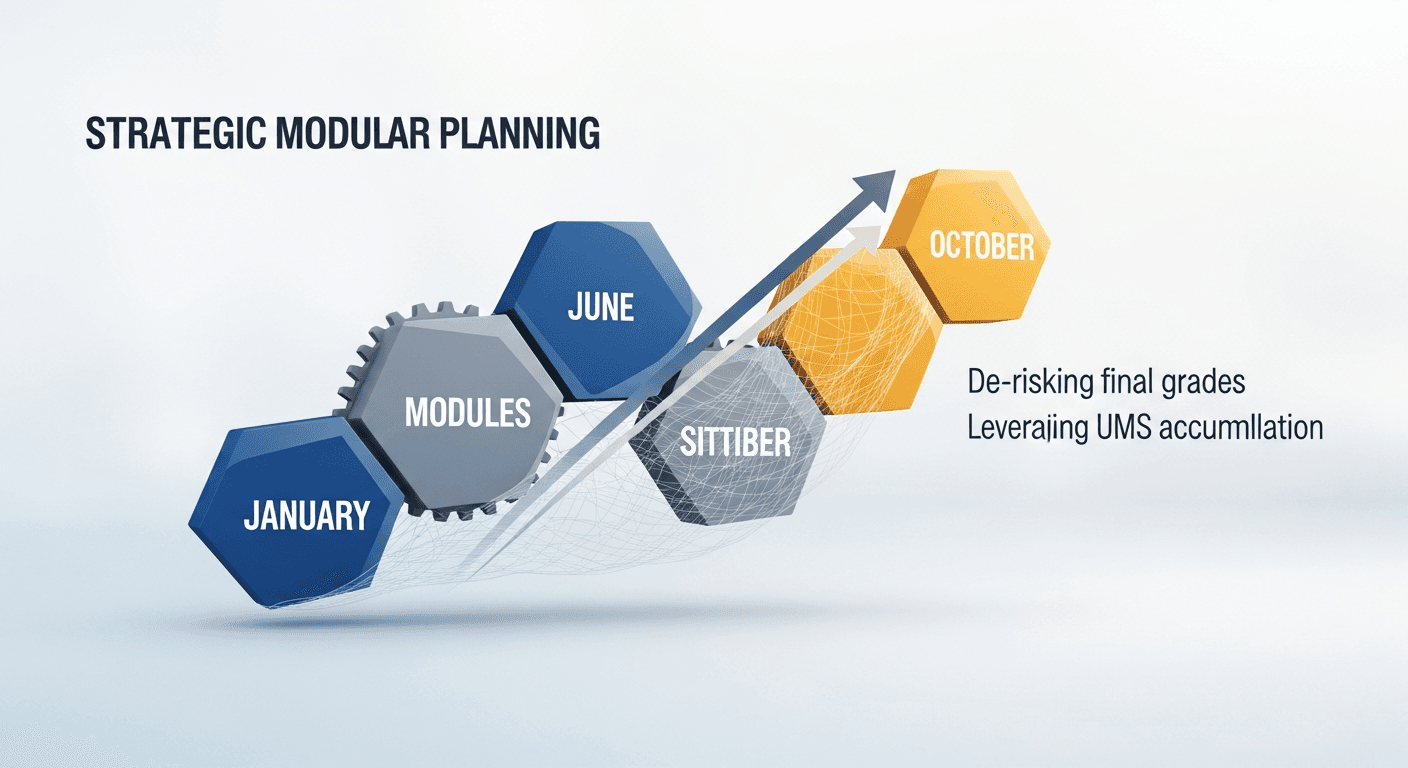
The High-Stakes Gamble vs. The Phased Masterplan
For decades, the standard British qualification pathway has been associated with a high-stakes, linear structure: a grueling two-year marathon culminating in a single, definitive set of summer examinations. In the linear UK system, a bad week in June can entirely derail a university application. However, for students enrolled in International A-Levels (IAL) offered by examination boards like Pearson Edexcel and Oxford AQA, the playing field looks drastically different. As prestigious universities globally revert to strict, pre-pandemic admission standards, international school students across Asia are rapidly realizing that winging it in a single summer session is an unnecessary gamble. Instead, an increasing number of high-achievers are turning to a more sophisticated approach: staggered exam sittings.
Unlike the traditional system, the modular structure of the IAL allows students to break down their syllabus into manageable units and sit for them at different times of the year—typically in January, June, and sometimes October. This flexibility completely redefines academic preparation. By strategically staggering unit entries, students can systematically manage their cognitive load, accumulate points early, and use re-sit opportunities as calculated safety nets rather than desperate last resorts. If you are navigating the demands of international schooling, adopting a multi-sitting masterplan is the ultimate way to de-risk your final grades and secure your conditional university offers with confidence.
Demystifying the UMS Currency
Before designing your phased timetable, you must understand the underlying mechanics of how your final grades are awarded. Recent search trends indicate a massive surge in students asking how to calculate UMS for A-Levels, and for good reason. UMS, or the Uniform Mark Scale, is the great equalizer of the International A-Level system. When you sit an exam, the examiner grades your paper out of a total number of raw marks. However, because the difficulty of exam papers inevitably fluctuates slightly between a January session and a June session, raw marks alone are not a fair measure of a student's absolute ability.
To solve this, exam boards mathematically convert your raw score into a UMS score. The UMS standardizes difficulty across all sittings. For example, if a January Physics paper was exceptionally challenging, a raw score of 58/75 might scale up to a perfect 120 UMS. If the June paper was relatively straightforward, you might need a raw score of 68/75 to achieve that identical 120 UMS. The formula mathematically normalizes the curve: \( \text{Total UMS} = \text{Unit 1 UMS} + \text{Unit 2 UMS} + \dots \). Because the UMS corrects for variance, the popular debate over IAL January vs June sittings being strictly easier or harder is technically a myth. The system is perfectly balanced. Understanding this liberates you to choose your exam sittings based purely on your personal readiness and syllabus completion, rather than attempting to guess which paper will be fundamentally easier.
Mapping the Sittings: January, June, and October
A strategic IAL timeline requires treating the academic year not as a countdown to June, but as an ongoing campaign with multiple operational phases. Let us break down the utility of each examination window.
The January Catalyst: Fragmenting the Pressure
The January examination window is arguably the most underutilized tool in the international school toolkit. Many students assume January is only for early re-sits. In reality, sitting fresh units in January is the cornerstone of cognitive load management. Consider a subject like Edexcel IAL Mathematics, which consists of six units. Attempting to review Core Mathematics, Advanced Mechanics, and Statistics simultaneously in June requires immense short-term memory capacity. By sitting Pure Mathematics 1 (P1) and Statistics 1 (S1) in January of Year 12, you effectively bank one-third of your final grade halfway through your first year. When summer arrives, your focus is entirely preserved for your remaining units. You are no longer juggling the entire curriculum; you are executing a precision strike on a localized fraction of the syllabus.
The June Consolidation: The Main Event
June remains the anchor of the academic calendar. Because most international schools naturally complete their core teaching cycles by April or May, June is the ideal window for your heaviest, most synoptic units. Units that require a deep, interconnected understanding of the entire syllabus—such as Unit 6 in IAL Biology or Physics—are best reserved for this window. However, because you have utilized the January window to clear foundational modules, your June revision schedule will be remarkably spacious, allowing for deeper, more intensive practice sessions.
The October Safety Net: Rapid Re-Sits
The October session, offered by select exam boards, serves a highly specific tactical purpose: rapid course correction. If a June exam result falls short of your expectations, the October window allows you to immediately re-sit the unit while the content is still relatively fresh in your mind. This is particularly crucial for Year 13 students applying to universities with early admission deadlines. By banking an improved UMS score in October, you solidify your predicted grades before the intense university application cycle truly begins.
Managing Cognitive Load Through Early Accumulation
Why is staggering so effective from a psychological standpoint? The answer lies in cognitive load theory. Human working memory is strictly limited. When an International School student attempts to revise the entirety of the A-Level Chemistry organic, inorganic, and physical pathways simultaneously, the brain quickly becomes overwhelmed, leading to diminishing returns during study sessions. Staggering units physically removes content from the equation.
Furthermore, early UMS accumulation completely shifts the psychological dynamic of Year 13. Imagine receiving a conditional university offer in March that requires an A* in Economics. If you have been strategically staggering your exams since Year 12, you may already have 80% of the required UMS locked in your academic vault. The pressure of the final summer exams is transformed from a terrifying do-or-die scenario into a simple mathematical exercise of securing the final few points. You are no longer chasing the grade; you are merely defending it.
Re-Framing the Re-Sit: A Tactical Adjustment
There is an outdated stigma surrounding exam re-sits, largely inherited from the traditional UK linear system where a re-sit implies an entire year lost. In the International A-Level modular ecosystem, this stigma is entirely misplaced. Re-sits are a structural feature, not a failure. Top-tier students use early re-sits to surgically bump a high B to an A* in a specific unit, thereby securing the highest possible cumulative UMS. This is the essence of de-risking. If you sit a challenging unit in January and score slightly lower than needed, you have a built-in safety net to retake it in June alongside your other papers. The best UMS score for that unit is the one that is carried forward. You literally cannot lose points by attempting a unit early, provided you balance your preparation time effectively.
Leveraging Technology to Plan Your Units
The most difficult aspect of the modular masterplan is deciding precisely which units you are ready to sit early. Attempting a January exam without adequate preparation can backfire, absorbing time that should have been spent on other subjects. This is where modern educational technology becomes indispensable. Instead of relying on gut feeling, international school students can utilize AI-driven analytics to map their readiness. If you are unsure whether to attempt a challenging module in January or delay it to June, Start Practicing in AI-Powered Practice Platform to generate real-time, data-backed insights.
Thinka assesses your micro-competencies across the syllabus, highlighting exact areas of mastery and lingering knowledge gaps. By reviewing your performance data on Thinka, you can make an objective, strategic decision. If the platform indicates you have achieved a 90% mastery rate in Mechanics 1 by November, you have the green light to register for the January sitting. If your mastery rate is hovering around 60%, the data clearly dictates a strategic delay to June. Utilizing tools like Thinka ensures your staggering strategy is fueled by empirical evidence rather than hopeful estimations. You can explore more about how data transforms revision on the thinka Home Page.
Executing Your Masterplan
Transitioning from a passive student to an academic strategist requires immediate action. First, download the modular specification for your specific IAL subjects and map out the exact UMS weightings for every unit. Second, plot a 24-month calendar detailing every available January, June, and October sitting. Third, distribute your units across these windows, ensuring no single session contains more than three heavy examinations. Finally, integrate regular, AI-powered diagnostic testing into your weekly routine to monitor your readiness for upcoming early entries. By embracing the modular chessboard of the International A-Level system, you protect your mental well-being, optimize your UMS yield, and navigate the path to top-tier global universities on your own terms.