Exam SkillsApr 6, 2026
The Triage Method: Tactical Question Prioritization to Maximize Point Output Under Strict Time Constraints
The Clock is Ticking: Why You Need an Exam Strategy, Not Just Knowledge
Picture this: You are sitting in the exam hall. You turn to page four of your IA-Level Physics paper and hit a mental wall. It is a complex, multi-part question worth a massive 8 marks. You spend fifteen minutes wrestling with calculations, crossing out mistakes, and starting over. By the time you finally move on, you have less than twenty minutes left to finish half the paper. Panic sets in. You rush through the final pages, leaving easy 2-mark and 3-mark questions completely blank.
If this scenario sounds familiar, you are not alone. Thousands of IGCSE and IA-Level students miss out on top grades every year—not because they lack knowledge, but because they run out of time. In the high-stakes world of exam preparation, knowing the syllabus is only half the battle. The other half is knowing how to extract the maximum number of marks in the limited time you have.
Enter The Triage Method: a tactical approach to question prioritization that can completely transform your test-taking efficiency and maximize your point output under strict time constraints.
What is the Triage Method?
The concept of "triage" originates in the medical field. In an emergency room, doctors do not treat patients in the order they walk through the door. Instead, they quickly assess and prioritize patients based on the severity of their condition and the likelihood of survival. The goal is simple: do the most good with the resources available.
When applied to exams, the Triage Method means abandoning the instinct to answer questions in chronological order from Question 1 to Question 10. Instead, you act like a strategic commander, scanning the paper and prioritizing questions based on two crucial metrics: Time Cost and Point Value.
Quick Fact: The Cognitive Load Factor
Recent educational psychology studies on cognitive load theory suggest that tackling high-stress, low-confidence problems early in an exam depletes your brain's working memory capacity. By contrast, scoring "quick wins" early on actually lowers cortisol (stress hormone) levels, improving your cognitive flexibility for the rest of the paper.
The Three Tiers of Exam Triage
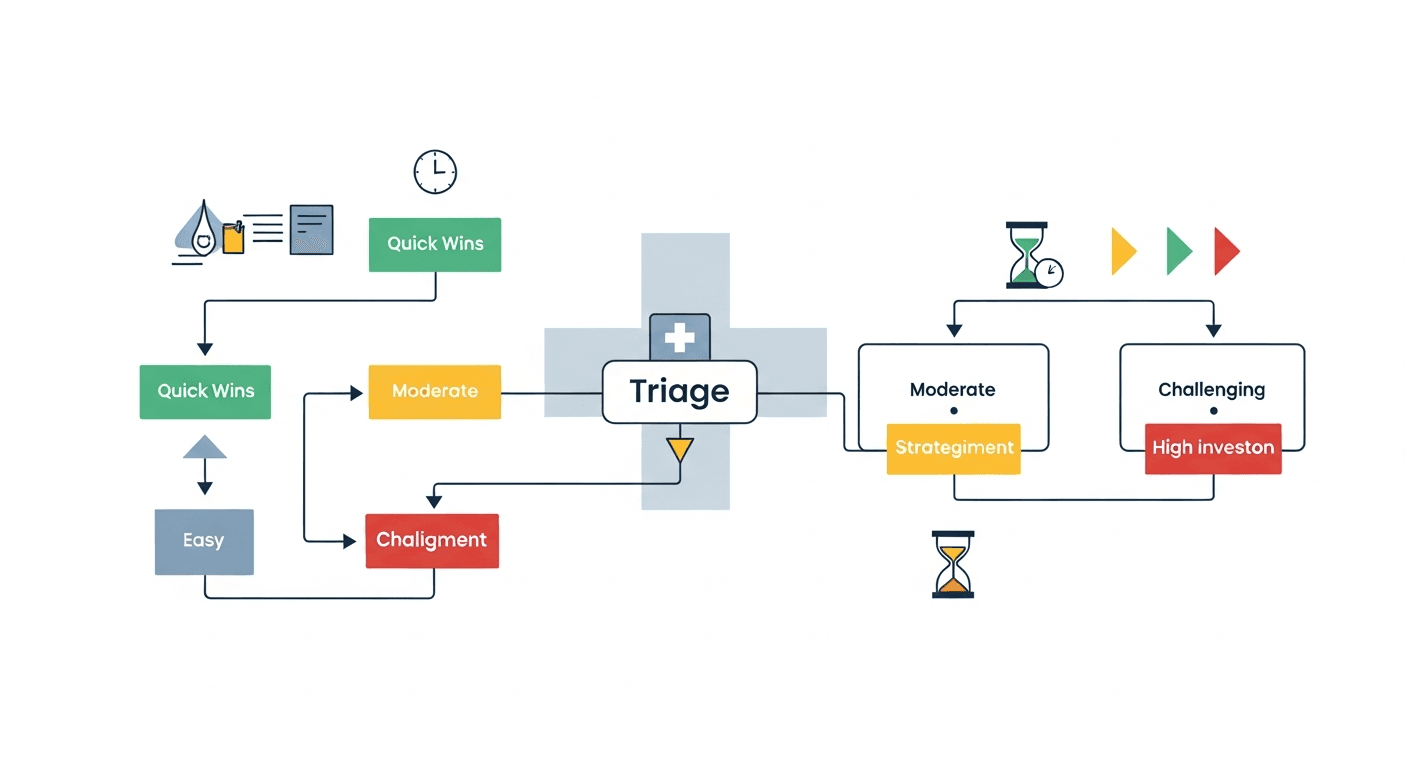
To successfully execute this strategy during your IGCSE or IA-Level exams, you need to mentally categorize every question into one of three tiers during your initial reading time.
Tier 1: The Quick Wins (Do Immediately)
These are questions with a high point value relative to the time they take, and more importantly, questions you feel 100% confident answering. They require minimal deep thinking and rely on solid recall or basic application.
Examples:
• Defining key terms in Business Studies.
• Solving a straightforward quadratic equation in Math, such as finding the roots of \( x^2 - 7x + 10 = 0 \).
• Multiple-choice questions where the answer is immediately obvious.
The Goal: Bank these points as fast as possible. This builds an immediate safety net and boosts your confidence.
Tier 2: The Thinkers (Do Second)
These questions are high-value, but they require structure, calculation, or deeper analysis. You know how to solve them, but they are going to take a chunk of time.
Examples:
• A 6-mark structured essay question in History.
• A multi-step stoichiometry calculation in Chemistry.
• Evaluating data from a graph in Geography.
The Goal: Dedicate the core of your exam time here. Since you already secured your Tier 1 points, you can afford to invest the necessary 10 to 15 minutes to carefully draft these answers without watching the clock in terror.
Tier 3: The Time Traps (Leave for Last)
These are the danger zones. They might be worth a lot of marks, but you have no immediate idea how to solve them, OR they are worth very few marks but require an exhaustive amount of time to figure out.
Examples:
• A complex 3D trigonometry proof where you cannot spot the initial triangle.
• A 2-mark question asking for a hyper-specific, obscure exception to a biology rule that you cannot quite remember.
The Goal: Skip them ruthlessly. Only return to Tier 3 questions once Tier 1 and Tier 2 are entirely complete. If you run out of time, losing these marks is far better than sacrificing the easy points you would have missed while stuck here.
Practicing Triage with AI-Powered Learning
Understanding the Triage Method in theory is easy, but executing it flawlessly under the pressure of a ticking clock takes practice. You need to instinctively know your own strengths and weaknesses to instantly categorize questions.
This is where modern educational technology shines. An AI-powered learning environment can completely revolutionize how you practice time management. Traditional past papers cannot tell you that you spend an average of 8 minutes on 3-mark data analysis questions but only 2 minutes on 4-mark calculation questions.
By utilizing a modern study platform, you can track your exact time-to-completion ratios across different question types. Through personalized learning algorithms, these platforms learn your individual pacing. They can highlight exactly which topics are your personal "Time Traps," allowing you to refine your triage strategy before you ever set foot in the exam hall.
If you are looking to elevate your revision strategy with smart, adaptive analytics, consider exploring the thinka Home Page to see how an AI-driven approach can sharpen your exam tactics. Alternatively, if you are ready to test your pacing right now, you can Start Practicing in AI-Powered Practice Platform to experience intelligent time-tracking firsthand.
Pro Tips for Flawless Execution
Ready to implement the Triage Method? Keep these tactical tips in mind during your next mock exam:
1. weaponize Your Reading Time
Many IGCSE and IA-Level exams grant you 5 to 10 minutes of reading time before you are allowed to pick up a pen. Do not just passively read the paper. Use this time to mentally categorize every question into Tier 1, 2, or 3. Map out your route through the paper before the timer officially starts.
2. The "Two-Minute Rule"
If you start a Tier 2 question but find yourself staring blankly at the page for more than two minutes without writing anything useful, downgrade it to Tier 3 immediately. Move on. Your brain will often continue to process the problem subconsciously while you work on other questions, and the answer might suddenly "click" when you return to it later.
3. Calculate Your "Mark Per Minute" Target
Before the exam, divide the total time in minutes by the total marks available. For example, if a paper is 90 minutes long and worth 60 marks, you have roughly 1.5 minutes per mark. This is your baseline. If a 4-mark question is taking you longer than 6 minutes, you are officially in a time deficit. Triage it and move on!
4. Leave Breadcrumbs
When you skip a question, don't just leave it blank. If you know the formula but don't have time to calculate, write the formula down. For instance, write \( F = ma \) or \( v = u + at \). Examiners look for partial credit. A formula or a brief bullet point might secure you 1 or 2 marks for a few seconds of work, which is the ultimate high-efficiency triage move.
The Changing Landscape of International Exams
Why is tactical prioritization more important now than ever? Recent updates across international exam boards indicate a shift away from simple rote memorization. Today’s IGCSE and IA-Level papers are deliberately designed to test problem-solving under pressure. They frequently include "distractor" questions—highly complex, low-yield problems placed early in the paper to test a student's time management and executive functioning.
Universities are actively looking for students who demonstrate this kind of strategic thinking. The ability to assess a situation, prioritize tasks, and execute a plan efficiently is a crucial skill not just for high school exams, but for university degrees and future careers.
Conclusion: Work Smarter, Score Higher
Exams are not just a test of what you know; they are a test of how well you can display what you know before time runs out. By adopting the Triage Method, you shift the power dynamic of the exam. You are no longer passively following the sequence dictated by the exam board; you are actively commanding your own point-scoring strategy.
Remember the core steps:
• Identify: Scan the paper and classify questions into Quick Wins, Thinkers, and Time Traps.
• Execute: Secure your baseline grade by banking Tier 1 points immediately.
• Invest: Spend your remaining time thoughtfully on Tier 2 questions.
• Avoid: Leave Tier 3 questions for the final moments, ensuring no easy points are left behind.
Mastering this technique takes deliberate practice, ideally supported by tools that provide real-time feedback on your pacing. By integrating strategic triage into your routine, you will walk into your IGCSE and IA-Level exams with the confidence of a tactician, ready to maximize every single minute.