Learning InsightsApr 5, 2026
The Synoptic Link: Developing Interconnected Thinking to Bridge Knowledge Gaps Across IGCSE and IA-Level Curriculums
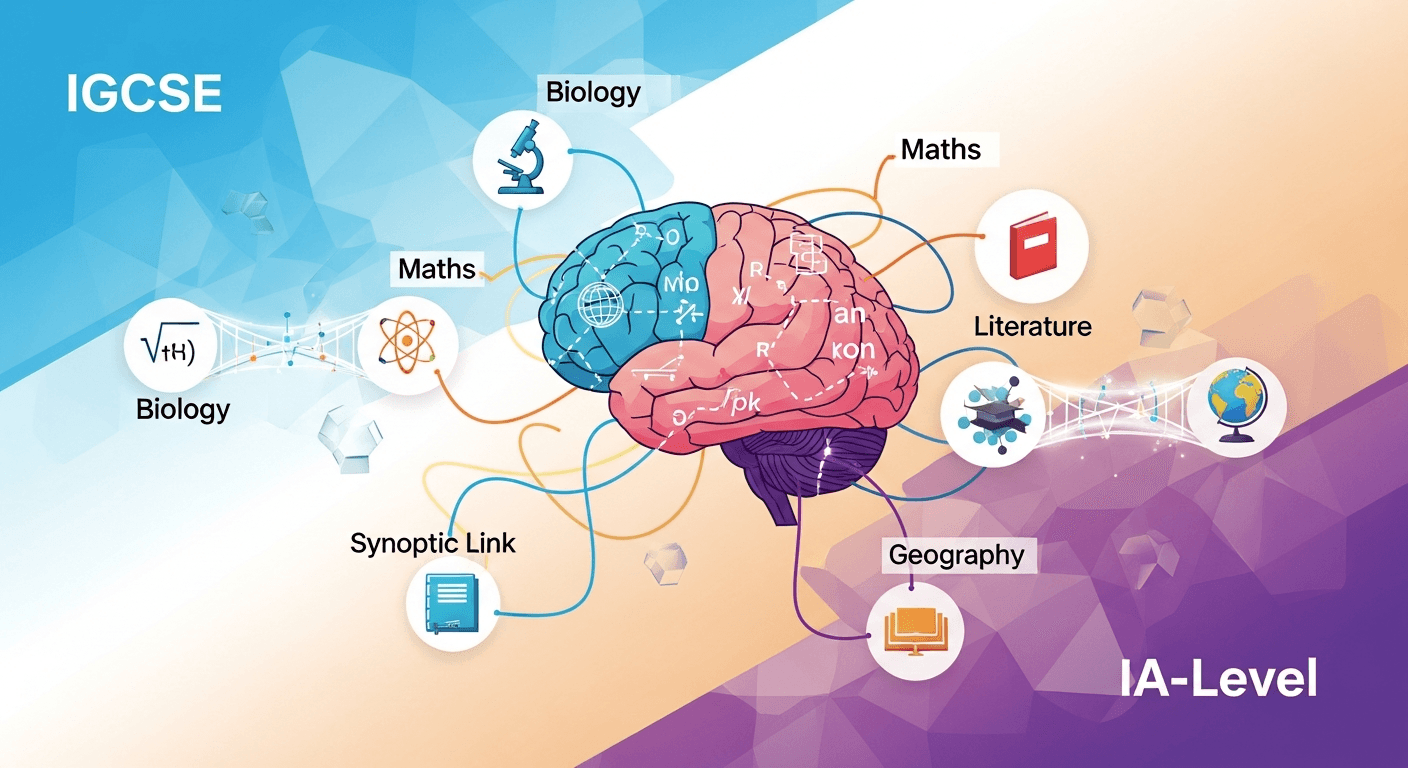
Breaking Out of the Subject Silo: Why Interconnected Thinking is Your Secret Weapon
Picture this: You are sitting in your final IA-Level Biology exam. You have spent weeks memorizing the intricate details of cellular respiration and photosynthesis. But when you turn to the final 15-mark essay question, it does not just ask about ATP. It asks you to evaluate how climate change impacts the thermodynamics of global ecosystems, requiring you to pull from ecology, cellular biology, and even a bit of chemistry. Panic sets in. You know the facts, but you have never thought about them together.
If this scenario sounds terrifyingly familiar, you are not alone. One of the biggest traps IGCSE and IA-Level students fall into is studying in "silos"—treating every chapter, module, and subject as an isolated island of information. However, recent trends across international exam boards like Cambridge and Pearson Edexcel show a dramatic shift. Examiners are prioritizing a crucial skill: The Synoptic Link.
Developing interconnected thinking is the key to bridging knowledge gaps and securing those top A and A* grades. In this guide, we will explore what synoptic thinking is, why it matters for your exam preparation, and how leveraging modern educational technology can transform the way you study.
What is Synoptic Thinking and Why is it Trending?
Synoptic thinking is the ability to draw connections between different areas of a subject, or even across entirely different subjects, to form a cohesive understanding of a larger concept. It is about seeing the forest, not just the individual trees.
Quick Fact: In many IA-Level subjects, "synoptic assessment" now makes up between 15% to 20% of the total grade. Exam boards explicitly design questions that cannot be answered using knowledge from just one chapter.
The modern world is complex and multidisciplinary. Solving real-world problems—like developing sustainable energy or managing global economies—requires overlapping knowledge. Exam boards have recognized this and adapted their curriculums to reward students who can synthesize information. If you want to excel, regurgitating facts is no longer enough; you must demonstrate how those facts interact.
The Danger of Compartmentalized Revision
Many students approach their revision linearly. You finish Topic 1, close the book, and open Topic 2. By the time you reach Topic 10, Topic 1 is a distant memory, and you have entirely missed how Topic 1’s foundational rules apply to Topic 10’s complex scenarios.
This compartmentalization leads to "knowledge gaps." You might understand the physics of kinematics and the mathematics of calculus, but fail to realize that velocity is simply the derivative of displacement, represented by the equation \( v = \frac{ds}{dt} \). When an exam paper presents a physics problem using mathematical graphs, compartmentalized thinkers freeze.
Step-by-Step Guidance: How to Build Your Synoptic Muscles
Transitioning from rote memorization to interconnected thinking takes practice. Here are actionable steps to start building your synoptic links today.
Step 1: The "Zoom Out" Mind Mapping Technique
After finishing a module, do not immediately jump to the next one. Take a blank piece of paper and write the central theme in the middle. Try to connect it to at least three other modules you have studied previously.
Example: If you are studying "Inflation" in IGCSE Economics, draw lines connecting it to "Exchange Rates," "Government Policies," and "Unemployment." Write a brief sentence on the connecting line explaining how they influence each other.
Step 2: Cross-Pollinate Your Practice Questions
Stop doing topical past papers exclusively. Once you are halfway through your syllabus, start tackling full, mixed-topic papers. Force your brain to switch gears rapidly from one concept to another. This is where an advanced study platform becomes invaluable, as it can generate customized quizzes that blend topics together.
Step 3: Ask the "What If" Questions
While reviewing your notes, play the "What If" game. If you are studying history, ask: "What if the economic conditions we learned in Chapter 2 were different during the political crisis of Chapter 5?" This trains your brain to evaluate causality across different curriculum areas.
Real-World Applications: The Synoptic Link in Action
To truly grasp interconnected thinking, let us look at how it manifests across popular IGCSE and IA-Level subjects:
The Science Nexus: Chemistry, Biology, and Physics
In the sciences, synoptic links are everywhere. You cannot fully master Biology without understanding Chemistry, and Chemistry often relies on Physics. Consider the ideal gas law: \( PV = nRT \). A physics student uses this to understand thermodynamics, a chemistry student uses it to calculate moles in a reaction, and a biology student applies the underlying principles to understand human respiration and gas exchange in the alveoli. Recognizing this shared principle makes studying all three subjects easier.
The Humanities Web: Geography, Economics, and Business
If you are tackling the humanities, the links are incredibly fluid. A question in Business Studies about expanding a factory overseas requires you to consider Economic concepts (like tariffs and exchange rates) and Geographical factors (like urbanization and resource scarcity). Students who weave these disciplines together in an essay craft much more compelling, high-scoring arguments.
Enhancing Interconnected Thinking with AI-Powered Learning
Traditionally, discovering these cross-topic connections required a highly experienced tutor or hours of analyzing mark schemes. Today, AI-powered learning is democratizing this level of elite exam preparation.
This is where modern educational tools shine. An intelligent system does not just grade your multiple-choice questions; it analyzes your underlying knowledge matrix. If you continually get A-Level Physics questions wrong when they involve complex algebraic rearrangements, a smart platform realizes your gap isn't in Physics—it is a synoptic gap linked to your Mathematics curriculum.
By utilizing a platform that embraces personalized learning, you receive dynamically generated practice that targets your specific blind spots. An AI-powered practice platform like Thinka adapts to your unique learning curve. Instead of just feeding you repetitive questions from a single chapter, it strategically introduces blended questions that force you to connect the dots, bridging the gaps in your interconnected thinking.
If you want to experience how adaptive technology can rewire your study habits, you can Start Practicing in AI-Powered Practice Platform and see the difference that dynamic, cross-topical questioning makes.
Pro Tips for Maintaining the Synoptic Mindset
1. Create a "Synoptic Cheat Sheet": Dedicate a specific notebook exclusively to recording links between topics. Every time you realize "Oh, Topic A affects Topic D!", write it down. Review this notebook before your exams.
2. Teach the Connections: Find a study partner and try to explain a complex topic using analogies from another subject. Teaching is the highest form of mastery.
3. Leverage the Mark Scheme Syllabus: Read the official syllabus specifications from your exam board (like Cambridge or Edexcel). They often contain a section explicitly detailing "Synoptic Links" or "Cross-Curricular Themes." Use this as your roadmap.
Conclusion: Becoming a Holistic Learner
Succeeding in your IGCSE and IA-Level exams is no longer about who can memorize the textbook the fastest. It is about who can manipulate that knowledge, draw insightful connections, and apply interconnected thinking to solve complex, multi-layered problems.
By stepping out of the "silo" mentality and actively seeking the synoptic links within your curriculum, you not only prepare yourself for top marks but also for the critical thinking required in university and beyond. Embrace mind mapping, tackle blended questions, and don't be afraid to utilize modern technology to guide your journey.
Ready to break down the walls between your subjects and study smarter? Explore how adaptive technology can elevate your academic journey by visiting the thinka Home Page. Start connecting the dots today, and watch your grades—and your understanding of the world—transform.