Latest News6 min read
The Interface Intuition: Mastering the Digital-First Shift for 2025 GCSE and A-Level Exams
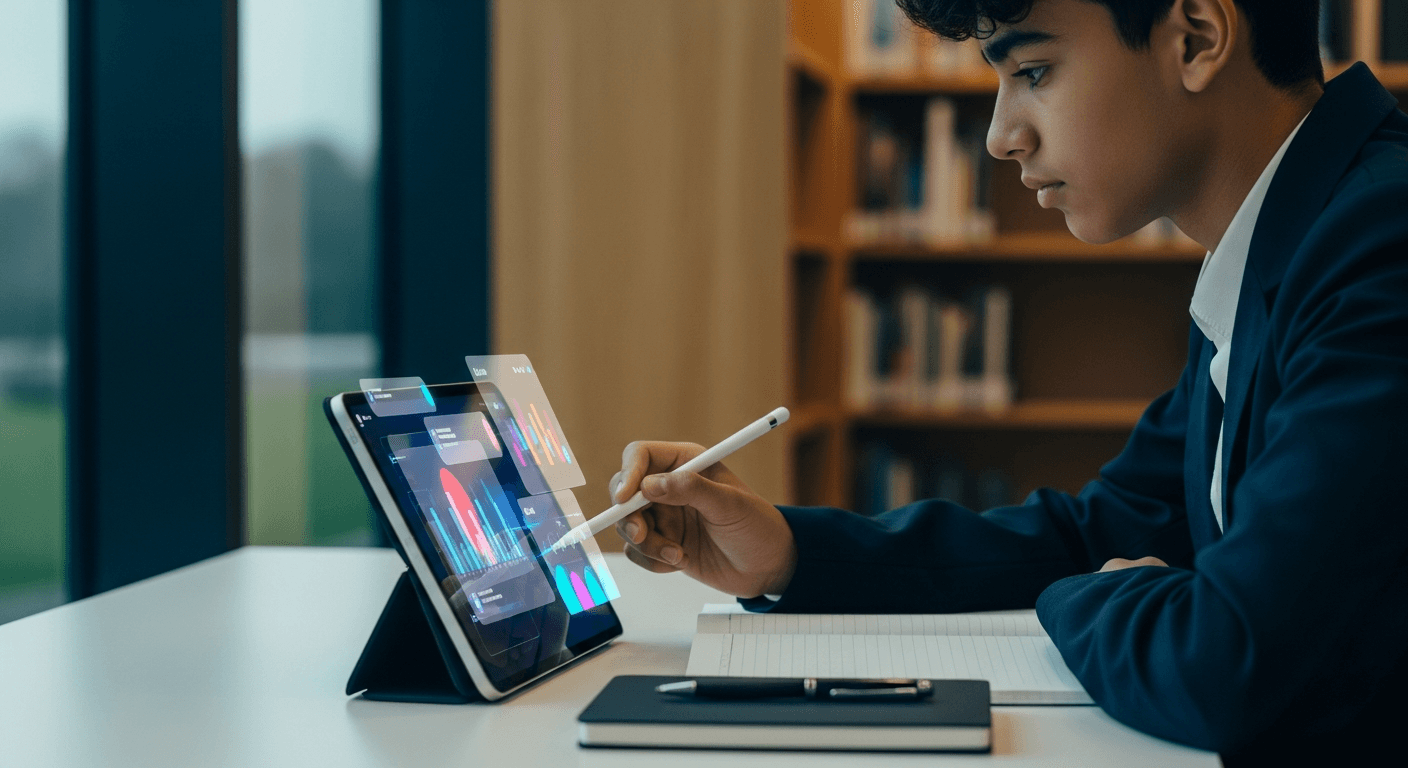
The Digital Transition: Why 2025 Marks a Turning Point for UK Exams
For decades, the sound of the summer exam season in the UK has been the scratching of ballpoint pens on paper scripts. However, as we approach the 2025 and 2026 exam cycles, a silent revolution is taking place in exam halls across the country. Major boards including AQA and Pearson Edexcel are accelerating their shift toward Computer-Based Testing (CBT), with digital pilots for subjects like GCSE English and Computer Science moving into formal assessment phases. For IGCSE and A-Level students, this isn’t just a change of medium; it is a fundamental shift in how subject knowledge is retrieved, organised, and expressed.
The transition from 'script to screen' introduces a unique set of cognitive challenges. Research into digital assessment suggests that students often perform differently when typing versus handwriting, not necessarily because of their knowledge, but because of the 'navigation load'—the mental energy spent moving through digital interfaces. To secure a Grade 9 or an A* in this new landscape, students must move beyond traditional revision and develop Interface Intuition.
The ‘Flick’ Factor: Managing Navigation Load
One of the most overlooked hurdles in digital exams is the loss of the physical exam booklet. On paper, a student can quickly flick back and forth between a 10-mark source and their own essay plan. In a digital environment, this often requires toggling between tabs or scrolling through split-screen windows. This creates a 'split-attention effect,' where the working memory is taxed by the interface rather than the question.
To combat this, 2025 candidates must practice 'active window management.' This involves learning to synthesise information from a digital source and holding it in the mind, or using the digital 'notepad' features provided by the platform effectively. Using AI-powered practice platforms can help students familiarise themselves with these layouts, ensuring that the first time they encounter a split-screen data source isn't in the high-stakes environment of the final exam.
Digital Annotation: From Marginalia to Highlighting Tools
For subjects like IGCSE English Literature or A-Level History, the margins of the paper are usually filled with shorthand, arrows, and circles connecting themes. In a computer-based exam, you lose the ability to draw freehand. Digital platforms offer highlighting and 'sticky note' tools, but these require a different motor-skill set.
Students should focus on Digital Scaffolding. Instead of the chaotic freedom of a pen, learn to use the platform's specific tools to categorise evidence. For example, use one colour for linguistic devices and another for structural points. If you are preparing for a 2025 pilot, you should spend time in your study materials practicing how to 'read' on a screen without losing your place—a common issue known as 'screen-skimming' where the eye wanders more than it does on a physical page.
The Typing Stamina Challenge
While most students are 'digital natives' when it comes to social media, the 'academic typing' required for a 2,000-word A-Level History essay or a 1.5-hour GCSE English paper is different. Handwriting speed is often a bottleneck for students, but typing speed can also be a barrier if not developed. More importantly, the way we think when typing is often more fragmented. We tend to edit as we go when using a keyboard, which can disrupt the 'flow' of an evaluative argument.
To prepare for the 2025-2026 cycles, students should:
1. Build Typing Fluency
Aim for a minimum of 40-50 words per minute. This ensures your fingers can keep up with your cognitive processing during a timed essay. Use AI-supported tools to track your progress and simulate the pressure of the ticking digital clock found in CBT interfaces.
2. Resisting the 'Delete' Trap
In a digital exam, it is tempting to constantly backspace and rephrase. This can waste precious minutes. Practice 'sprint-writing' where you get your initial thoughts down in the digital notepad before moving them into the main response area.
STEM Subjects and the Symbol Barrier
For A-Level Maths and Sciences, the digital shift is even more complex. Inputting complex equations like \( \int_{a}^{b} f(x) dx \) or chemical structures requires specific interface knowledge. While many boards are still refining how these are handled—often using a mix of digital input and scanned 'working out' paper—students must be prepared for hybrid assessment models.
Understanding how to use formula editors and symbolic keyboards is now a necessary part of the specification. Teachers can use advanced tools to generate practice papers that mimic these digital inputs, ensuring students aren't fumbling with a 'square root' symbol when they should be focusing on the mechanics of the problem.
The Psychological Shift: Screen Fatigue and Focus
Exam halls are usually low-stimulus environments. However, staring at a high-contrast white screen for three hours can lead to visual fatigue, which in turn leads to 'silly mistakes' in the final thirty minutes of a paper. This is particularly dangerous for A-Level candidates facing multiple long-form papers in a single week.
Students should adopt the '20-20-20 rule' during their mock digital sessions: every 20 minutes, look at something 20 feet away for 20 seconds. Additionally, many digital platforms allow you to change the background contrast or text size. Identifying your preferred visual settings during revision is just as important as knowing your subject content.
How AI Prepares You for the CBT Era
The rise of digital exams coincides perfectly with the rise of AI-driven study. Platforms like Thinka are designed to live in the digital space where your exams will now take place. By moving your revision away from passive paper notes and into an interactive digital environment, you are subconsciously building the digital endurance required for 2025.
AI can simulate the 'unseen' nature of digital questions, providing instant feedback on how your typed responses align with the mark scheme. This 'live' feedback loop is far more representative of the digital exam experience than the delayed feedback of a traditional paper mock. It allows you to audit your digital performance: Are you losing marks because of typos? Are you failing to navigate the sources quickly enough? Are your typed evaluations too brief?
Final Checklist for 2025/26 Digital Candidates
If you are part of the first wave of students sitting computer-based GCSEs or A-Levels, your preparation must be tech-centric:
1. Familiarise with the Platform: Check which software your exam board (AQA, Pearson, OCR) is using and find their 'sandbox' or demo versions early.2. Practice Under Digital Conditions: Don't just revise on paper and then 'show up' for the digital exam. Ensure at least 50% of your timed practice is done on a laptop or desktop.
3. Master the Shortcut: Learn the specific keyboard shortcuts for the exam software (e.g., how to highlight, how to flag a question for review).
4. Build Cognitive Stamina: Gradually increase the time you spend working on deep, complex tasks on a screen to avoid the 'one-hour slump' during the actual assessment.
The shift to digital is not just a change in how we write; it is an opportunity to streamline how we demonstrate our intelligence. By embracing the interface early and using the latest AI practice tools, you can ensure that the technology becomes a bridge to your A*, not a barrier.
Related posts
- May 30, 2026
The Blended Evaluation Era: Why 2025 A-Levels and IGCSEs Now Value Your Learning Journey
2025 exam boards are shifting toward 'Blended Evaluation'. Learn how to document your learning process to boost your IGCSE and A-Level results using AI-powered study habits.
- May 20, 2026
The Cognitive Lockdown: Turning School Smartphone Bans into an A* Competitive Edge
Master the transition to phone-free schools. Learn how IGCSE and A-Level students can rebuild focus stamina and use AI to dominate the 2025 exam season.
- May 10, 2026
The Synthesis Advantage: Mastering Unseen Contexts in 2025 IGCSE and A-Level Exams
Learn why 2025 IGCSE and A-Level exams are shifting toward complex, unseen data and how Contextual Synthesis can help you secure an A* in the new assessment landscape.
- Apr 30, 2026
From Pen to Pixel: Mastering the 2025 Shift to Digital IGCSE and A-Level Exams
As major exam boards move on-screen for 2025, learn how to master digital exam literacy, adaptive testing, and on-screen annotation to maintain your A* trajectory.