Primary School Education6 min read
The Inference Engineer: Bridging the ‘Comprehension Chasm’ for the Year 7 Transition
The Hidden Hurdle of the Secondary Transition
For many Year 6 parents, the focus in the final term is often on the practicalities of the ‘big school’ jump: the new blazer, the bus route, and the logistics of a rotating timetable. However, educational data suggests a more significant challenge lies in what researchers call the ‘Comprehension Chasm’. This is the sudden shift from Key Stage 2 (KS2), where children are often ‘learning to read’, to Key Stage 3 (KS3), where they are expected to ‘read to learn’ increasingly abstract and complex texts.
In the UK, the ‘Science of Reading’ movement has highlighted that while many children are excellent at ‘decoding’ (the mechanical act of reading words), they often lack the deep vocabulary and inference skills required to navigate the secondary curriculum. This isn't just an English Literature problem; it affects their ability to interpret a Geography case study, a Science experiment protocol, or a History source. To bridge this gap, parents can adopt the role of an ‘Inference Engineer’, using modern tools to help their children build a robust internal dictionary.
Moving Beyond Decoding: The Tier 2 Vocabulary Advantage
To support a child’s literacy, we must understand that not all words are created equal. Educators categorise vocabulary into three tiers:
- Tier 1: Basic, everyday words (e.g., house, walk, happy).
- Tier 2: High-frequency academic words that appear across subjects (e.g., evaluate, context, accumulate, precede).
- Tier 3: Low-frequency, domain-specific words (e.g., photosynthesis, isosceles, feudalism).
The ‘Comprehension Chasm’ is usually caused by a lack of Tier 2 mastery. These are the words that allow a student to understand the relationship between ideas. When a Year 7 History teacher asks a student to ‘evaluate the impact’ of a treaty, the student might know what a ‘treaty’ is (Tier 3), but if they cannot grasp the nuance of ‘evaluate’ or ‘impact’ (Tier 2), the task becomes impossible.
Using an AI-powered practice platform can help parents identify these Tier 2 gaps. Instead of simply asking what a word means, Thinka allows students to see how words function in different contexts, preventing the ‘shallow learning’ that comes from memorising a dictionary definition without understanding its application.
Combating ‘Digital Skimming’ with Deep Reading Stamina
A growing concern for UK parents and teachers is the decline in deep reading stamina. In an age of social media and rapid-fire content, many children have become proficient ‘skimmers’. They scan for keywords to answer a specific question but fail to absorb the narrative arc or the author’s underlying tone. This is particularly evident during KS2 SATs, where the reading paper increasingly requires children to infer meaning from subtle clues rather than finding literal answers.
To combat this, parents should encourage ‘Active Inquiry’. This means moving away from passive reading and towards a model where the child interrogates the text. When reading together at home, try asking questions that don't have a direct answer on the page:
- "Why did the author choose to describe the room as 'stagnant' rather than just 'smelly'?"
- "If the protagonist had made a different choice in the first chapter, how would this paragraph change?"
- "What does this word tell us about the character's social standing without saying it directly?"
The Semantic Map: Visualising Word Relationships
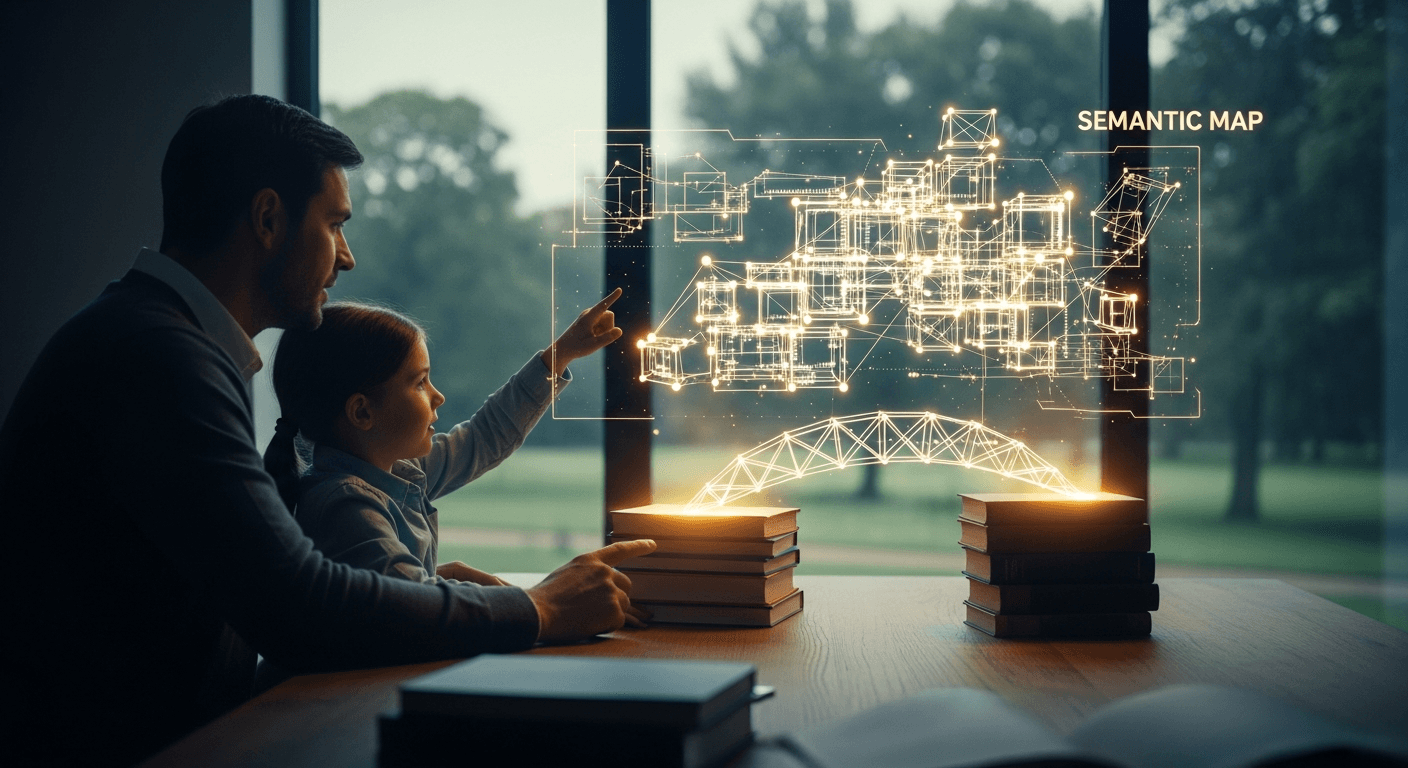
One of the most effective ways to build deep comprehension is through ‘Semantic Mapping’. This is the process of building a visual web around a word to understand its synonyms, antonyms, and ‘emotional temperature’. For example, the word ‘angry’ has a different weight than ‘livid’ or ‘perturbed’.
In a classroom setting, teachers often use these maps to help children improve their writing, but they are equally vital for reading comprehension. AI tools like Thinka can act as a digital scaffolding for this process. By using personalized study support, children can explore ‘word gradients’. If they encounter the word ‘reluctant’ in a book, they can use AI to find words that are slightly more or slightly less intense, helping them understand the exact shade of meaning the author intended.
Preparing for the Year 7 English Curriculum
The jump to Year 7 English often involves a move toward pre-20th-century literature and complex poetry. The sentence structures are longer, the vocabulary is more archaic, and the themes are more sophisticated. For a child who has only ever read contemporary middle-grade fiction, this can feel like learning a foreign language.
Parents can help by ‘pre-loading’ these linguistic structures. This doesn't mean forcing a 10-year-old to read Bleak House cover-to-cover. Instead, it involves exposure to shorter, high-quality excerpts. Free study materials and resources often provide accessible ways to introduce these more demanding texts. The goal is to build ‘schema’—a background knowledge of how complex language works—so that when they encounter it in the classroom, their cognitive load is reduced.
How AI Transforms the ‘Homework Battle’ into a Logic Puzzle
Many parents dread the Year 6 and Year 7 homework transition because it often feels like a test of the parent's own knowledge. However, the role of the parent is shifting from ‘answer-giver’ to ‘strategic consultant’. Instead of telling a child what an inference question is looking for, you can use AI to model the logic of the mark scheme.
Thinka’s platform allows students to receive immediate, formative feedback. If a student makes an incorrect inference, the AI doesn't just provide the right answer; it acts as a ‘logic mirror’, showing the student where their reasoning went off track. This is crucial for 11-plus and KS2 SATs preparation, where the ability to justify an answer with evidence from the text is the difference between a ‘working towards’ and a ‘greater depth’ mark.
Practical Tips for Parents: The 10-Minute Inference Workout
Building these skills doesn't require hours of extra tutoring. Consistency is more effective than intensity. Here are three quick ‘inference workouts’ you can do at home:
- The Synonym Swap: Take a sentence from your child’s school book and ask them to replace one verb with a synonym that changes the mood of the sentence. (e.g., Change "The cat sat on the mat" to "The cat loomed on the mat".)
- The ‘Unseen’ Prediction: Read the first page of a news article or a short story and stop. Ask your child to predict three things that will happen next based only on the adjectives used in the opening paragraph.
- The Word Graveyard: Identify overused words like ‘nice’, ‘sad’, or ‘big’ and challenge your child to find three Tier 2 alternatives using practice tools that provide contextual examples.
Conclusion: Engineering Success
The transition to secondary school is a milestone that marks the beginning of a child's journey toward GCSEs and beyond. By focusing on the ‘architecture’ of vocabulary and the ‘engineering’ of inference now, you are giving your child the tools to not only survive the Year 7 curriculum but to thrive within it. Modern education is no longer about how much information a child can store, but how effectively they can process and interrogate the information they find. With the support of AI-powered platforms like Thinka, the ‘Comprehension Chasm’ becomes a bridge to academic independence.
Related posts
- Jul 1, 2026
The Scaffolding Pivot: Moving from Homework Manager to Strategic Consultant for the KS3 Transition
Stop the homework battles. Learn how to build your child's executive function and shift from managing tasks to coaching independent study for a smooth Year 7 transition.
- Jun 21, 2026
The Thinking Audit: Why 'Debugging' Homework is the Secret to 11-Plus and KS2 Success
Stop chasing the correct answer. Learn how UK parents can use AI as a 'logic mirror' to help primary children identify cognitive blind spots and boost academic progress.
- Jun 11, 2026
The Visual Logic Shift: Mastering Heuristic Problem-Solving for the KS2 Reasoning Paper
Move beyond rote maths. Discover how visual bar-modelling and AI-powered 'hint paths' build the mathematical reasoning skills your child needs for KS2 SATs and 11+ success.
- Jun 1, 2026
The Verification Vault: Transforming AI from a Homework Shortcut into a Research Partner for Primary Students
Learn how to guide your KS2 child to use AI as a critical inquiry engine. Build essential fact-checking habits and research rigour for the leap to secondary school.