Latest News6 min read
The Algorithm Architect: Mastering the ‘Front-Loading’ Shift in Adaptive Digital Exams
Beyond the Linear Paper: The Digital Frontier for Hong Kong Students
For decades, the Hong Kong education system has been synonymous with the linear paper-and-pen examination. From the primary school TSA to the high-stakes HKDSE, the strategy has remained consistent: scan the whole paper, tackle the easy marks first, and leave the hardest problems for the final thirty minutes. However, the global landscape is shifting. With the College Board’s transition to the Digital SAT and the recent announcements from Pearson Edexcel and Cambridge International regarding adaptive IGCSE pilots for 2025 and 2026, the ‘linear’ era is being replaced by the ‘adaptive’ era. For Hong Kong students, this is not just a change of medium from paper to screen; it is a fundamental shift in the logic of assessment that requires a new kind of strategic maturity.
Decoding the ‘Branching Logic’ of Modern Assessments
Unlike traditional DSE papers where every student answers the same questions in the same order, adaptive digital exams use Multi-Stage Testing (MST) or Computerized Adaptive Testing (CAT) algorithms. In these models, the exam is a living organism that reacts to your performance in real-time. If you are sitting the Digital SAT, for example, your performance in the first module of Reading and Writing dictates the difficulty level of the second module. The assessment follows a branching logic: a high accuracy rate in the initial stage ‘branches’ you into a more difficult second stage, which is the only way to access the highest score brackets. Conversely, poor performance in the first half caps your potential score, regardless of how perfectly you answer the subsequent easier questions.
The Danger of the ‘DSE Mindset’ in Digital Environments
In a typical HKDSE Mathematics paper, a student might struggle with a complex 3D trigonometry question in Section B and decide to skip it, hoping to gain momentum elsewhere and return to it later. In an adaptive digital environment, this ‘save it for later’ approach can be catastrophic. Because the algorithm uses your early responses to calibrate the rest of your exam, an early error carries significantly more weight than an error made at the end of a linear paper. This necessitates a shift to a ‘Precision-First’ mindset. You can no longer afford to ‘warm up’ during the first few questions; you must be at peak cognitive performance from the moment you click ‘Start’.
The Strategy of Front-Loading: Securing the Difficulty Ceiling
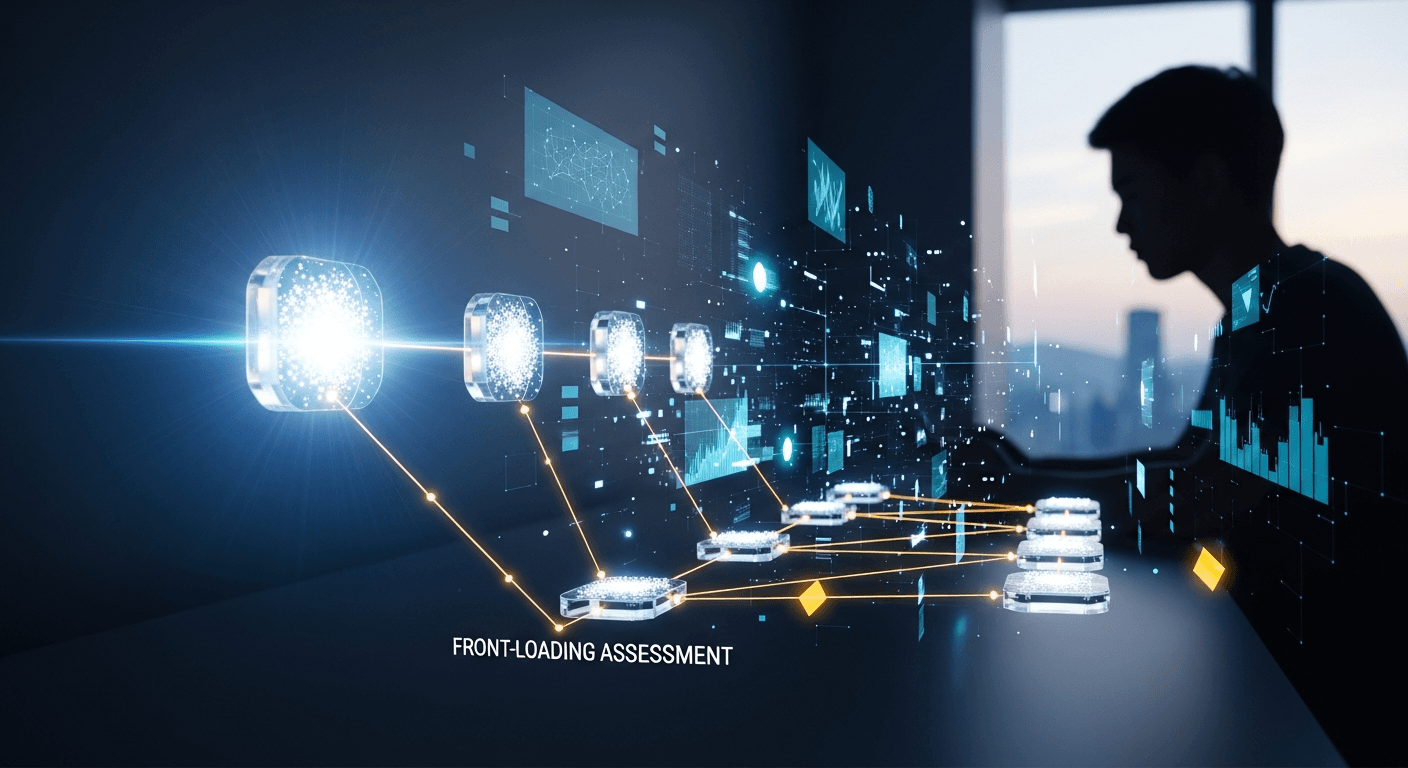
To succeed in 2025 and beyond, Hong Kong students must master the art of Front-Loading. This means dedicating a disproportionate amount of mental energy and time-management focus to the first module or the first ‘block’ of questions. In an adaptive system, these early questions act as a gatekeeper. By achieving near-perfect accuracy in the initial phase, you prove to the algorithm that you are a high-ability candidate, thereby unlocking the ‘Hard’ module where the top-tier scores (like the 750-800 range in SAT Math) live. When improving your performance with AI-driven insights, it is crucial to focus on this calibration phase. If you fail to ‘front-load’ your precision, you may find yourself trapped in an ‘Easy’ module where, even if you get 100% of the questions correct, your final score is mathematically capped at a mediocre level.
Managing the ‘Lock-and-Move-On’ Psychological Pressure
One of the most significant pain points identified by students in recent digital pilots is the ‘lock-and-move-on’ nature of adaptive testing. Unlike paper exams where you can flip back and forth to check your work, many digital interfaces discourage or strictly limit revisiting questions across modules. This creates a unique form of psychological fatigue. In Hong Kong, where exam anxiety is already high, the inability to double-check every answer can lead to ‘perfectionist paralysis.’
Building ‘Single-Pass’ Accuracy
To counter this, students need to move away from the habit of ‘rough work and revision’ and move toward ‘single-pass accuracy.’ This involves building the confidence to solve a problem, verify the logic once, and move on without looking back. For instance, when solving a quadratic equation such as \( x^2 - 5x + 6 = 0 \), the student must be trained to verify the roots \( x=2, x=3 \) mentally and immediately, rather than flagging it for a 15-minute review at the end of the session. Using curated exam resources that focus on mental verification techniques can help build this specific form of digital stamina.
Simulating the Algorithm: The Role of AI in Exam Preparation
Traditional past papers are static; they cannot replicate the experience of an exam that changes based on your answers. This is where AI-powered practice platforms become essential. To truly prepare for the 2025/2026 digital shift, students should not just be doing ‘drills,’ but ‘adaptive drills.’ Platforms like Thinka allow students to start simulating adaptive drills that mirror the branching logic of the new IGCSE and SAT formats. By using AI to dynamically increase question difficulty as you improve, you are essentially ‘sparring’ with the same logic that will govern your final grade.
The ‘Difficulty Spike’ Drill
A specific technique for Hong Kong students to try is the ‘Difficulty Spike’ drill. In this exercise, the first five questions of a set are intentionally designed to be high-pressure, high-complexity problems that require absolute precision. The goal is to train the brain to enter ‘Deep Work’ mode instantly. This counters the tendency to treat the beginning of an exam as a low-stakes introductory period.
Transitioning from DSE to International Adaptive Standards
For students in Band 1 schools or those navigating the transition between the local DSE curriculum and international pathways, the adaptive shift is an opportunity to gain a competitive edge. While the DSE remains a formidable test of knowledge volume, the new digital standards are a test of strategic agility. In a city where every mark counts toward university placement at HKU, CUHK, or global institutions, understanding the ‘math’ behind the algorithm is just as important as understanding the math in the syllabus.
Actionable Steps for the 2025/2026 Cycle:
1. Prioritize Early-Stage Accuracy: Treat the first 25% of any digital assessment as the most high-stakes portion of the paper.
2. Audit Your Revision Habits: Stop practicing solely with paper booklets. Ensure at least 50% of your study time is spent on a screen to build ‘Interface Agility.’
3. Master the ‘Mental Check’: Develop a 5-second verification protocol for every answer to avoid the need to return to questions later.
4. Use Adaptive Tools: Don't just settle for static PDFs. Engage with platforms that simulate the branching logic of modern exams.
Conclusion: Becoming the Architect of Your Own Result
The transition to adaptive digital assessments is not a hurdle; it is a refinement of how we measure intelligence and performance. By moving away from the linear, one-size-fits-all model, exam boards are asking students to be more than just ‘answer-recorders’—they are asking them to be strategists. For the Hong Kong student, mastering the ‘Algorithm-Responsive’ mindset means understanding that every click, every second, and every early-stage decision builds the ceiling of their potential. By leveraging AI to simulate these dynamic environments and focusing on front-loaded precision, you can ensure that when the algorithm evaluates you, it sees a student who is not just prepared, but truly optimized for the digital age.
Related posts
- Oct 19, 2026
CIE IGCSE Exam Dates: Hong Kong Timetable Guide, Zone 5 Key Times, and Paper Strategy
Plan CIE IGCSE exam dates in Hong Kong. Master Zone 5 Key Times, manage Theory vs ATP splits, handle HKEAA clashes, and build a backwards revision schedule.
- Oct 9, 2026
CIE IGCSE Results Day Time: Hong Kong Release Schedule, Portal Access, and IB or A-Level Progression
Looking for the exact CIE IGCSE results day time in Hong Kong? Check release hours, candidate portal login steps, grade thresholds, and remark protocols.
- Sep 29, 2026
AQA A-Level Grade Boundaries: Raw Mark Matrix, Component Weightings, and Non-JUPAS Benchmarks
Decode AQA A-Level grade boundaries across STEM and humanities. Master raw mark thresholds, paper weightings, and A* benchmarks for UCAS and Non-JUPAS.
- Sep 19, 2026
CIE A-Level Exam Dates: The Hong Kong Master Timetable, Zone 5 Key Times, and Clash Protocols
Navigate CIE A-Level exam dates for Hong Kong. Master Administrative Zone 5 Key Times, HKEAA timetable clash protocols, contingency days, and smart revision milestones.