AI Applications5 min read
The Syllabus Architect: Building Your AI-Powered ‘Second Brain’ for HKDSE Mastery
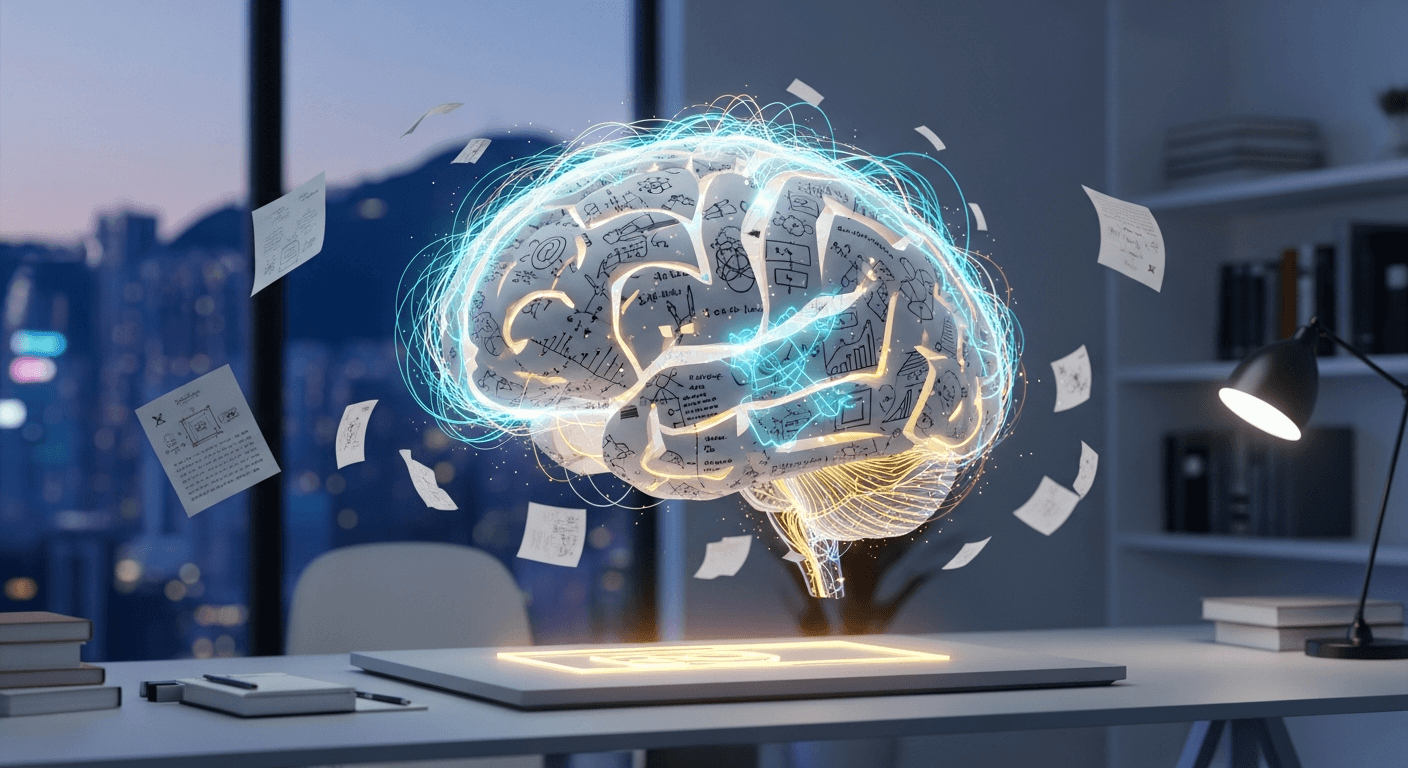
The Information Avalanche: Why Your Current Revision Strategy is Stalling
For any S6 student in Hong Kong, the months leading up to the HKDSE are less of an academic journey and more of a logistical battle. You are currently likely buried under a mountain of paper: color-coded tutorial notes from Mong Kok or Causeway Bay, thick stacks of HKEAA Past Papers dating back to 2012, and textbooks that seem to get heavier by the day. The core challenge isn’t just ‘learning’ the material; it’s the cognitive load of retrieving the right information under the high-pressure clock of the examination hall.
Traditional revision—passive reading, highlighting, and even rote memorization—often fails because it treats your brain like a warehouse. You keep shoving boxes in, but when Paper 1 starts, you can't find the specific ‘Marker’s Report’ insight you need to secure that final mark. This is where the concept of a 'Second Brain' comes in. By leveraging Retrieval-Augmented Learning (RAL), you can move away from being a passive consumer of notes to becoming a ‘Syllabus Architect,’ using AI to build a personalized, searchable knowledge base that knows your strengths and weaknesses as well as you do.
What is Retrieval-Augmented Learning?
Most students use AI as a simple chatbot—asking it to ‘explain photosynthesis’ or ‘summarize the Industrial Revolution.’ While helpful, this relies on the AI’s general knowledge, which might not align with the specific HKDSE marking schemes or the particular way your teacher explained a concept in class.
Retrieval-Augmented Generation (RAG) is different. Instead of the AI guessing from the whole internet, it is ‘grounded’ in specific documents you provide. When you build a Second Brain using RAG tools, you are essentially telling the AI: “Only answer my questions using my class notes, these specific HKEAA sample essays, and my own past paper mistakes.” This transforms the AI from a generic tutor into a hyper-localized HKDSE specialist.
Step 1: Constructing Your ‘Synthetic Syllabus’
The first step to building your AI Second Brain is curating your data. For a DSE candidate, your knowledge base should be more than just a PDF of a textbook. To reach Level 5**, your ‘Synthetic Syllabus’ needs three layers:
1. The Personal Layer: Upload your digital notes, photos of your hand-written diagrams, and even voice memos from lessons. This ensures the AI understands the ‘logic’ you already have in your head.
2. The Institutional Layer: This is where you upload the HKEAA Assessment Frameworks and the often-ignored ‘Marker’s Reports.’ These reports are gold mines—they tell you exactly where students ‘tripped up’ in previous years.
3. The Error Layer: Digitally archive every ‘red ink’ correction from your mock exams. By feeding your mistakes into your Second Brain, the AI can start to spot patterns in your logic that you might have missed.
Step 2: Moving from Passive Review to ‘Active Interrogation’
Once your Second Brain is built, the goal isn’t to let the AI do the work for you. Instead, you use it to interrogate your own learning. Instead of reading your notes on Economics, you can ask your AI: “Based on my mock exam results and the 2023 Marker’s Report, what are the three most likely reasons I will lose marks on a question about Fiscal Policy?”
This approach forces you into a state of ‘desirable difficulty.’ You aren't just looking at the answer; you are engaging in a meta-analysis of your own performance. You can even use exam-ready practice tools to simulate these high-stakes scenarios, ensuring that your AI-assisted insights translate into actual marks under exam conditions.
Subject-Specific Applications for the HKDSE
English Language: The Register Refiner
In the DSE English exam, particularly Paper 2 (Writing) and Paper 3 (Listening and Integrated Skills), the ‘Tone and Style’ (the register) is what separates a Level 4 from a Level 5. Use your Second Brain to upload successful sample essays provided by the HKEAA. Then, ask the AI to audit your own practice drafts: “Is my tone in this formal letter to the editor consistent with the 5** samples in my database?”
Mathematics and Sciences: The Logical Auditor
For subjects like Physics or M1/M2, precision is everything. You can use your AI knowledge base to cross-reference your steps against the specific marking logic of the HKEAA. For instance, if you are struggling with a complex integration problem:
\( \int x e^x dx \)
You can ask the AI to show you how the ‘Step-by-Step’ marking criteria would award marks for the ‘integration by parts’ method versus a common error you made in your last mock.
The Thinka Advantage: Precision Practice
Building a Second Brain is about organizing knowledge, but the HKDSE is ultimately about performance. While your personal AI helps you organize, Thinka helps you execute. By using personalized study support, you can take the insights from your Second Brain and apply them to thousands of curated practice questions.
For example, if your Second Brain identifies that you consistently fail to use the correct ‘Command Verbs’ in Citizenship and Social Development, you can use Thinka to drill specifically on questions that require you to ‘evaluate’ or ‘justify,’ ensuring your exam technique is as sharp as your knowledge base. Educators can even use Thinka’s platform to generate high-quality practice papers that mimic the structure and rigor of the actual DSE, providing students with a continuous loop of feedback.
Overcoming the ‘Fluency Trap’
A major risk for DSE students is the ‘Fluency Trap’—the feeling that because you recognize a page of notes, you actually know the material. A Second Brain protects you from this. Because you are constantly ‘querying’ the AI and asking it to find gaps in your specific notes, you are forced to confront what you don't know. It turns a 500-page curriculum into a targeted checklist of your personal weaknesses.
Conclusion: Your Digital Advantage in 2025 and Beyond
The HKDSE is a competition of efficiency. The students who succeed aren't necessarily those who study the longest, but those who manage their cognitive load the most effectively. By building an AI-powered Second Brain, you stop wasting time searching for that one lost handout and start focusing on the high-level analysis that earns top grades.
Start today by gathering your digital assets. Use DSE-specific resources to supplement your notes, and then integrate them into an AI workflow that turns your revision from a chore into a precision engineering project. In the era of AI, the best student isn't the one who knows everything—it's the one who knows how to architect their own intelligence.
Related posts
- Jun 13, 2026
The Evaluation Auditor: Bridging the ‘5** Gap’ with AI-Powered Nuance
Stop losing marks for being 'too descriptive'. Learn how to use AI to identify blind spots and build the evaluative depth required for Level 5** in the HKDSE.
- Jun 3, 2026
The Comparative Bridge: Using AI to Master Level 5** Synthesis in HKDSE Assessments
Stop writing parallel descriptions. Learn how to use AI to build integrated comparative frameworks for HKDSE English and Humanities to secure a Level 5**.
- May 24, 2026
The Syllabus Simulator: Level Up Your HKDSE Evaluation Skills via AI Role-Play
Ditch rote memorization for the HKDSE. Discover how AI-driven persona role-play helps S4-S6 students master evaluative writing and secure Level 5** marks in 2025.
- May 14, 2026
The DSE Stress-Test: Leveraging AI to Shatter the ‘Illusion of Mastery’ and Secure Your 5**
Stop falling for the 'confidence trap' in your HKDSE revision. Learn how to use AI to generate cognitive conflict and master non-routine questions for top grades.