AI Applications4 min read
The Simulation Tactician: Mastering HKDSE Science Practical Exams with AI Sandboxes
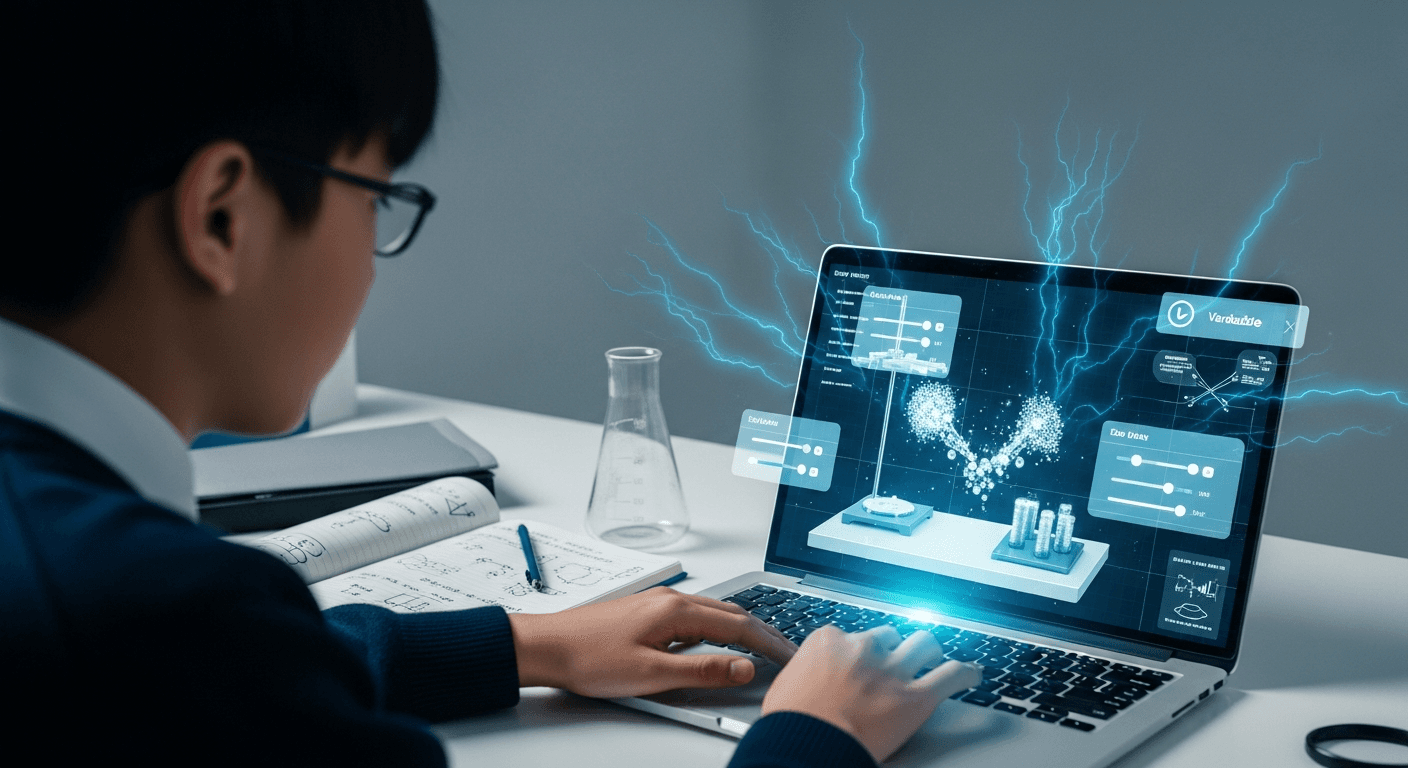
The Practical Assessment Bottleneck in the HKDSE Curriculum
For many secondary school students navigating the Hong Kong Diploma of Secondary Education (HKDSE), the science laboratory is a space of high anxiety. Whether you are studying Physics, Chemistry, Biology, or Combined Science, the school-based assessment (SBA) and Paper 3 practical-related components demand more than just rote memorization of textbook equations. Students are increasingly tested on their ability to design experiments, anticipate anomalies, handle unexpected equipment errors, and analyze unscripted data sets under severe time constraints.
Yet, traditional study methods often fall short. Reading a chemistry manual or watching a YouTube walkthrough of a titration experiment provides a false sense of security—what cognitive scientists call the illusion of competence. When you step into the lab or face a practical-based exam question, unpredictable real-world variables, faulty apparatus configurations, or subtle procedural deviations can derail your entire methodology. To break the grade ceiling and secure a Level 5** in your science electives, you need a way to run iterative dry-runs without the physical constraints of limited chemicals, restricted lab hours, or broken equipment.
Entering the Sandbox: How AI Simulation Models Transform Lab Preparation
Modern educational technology has introduced a powerful solution for science students: AI-powered simulation sandboxes. Unlike static video tutorials, an AI simulation model acts as a dynamic, reactive laboratory partner. By prompting an intelligent platform like Start practicing in AI-Powered Practice Platform, you can construct virtual environments to test hypotheses, manipulate experimental parameters, and observe the simulated consequences of procedural mistakes in real-time.
Imagine you are preparing for a complex organic chemistry synthesis or an advanced electromagnetic induction experiment in Physics. Instead of simply reviewing past paper marking schemes, you can ask an AI sandbox to simulate an experiment with deliberate errors—such as incorrect thermometer calibration or fluctuating current—and challenge yourself to diagnose the anomaly. This active troubleshooting mirrors the exact competencies examiners look for in HKDSE Paper 3 investigative tasks.
Three Strategies to Master Experimental Design Using AI
To maximize your preparation for HKDSE practical assessments, you must move beyond passive consumption and adopt a systematic approach to virtual experimentation. Here is how you can integrate AI-driven simulations into your weekly revision routine:
1. Stress-Testing Independent and Dependent Variables
A common pitfall in HKDSE investigative questions is the inability to isolate variables or predict how altering a single factor will affect the dependent variable. Use an AI sandbox to model your experiment across extreme ranges. For instance, if you are investigating the effect of temperature on enzyme activity in Biology, instruct the AI to simulate data points at irregular intervals, including extreme overheating where denaturation occurs. By analyzing the generated graphs and identifying unexpected trends, you train your brain to handle unscripted data presentation in the exam hall.
2. Anticipating Procedural Errors and Systematic Bias
Examiners love testing whether students understand the difference between random errors and systematic errors. Set up a prompt where the AI acts as an experimental critic. Describe your proposed step-by-step method for a titration or calorimetry experiment, and ask the AI to identify potential sources of error, such as parallax error in reading the meniscus or heat loss to the surroundings. You can Learn more about how thinka can help students improve grades through AI by transforming these identified errors into targeted practice drills that refine your laboratory precision.
3. Practicing Data Interpretation and Error Analysis
Many students lose crucial marks not because they performed the experiment poorly, but because they cannot write a coherent conclusion or evaluate the reliability of their results. Feed raw, messy data sets into an AI simulation and practice calculating percentage errors, drawing best-fit lines, and evaluating validity. For quantitative subjects, ensuring you can seamlessly integrate formulas like \( \Delta H = mc\Delta T \) into your written analysis is essential for securing top marks.
Bridging Theory and Practice for HKDSE Success
The jump from theoretical concepts to practical execution is the ultimate differentiator between average grades and top-tier achievement in the HKDSE. By leveraging AI-powered simulation sandboxes, you eliminate the guesswork from your lab preparation, turning every potential mistake into a valuable learning iteration. Combine your digital simulations with official Free study materials and resources to ensure your foundational knowledge is as sharp as your investigative instincts. For educators looking to design customized practical worksheets and lab scenarios that challenge their classes, platforms like Explore how thinka can help teachers to generate practice paper offer invaluable support in building rigorous, exam-aligned challenges.
Mastering the science laboratory does not require endless hours of physical access to restricted school facilities. By embracing the power of simulation, you can build the cognitive agility, error-detection skills, and experimental confidence needed to conquer your upcoming HKDSE science assessments.
Related posts
- Oct 13, 2026
Can ChatGPT Grade HKDSE Essays Accurately? We Tested It Against Official HKEAA Rubrics
Wondering if ChatGPT can grade your HKDSE essays? We tested AI against official HKEAA marking rubrics to expose mark inflation, blind spots, and prompt drift.
- Oct 3, 2026
How to Cite AI in Coursework: HKDSE SBA, IB, and Exam Board AI Guidelines
Learn how to cite AI in HKDSE SBA and coursework. Master HKEAA & IBO academic integrity rules, prompt logs, citation templates, and AI detector defense.
- Sep 23, 2026
How to Use ChatGPT for Revision: The HKDSE Syllabus-Aligned AI Framework
Master how to use ChatGPT for HKDSE revision. Discover 4 spec-aligned prompt templates, HKEAA mark scheme simulations, and active recall guardrails for Level 5**.
- Sep 12, 2026
Can ChatGPT Grade Essays Accurately for HKDSE? The Rubric Calibration Protocol to Beat AI Score Inflation
Wondering if ChatGPT can grade essays accurately for HKDSE? Learn how to eliminate AI score inflation and calibrate prompts to HKEAA marking schemes for top results.