Professional Certifications5 min read
PMP Brain Dump Policy in Singapore: Pearson VUE Rules, Whiteboard Limits & 230-Minute Pacing
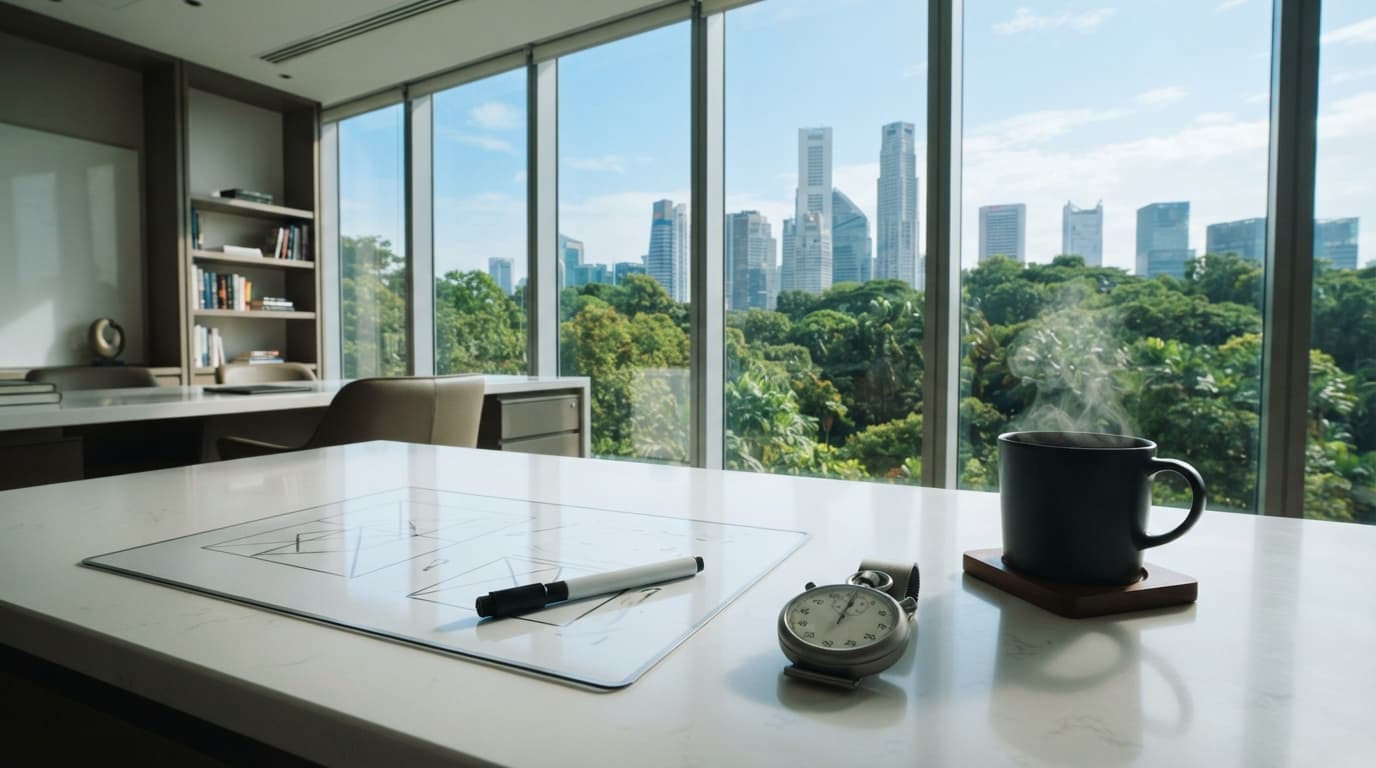
Understanding the PMI & Pearson VUE Brain Dump Policy
If you are preparing to sit for the Project Management Professional (PMP)® certification in Singapore—whether booking a seat at a physical Pearson VUE testing centre in International Plaza, Anson Road, or testing remotely from home via OnVUE—the rules regarding note-taking and formula sheets are uncompromising. Under the official pmp brain dump policy enforced by the Project Management Institute (PMI) and Pearson VUE, writing down formulas, acronyms, or process charts during the pre-exam tutorial or before the exam clock officially begins is strictly prohibited.
Attempting to sketch out Earned Value Management (EVM) equations or critical path diagrams onto your scratch booklet or digital whiteboard during the 10 to 15-minute tutorial screen will result in an immediate security flag. Test centre proctors and remote OnVUE invigilators are trained to terminate sessions immediately if candidates begin scribbling notes before question 1 appears. To safeguard your test fees and avoid disqualification, you need to understand exact workstation rules and adopt a modern 230-minute pacing framework rather than relying on manual pre-test brain dumps.
Pearson VUE Test Centre vs. OnVUE Online: Scratch Paper Rules
Your note-taking environment depends heavily on where you sit the exam in Singapore. Pearson VUE applies distinct hardware and materials policies across physical and remote testing setups:
1. In-Person Pearson VUE Test Centres (e.g., Tanjong Pagar / Jurong East)
When testing at a physical centre, you are provided with:
- A reusable, double-sided laminated scratch booklet (usually 3 to 5 spiral-bound grid sheets).
- Fine-tip dry-erase markers.
- No physical tissues or erasers (you must raise your hand to request an exchange once your sheets are full).
- The Rule: You cannot touch the marker to the surface until you click through the tutorial and the 230-minute official exam clock begins running.
2. Online Proctored Exam (OnVUE Remote Testing)
When taking the exam from your home or office in Singapore via OnVUE:
- Zero physical paper, pens, or whiteboards are allowed on your desk.
- You are limited exclusively to the built-in Pearson VUE digital whiteboard app integrated into the testing interface.
- Typing or drawing with a mouse on the digital whiteboard is slow and cumbersome.
- The Rule: Accessing the digital whiteboard tool is locked until the timer starts. Any attempt to write on external paper or looking down away from the webcam triggers an instant session termination.
Explore more technical breakdowns across certifications in our professional exam preparation guides.
Why the "Tutorial Brain Dump" Method Is Obsolete
Years ago, candidates frequently spent the 15-minute software tutorial writing out 49 processes and EVM formulas such as Cost Variance ( ext{CV} = ext{EV} - ext{AC} ext{)} or Schedule Performance Index ( ext{SPI} = rac{ ext{EV}}{ ext{PV}} ext{)}. Today, PMI has rendered this approach both illegal and tactically counterproductive for three main reasons:
1. Strict Proctor Disqualification: PMI’s Candidate Security and Pearson VUE proctor regulations explicitly define writing prior to test commencement as test compromise. Proctors have cameras focused directly on your hands and screen.
2. The 2026 ECO Exam Weighting: The current PMP Exam Content Outline focuses on three domains: Process (41%), People (33%), and Business Environment (26%). Over 60% of questions reflect Agile and Hybrid scenarios, leadership mindset, servant leadership, and conflict resolution, where formula memorisation plays a minimal role.
3. Time Penalty: The exam delivers 180 questions in 230 minutes. Spending 5 to 8 minutes of active exam time drawing manual tables robs you of precious seconds needed for complex scenario comprehension.
The 230-Minute Block Pacing Strategy: 75-75-80 Distribution
The PMP exam is structured into three consecutive blocks of 60 questions, punctuated by two optional 10-minute scheduled breaks that do not deduct from your 230-minute timer. Once you review and submit a 60-question block, you cannot revisit those questions after your break.
To maintain peak focus without falling behind the average pacing requirement of roughly ext{76.6} ext{ seconds per question}, apply this proven time management matrix:
Block 1 (Questions 1 to 60) — Target: 75 Minutes
- Exam Clock Remaining: Start at 230:00 ext{ minutes}, submit Section 1 review by 155:00 ext{ minutes}.
- Objective: Settle your nerves and tackle initial situational scenarios smoothly. Flag no more than 5 to 7 questions for review so you do not exceed your 75-minute limit.
- Action: Accept the optional 10-minute break. Step away from the screen, hydrate, and stretch.
Block 2 (Questions 61 to 120) — Target: 75 Minutes
- Exam Clock Remaining: Resume at 155:00 ext{ minutes}, submit Section 2 review by 80:00 ext{ minutes}.
- Objective: Maintain consistent pacing through heavy hybrid and agile workflow problems.
- Action: Take the second 10-minute break. Refuel with water or a quick snack to prevent cognitive fatigue during the final stretch.
Block 3 (Questions 121 to 180) — Target: 80 Minutes
- Exam Clock Remaining: Resume at 80:00 ext{ minutes}, finish all questions with 5 minutes to spare (05:00 ext{ minutes}) for final flagged reviews.
- Objective: Use the extra 5-minute buffer in this final section to compensate for mental fatigue on wordy governance and contract scenarios.
Replacing Brain Dumps with Instant Retrieval Practice
Because you cannot rely on writing down memory aids during the tutorial, your operational knowledge of Agile ceremonies, EVM interpretations, and risk responses must be intuitive. Instead of memorising static charts, Singapore professionals benefit most from active scenario application.
Practicing on an AI-powered practice platform helps condition your mind to identify root causes and PMI mindset answers rapidly. With targeted exam practice on Thinka, AI scenario drills evaluate your weak domains in real-time, training you to interpret variance indicators such as ext{CPI} < 1.0 ext{ (over budget)} or ext{SPI} > 1.0 ext{ (ahead of schedule)} within seconds—eliminating any need to write manual cheat sheets under exam pressure.
Exam Day Checklist for Singapore Test Takers
- Bring Valid IDs: Your primary ID (such as an NRIC or Singapore Passport) must match the exact name spelling on your PMI scheduling confirmation.
- Test Centre Timing: Arrive at the Pearson VUE centre at least 30 minutes prior to your appointment time to clear biometric palm-vein and photo registration.
- OnVUE Workspace Prep: If testing at home, clear your entire desk surface, ensure reliable high-speed fibre broadband, and do not use a secondary monitor.
- Respect Marker Etiquette: In test centres, never wipe down the laminate booklet with your bare fingers, as proctors may inspect smudged markings for potential security infractions.
Related posts
- Sep 19, 2026
PMP Formulas Cheat Sheet: EVM, Critical Path & Calculation Shortcuts
Master the PMP formulas cheat sheet. Decode EVM, Critical Path Method, and PERT calculations with scenario diagnostics and situational shortcuts for exam day.
- Sep 16, 2026
PMP Domain Weightings Guide: Singapore Candidate Breakdown for People, Process & Business
Master PMP domain weightings: People (33%), Process (41%), and Business (26%). Learn the 50/50 agile-predictive split, AI focus, and strategic revision methods.
- Sep 13, 2026
CFA vs FRM in Singapore: Syllabus Overlap, Exam Difficulty, and Career ROI
Evaluate CFA vs FRM for Singapore finance careers. Compare 900 vs 400-hour study commitments, quantitative overlap, banking ROI, and dual-charter sequencing.
- Sep 10, 2026
FRM Pass Rates & Quartile Scoring Guide: Part 1 vs Part 2 Analysis for Singapore Professionals
Explore historical FRM pass rates across Part 1 and Part 2, decode GARP's quartile scoring system, and plan your 200-hour study strategy for Singapore's risk sector.