Primary School Education6 min read
The Analogy Alchemist: Bridging the ‘Abstraction Gap’ in PSLE Science and Mathematics with AI
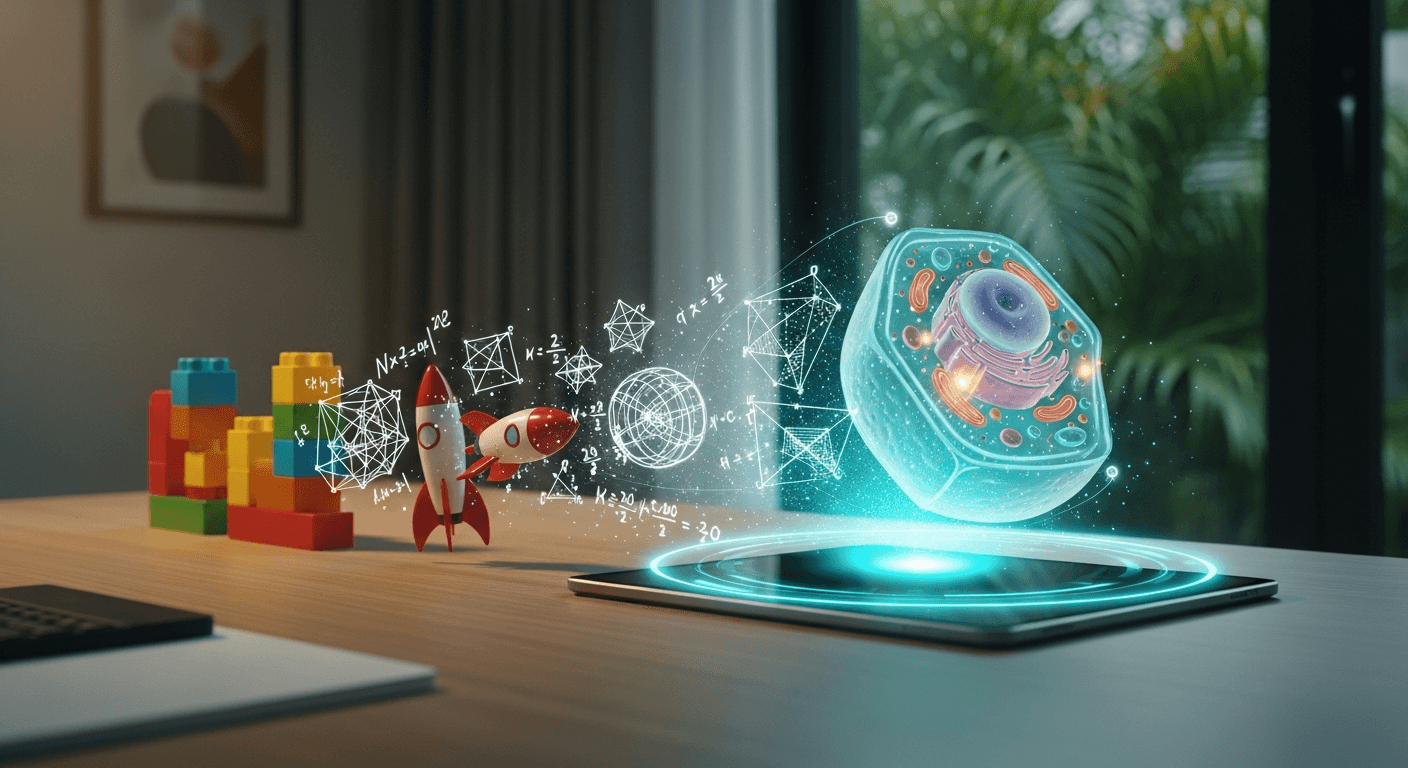
The P5 Jump: When Concrete Learning Meets Abstract Reality
For many Singaporean parents, the transition from Primary 4 to Primary 5 feels like a sudden steep climb. This is often referred to as the 'P5 Jump,' where the curriculum shifts from straightforward, concrete knowledge to complex, abstract reasoning. In Science, it is no longer enough to identify the parts of a plant; students must now explain the mechanics of transpiration. In Mathematics, simple arithmetic is replaced by intricate heuristics and 'unseen' problem sums.
This 'abstraction gap' is where many students lose their confidence. They can memorise the keywords for the MOE Science syllabus, but they struggle to apply them when a PSLE Open-Ended Question (OEQ) presents a scenario they haven’t seen before. The challenge isn't a lack of effort; it is a lack of a mental model. To succeed in the modern PSLE landscape, which increasingly rewards conceptual understanding over rote learning, students need a bridge from what they know to what they are learning.
The Power of the 'Conceptual Translator'
Enter the Analogy Alchemist. An analogy is more than just a comparison; it is a cognitive tool that maps the structure of a familiar concept onto a new, unfamiliar one. Research in educational psychology suggests that when children can relate abstract academic theories to their existing hobbies—whether that is Minecraft, Roblox, soccer, or even the logistics of a bubble tea shop—the new information 'sticks' much faster.
With the rise of generative AI, parents now have access to a personal 'conceptual translator.' Instead of struggling to explain the flow of electricity or the concept of equivalent fractions using dry textbook definitions, you can use AI to build custom-fit analogies that resonate with your child’s specific world.
Bridging Science: From Keywords to Meaning-Making
In the PSLE Science paper, the markers are looking for 'Concept + Application.' Many students lose marks because they provide a 'canned' answer that doesn't quite fit the specific context of the question. By using AI-powered practice platforms, parents can help children visualize these invisible processes.
Example: The Human Circulatory System vs. NinjaVan Logistics
If your child finds the circulatory system abstract, try using a logistics analogy.
The Concept: The heart pumps blood, carrying oxygen and nutrients to the body, and removing carbon dioxide.
The AI-Generated Analogy: The heart is the NinjaVan sorting hub. The blood vessels are the delivery routes across Singapore. The oxygen and nutrients are the Shopee parcels everyone is waiting for. The carbon dioxide is the 'returned' packaging that needs to go back to the warehouse for recycling. If the 'hub' (heart) slows down, the 'parcels' (oxygen) don't reach the 'houses' (cells) on time, and the system clogs up.
This mental model helps a student understand why the heart rate increases during exercise—the 'sorting hub' needs to work faster because the 'houses' are demanding more 'parcels' at a higher frequency. When they sit for a practice paper, they aren't just recalling words; they are visualizing a system.
Tackling the Mathematics Heuristics Hurdle
Singapore Math is world-renowned for its focus on problem-solving, but the move toward 'Conceptual Understanding' means that memorising the 'Model Method' isn't always enough for high-mark questions. Students often struggle with the logic behind why a certain step is taken.
Example: Equivalent Fractions via 'Game Skins'
Fractions are a common pain point in Primary 3 and 4. If a child is a fan of games like Fortnite or Roblox, an analogy about 'skins' can bridge the gap.
The Concept: ( \frac{1}{2} ) is the same value as ( \frac{4}{8} ).
The AI-Generated Analogy: Think of ( \frac{1}{2} ) as your base character. If you put on a fancy 'Legendary Skin' that divides your character into 8 glowing segments, and you activate 4 of them, you are still playing the exact same character. The 'look' (the numbers) has changed, but the 'power level' (the value) remains identical. You haven't gained more 'character'; you’ve just changed how the parts are displayed.
By using these relatable frameworks, the fear of the abstract begins to dissipate. You can find more targeted strategies in our library of primary study resources designed for the Singapore context.
How to Use AI as Your Home Analogy Architect
You don't need to be an expert in pedagogy to help your child. You can use AI to generate these bridges in real-time while helping with homework. Here is a simple framework for prompting an AI to help your child:
Step 1: Identify the Friction Point
Is it the 'Flow of Energy' in a food web? Is it 'Subject-Verb Agreement' in English? Identify the specific concept where your child says, "I don't get it."
Step 2: Define Their 'World'
What is your child obsessed with right now? Is it Taylor Swift? Is it building Lego Technic? Is it playing competitive badminton?
Step 3: Prompt for the Bridge
Use a prompt like: "Explain the concept of 'Potential Energy vs. Kinetic Energy' to a 10-year-old using a Lego roller coaster analogy. Make it specific to the Singapore Primary 5 Science syllabus."
Step 4: Stress-Test the Analogy
Ask your child to explain the concept back to you using the same analogy. If they can extend the analogy—for example, by telling you where the 'friction' happens on the Lego track—you know they have achieved deep conceptual understanding.
Moving Toward PSLE Mastery
The Ministry of Education’s shift away from T-scores to AL (Achievement Level) bands has placed a premium on consistent, deep understanding. In a system where every mark in a Science OEQ or a Math Paper 2 can affect an AL score, the ability to 'see' the logic behind a question is a significant competitive advantage.
For educators looking to bring this level of personalization into the classroom, tools that help generate context-aware practice papers are becoming essential. By aligning the practice context with the student's reality, we reduce the cognitive load required to understand the question, allowing the student to focus entirely on demonstrating their mastery.
Conclusion: From Passive Learning to Active Inquiry
The goal of using AI-driven analogies isn't to entertain your child, but to empower them. When a child stops seeing Science and Math as a series of disconnected rules to be memorised and starts seeing them as systems that govern the things they love, their motivation shifts. They move from being passive recipients of information to active investigators of their world.
At Thinka, we believe that every child has a unique 'Learning Signature.' By using AI to bridge the abstraction gap, we can ensure that no student is left behind by the 'P5 Jump.' You can learn more about how our AI platform personalizes learning to fit the needs of primary students in Singapore, helping them turn abstract challenges into concrete successes.
Related posts
- Oct 21, 2026
ISEE vs SSAT for Primary School Admissions: Scoring, Format, and Parent Guide
Choosing between ISEE vs SSAT for private or international school entry? Compare scoring, guessing penalties, test formats, and child cognitive fit.
- Oct 11, 2026
Year 4 Times Tables Test Pass Mark: The 6-Second MTC Format and 25/25 Fluency Guide
Wondering about the Year 4 times tables test pass mark? Discover why 25/25 is the true benchmark, the 6-second MTC screen rule, tricky table pairs, and speed drills.
- Oct 1, 2026
PSLE Raw Mark to AL Conversion Guide: Achievement Level Thresholds, Posting Groups, and Mark Optimisation
Demystify Singapore PSLE raw mark to Achievement Level (AL) conversion. Discover AL1-AL8 score boundaries, Posting Groups 1-3 cut-offs, and borderline score tactics.
- Sep 21, 2026
PSLE Exam Dates and Timetable: Paper Schedules, Durations, and the 12-Week Backwards Revision Protocol
Master the PSLE exam dates and daily paper schedule. Get exact paper durations, subject sequencing, and a 12-week backwards revision roadmap for Primary 6 success.