Latest News6 min read
A-Level Results Day Date and Time: SEAB Timelines, UAS Calculation, and Admissions Contingency
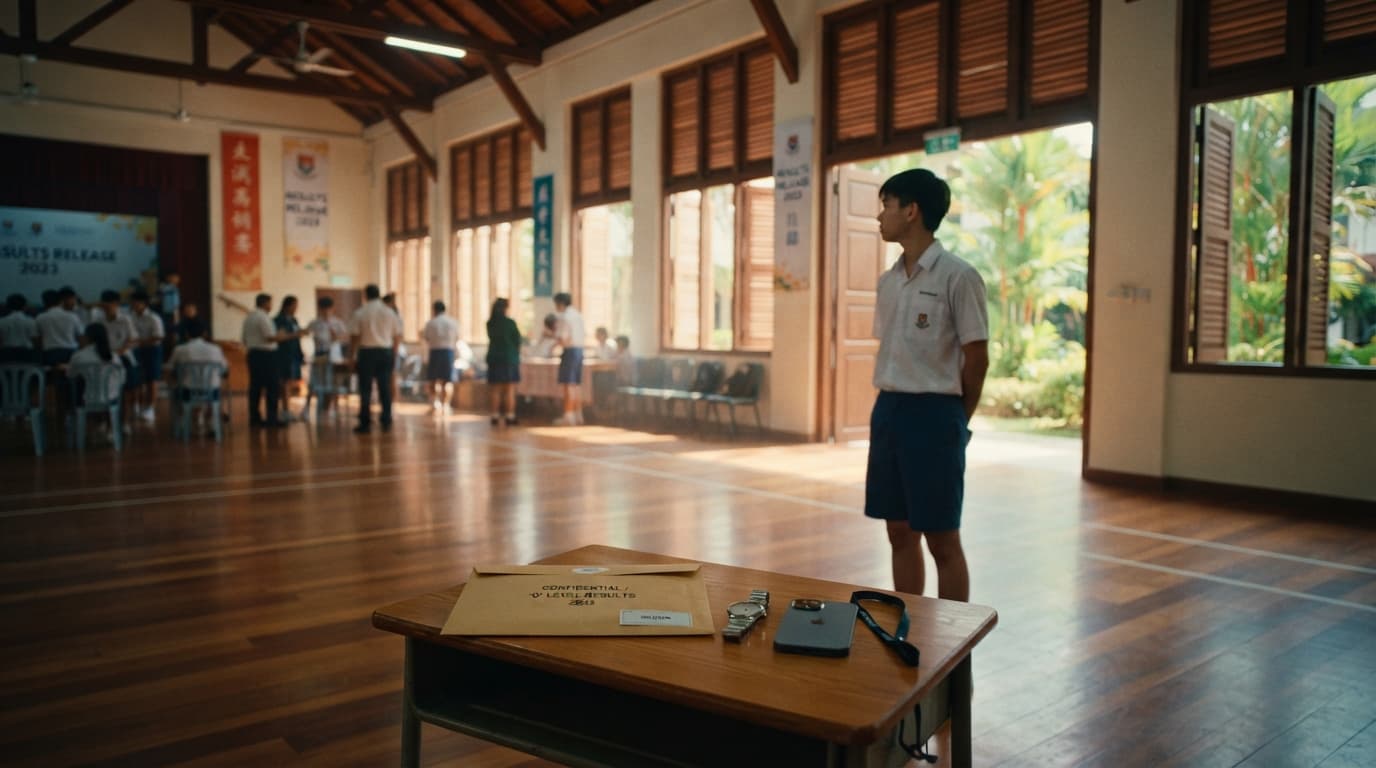
When Are A-Level Results Released? Exact Dates and Release Hours
For students awaiting their Singapore-Cambridge GCE A-Level results, official score release occurs in late February, with physical collection at Junior Colleges scheduled for 14:30 SGT and digital access via the Singapore Examinations and Assessment Board (SEAB) Candidate Portal opening at 15:15 SGT. For candidates taking Cambridge International AS & A Levels, the November 2026 series results drop officially on January 7, 2027 at 06:00 UTC (14:00 SGT), while the June series publishes in mid-August at 06:00 UTC alongside the UCAS Hub status updates at 08:00 BST (15:00 SGT).
Knowing your exact a level results day date time allows you to plan your morning systematically rather than reacting in panic. Whether you are walking into your JC school hall, logging in via Singpass overseas, or refreshing UCAS Track to see if your UK conditional offer has converted to unconditional, having a synchronised schedule ensures you can execute admissions appeals or clearing calls before hotline queues saturate.
The Synchronised Results Day Timeline
Results morning demands strict time-blocking. Depending on whether your priority is local Autonomous University (AU) matriculation or securing an overseas place, follow this hour-by-hour protocol:
06:00–12:00 SGT: Administrative Prep and Threshold Checks
Before any portals open, verify your Singpass two-factor authentication (2FA) and locate your Cambridge candidate numbers. If you hold conditional offers in the UK, inspect the grade boundary tables released by Cambridge early on results morning. These documents show the raw mark boundaries required for each grade, letting you determine whether you sit squarely inside a boundary or near the edge.
14:00–14:30 SGT: The First Wave (Cambridge & JC Halls)
Cambridge International candidates receive access via the Direct Candidate Results portal at 14:00 SGT (06:00 UTC). At 14:30 SGT, Singapore JC cohort candidates assemble in their respective school venues to collect physical result slips, SGCs (Singapore Cambridge General Certificates of Education), and university application booklets.
15:00–15:15 SGT: Digital Release & UCAS Update
At 15:00 SGT (08:00 BST), UCAS Hub updates for UK applicants. Simultaneously, at 15:15 SGT, SEAB activates the digital Candidate Portal for school and private candidates accessing results online. You can view your H1, H2, and H3 performance using your Singpass credentials.
Decoding Your Score: University Score Calculations and Raw Mark Audits
Once your slip is in hand, your immediate priority is establishing your competitive standing across local and overseas admissions matrices.
Calculating Your University Admission Score (UAS)
For Singapore Autonomous Universities (NUS, NTU, SMU, SUTD, SIT, SUSS), admissions teams evaluate your University Admission Score (UAS). Under the revised 70-point system, your UAS is calculated using your 3 H2 content subjects and H1 General Paper (GP), with H1 Project Work (PW) and your fourth content subject included only if they improve your overall aggregate:
\[\text{H2 Grade Value: } A = 20, \; B = 17.5, \; C = 15, \; D = 12.5, \; E = 10, \; S = 5, \; U = 0\]
\[\text{H1 Grade Value: } A = 10, \; B = 8.75, \; C = 7.5, \; D = 6.25, \; E = 5, \; S = 2.5, \; U = 0\]
Maximum possible base score under this framework is \(20 + 20 + 20 + 10 = 70\) rank points. Compare your calculated score directly against the 10th percentile Indicative Grade Profiles (IGP) published annually by the universities. If your score sits above the 10th percentile mark, your pathway to direct shortlisting is statistically secure.
The 1–2 Mark Audit Before Paying for an Appeal or Remark
If your awarded grade falls short of an entry prerequisite—such as missing an 'A' in H2 Mathematics for Computing or Data Science—do not blindly lodge an appeal for review of marking. SEAB and Cambridge reviews carry administrative fees and rarely result in upward grade shifts unless the raw mark is perched within 1 to 2 marks of the boundary threshold.
Consult your JC subject tutor immediately. Tutors often retain copies of internal preliminary correlation curves and can help evaluate whether your exam performance legitimately warrants an appeal. If you need targeted practice papers to diagnose where understanding broke down for future sittings, explore comprehensive study resources and notes to benchmark syllabus requirements.
The 3-Scenario University Contingency Matrix
Depending on your results, execute one of three pre-planned tactical workflows:
Scenario A: Met or Exceeded Offer Thresholds (UAS > IGP 10th Percentile / Firm Offer Met)
If your results match your firm UK choice or place you safely within your desired AU course's 10th percentile IGP, follow standard confirmation procedures:
- For Singapore universities: Complete your Joint Acceptance Portal (JAP) selections prior to the late-May deadline.
- For UK universities: Confirm your unconditional status on UCAS Hub. You do not need to contact the university directly unless your status has not updated within 48 hours.
- Submit scholarship applications immediately; most competitive scholarship windows (PSC, college-specific awards) close shortly after results release.
Scenario B: Marginal Miss (Within 2.5 UAS Points or One Sub-Grade Off UCAS Offer)
If you scored slightly below the standard cutoff, immediate strategic action can preserve your trajectory:
- Aptitude-Based Admissions (ABA): Singapore universities reserve a substantial quota of places for holistic entry. Prepare your personal statement, verified portfolio (leadership roles, Olympiad participation, hackathons, or national service achievements), and referee contacts to submit alongside your ABA application.
- UCAS Near-Miss Discretion: UK university admissions teams frequently accept students who missed their conditional offer by one grade (e.g., scoring AAB instead of AAA), especially if the dropped grade is in a non-prerequisite subject. Call the university admissions office directly before entering Clearing.
Scenario C: Significant Shortfall (Below IGP Baselines / Unsuccessful Offer Conditions)
If your results prevent entry into your target degree track, deploy this contingency protocol:
- Singapore AU Course Realignment: Target related degrees with lower historical IGP cutoffs (e.g., pivoting from Computer Science to Information Systems, or from Mechanical Engineering to Project and Facilities Management) with an internal transfer strategy after Year 1.
- UCAS Clearing Execution: Clearing officially updates in real time on results day. Use the UCAS Clearing search tool to filter courses with vacancies. Call international admissions hotlines directly, equipped with your Clearing Number, Personal ID, and breakdown of H1/H2 subject grades.
- Private Candidate Retake Strategy: If you decide to retake your A-Levels, commit early. The syllabus demands rigorous concept mastery, timed drill execution, and diagnostic feedback. You can start practicing with an interactive learning platform to identify specific component weaknesses and rebuild core problem-solving routines.
Equipping Teachers and Tutors for Results Day Guidance
Results day is equally demanding for educators fielding inquiries from anxious students evaluating appeal odds. School departments can leverage structured diagnostic frameworks to help students evaluate retake viability. Tutors looking to set up baseline tests for retake cohorts can generate targeted practice assessments that isolate specific syllabus sections.
Next Steps: Securing Your Next Academic Chapter
A-Level results day marks a transition point rather than a final verdict. Whether you are finalizing admissions on the Joint Acceptance Portal, negotiating a Clearing place with a UK university, or preparing for an Aptitude-Based Admissions interview, swift, calculated action consistently outperforms hesitation.
If your next steps require mastering advanced academic modules or refining core analytical techniques, discover how personalized AI-powered study assistance can support your academic progression, ensuring you approach university-level coursework with clarity and confidence.
Related posts
- Oct 19, 2026
CIE IGCSE Exam Dates in Singapore: Zone 5 Timetable Schedules, Component Dependencies, and Revision Milestones
Navigate CIE IGCSE exam dates for Singapore Zone 5 candidates. Decode paper splits, Alternative to Practical sequencing, clash rules, and revision plans.
- Oct 9, 2026
CIE IGCSE Results Day Time: Singapore Portal Access, Grade Boundaries, and Post-16 Pathways
Cambridge IGCSE results drop at 14:00 SGT (06:00 UTC). Master portal login protocols, component grade threshold calculations, and Singapore JC or Poly admissions.
- Sep 29, 2026
AQA A Level Grade Boundaries: Raw Mark Cut-Offs, Component Weightings, and A* Benchmarks
Master AQA A Level grade boundaries across STEM and humanities. Decode raw mark scaling, component weightings, and AI-driven mock paper grading for A* performance.
- Sep 19, 2026
CIE A-Level Exam Dates: Master Timetables, Session Codes, and Clash Protocols
Navigate the CIE A-Level exam dates, session windows, Key Time rules, and timetable clash protocols with a step-by-step backwards revision strategy.