Secondary School Selection for Primary Students5 min read
The Independence Architect: Auditing Middle Schools for Executive Function and Autonomous Learning Readiness
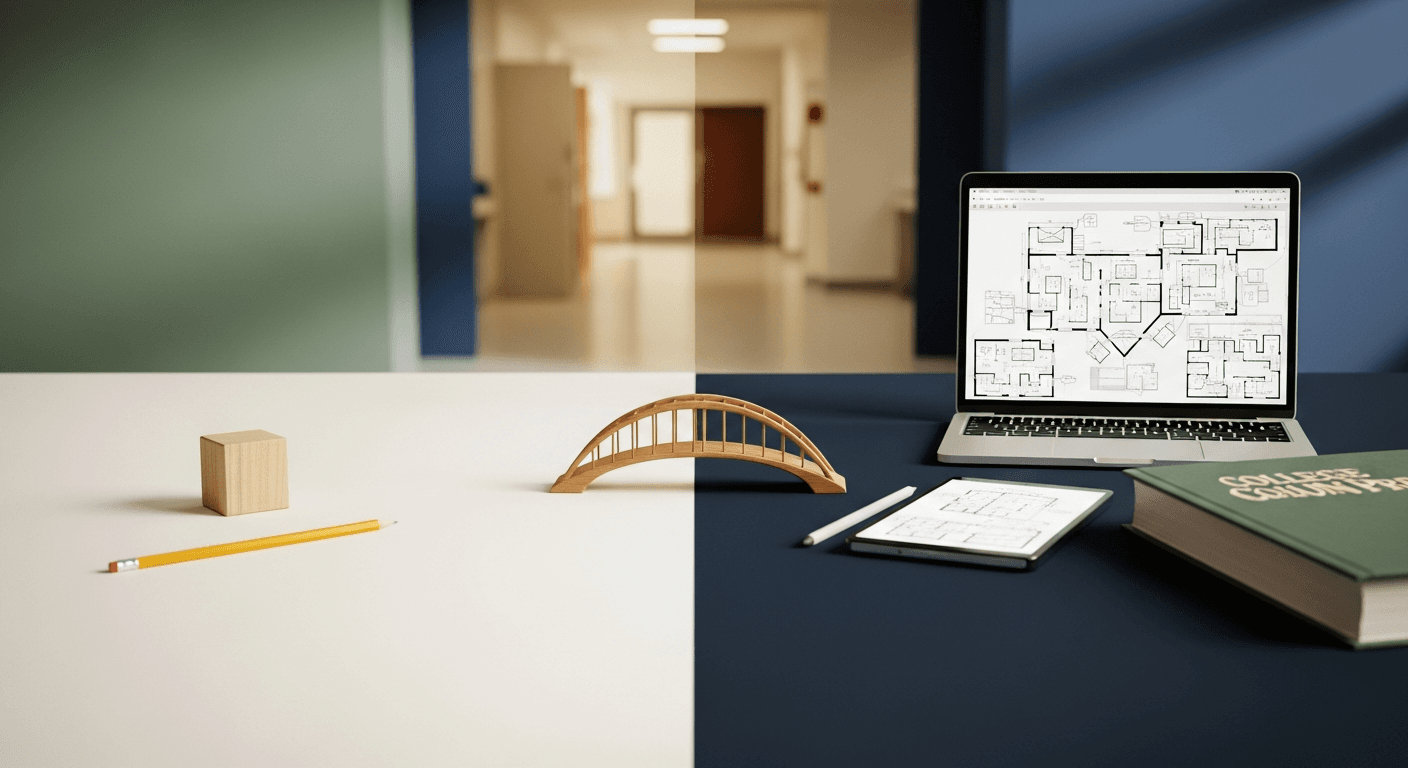
The Middle School Transition: More Than Just a New Building
For most American parents, the transition from elementary to middle school feels like a rite of passage. We worry about lockers, changing classrooms, and social dynamics. However, there is a much quieter, more significant shift happening: the move from directed learning to autonomous learning. In elementary school, teachers often act as the primary organizers of a student’s time, materials, and thoughts. In middle school, that scaffolding is abruptly removed.
As we look toward high school success—specifically the stamina required for AP (Advanced Placement) courses and the SAT—the ability to self-regulate is actually a better predictor of success than raw IQ. When choosing a middle school, parents need to move beyond GreatSchools ratings and state report cards. You need to become an 'Independence Architect,' auditing a school’s ability to bridge the Executive Function Gap.
What is the Independence Gap?
In many U.S. elementary schools, students are told exactly what to do, when to do it, and how to turn it in. This is 'directed learning.' By the time a student reaches 9th grade, they are expected to manage long-term projects, synthesize complex texts, and self-correct their errors without a teacher hovering over their shoulder. This is 'autonomous learning.'
The gap between these two stages is where many students struggle, leading to 'homework battles' at home and a dip in grades during 6th or 7th grade. A school with a formal Self-Regulated Learning (SRL) framework doesn't just teach math or English; it teaches the metacognitive skills required to master those subjects independently.
How to Audit a School for Executive Function Support
When you attend an open house or browse a school’s curriculum guide, look for evidence of how they handle the 'how' of learning. You can even use AI to help you analyze school handbooks or mission statements for specific indicators of independent learning readiness.
1. Look for Metacognitive Coaching, Not Just 'Study Skills'
Generic 'study skills' classes often teach students how to highlight text or color-code a binder. Metacognitive coaching goes deeper. It asks students to reflect on their own thinking process. "Which part of this math problem did I get stuck on? Why did I choose this strategy? How will I check my work?"
Ask the administration: "Does the school have a formal framework for teaching executive function, or is it left up to individual teachers?" If the answer is 'it's integrated,' ask for a specific example of how a 6th-grade teacher helps a student plan a three-week research project.
2. The Homework Philosophy
In a school that prioritizes autonomy, homework isn't just 'busy work' or compliance. It’s an opportunity for retrieval practice. Check if the school encourages students to use personalized AI study platforms to identify their own knowledge gaps. An autonomous-ready school values the process of correction over the result of the first attempt.
3. Scaffolding the 'Long-Term'
Elementary students live in the 'now.' Middle school requires living in the 'two weeks from now.' Audit the school's digital portal or planner system. Do teachers post assignments at the last minute, or is there a transparent, long-term roadmap that allows students to practice time management? Schools that foster independence will have clear, predictable structures that allow students to fail safely and learn from it before they reach the high-stakes environment of high school GPA calculations.
Using AI as Your 'School Selection Auditor'
Parents are increasingly using AI to cut through marketing jargon. You can take a school’s 'Learning Philosophy' statement and input it into an AI tool with the prompt: "Analyze this text for evidence of explicit instruction in executive function and metacognition. Does this school emphasize student autonomy or teacher-led compliance?"
This allows you to see if the school is truly preparing your child for the rigors of the 21st-century economy, which demands self-starters, or if they are simply a 'test-prep factory.' At Thinka, we believe that personalized AI study support is the ultimate tool for this transition, as it allows students to take ownership of their progress in a way a traditional classroom often cannot.
Questions for the Principal: The Autonomy Checklist
When you have the opportunity to speak with school leadership, move past questions about sports or facilities. Instead, use these 'Autonomy Auditor' questions:
• "How do you support students who have mastered the content but struggle with the organization of the work?" (This tests their focus on executive function).
• "What role does student self-reflection play in your grading system?" (This checks for metacognitive frameworks).
• "How do you introduce digital literacy and the ethical use of AI in research?" (This checks for future-readiness).
• "Is there a dedicated time in the schedule for students to manage their own 'flex' time or independent study?"
Why This Matters for the AP and SAT Roadmaps
The College Board has shifted its focus. Modern AP exams and the Digital SAT no longer reward simple rote memorization. They reward 'thinking about thinking'—the ability to analyze a prompt, plan a response, and pivot when a strategy isn't working. If a middle school doesn't build these muscles early, the student will find the jump to honors-level high school work overwhelming.
By choosing a school that values autonomous learning, you aren't just choosing a 6th-grade experience; you are choosing the foundation for their college applications. You are ensuring they won't need a parent to manage their calendar when they are 17 because they learned how to manage it when they were 11.
Bridging the Gap at Home
Regardless of which school you choose, you can begin fostering these skills at home. Encourage your child to use free educational resources that challenge them to solve problems, rather than just find answers. Shift your language from "Did you finish your homework?" to "How did you decide which assignment to do first today?"
For educators looking to support this transition, Thinka also offers tools to generate standards-aligned practice papers that emphasize reasoning and logic over simple recall. When schools and parents align on the goal of autonomy, the 'Middle School Slump' becomes a 'Middle School Leap.'
The Final Verdict
Don't be blinded by the prestige of a school’s name or its sports trophies. The most valuable gift a middle school can give your child is the ability to learn without them. By auditing for independence and executive function now, you are building the 'Independence Architect' your child needs to thrive in high school, college, and beyond.
"}Related posts
- Jun 20, 2026
The Growth Velocity Audit: Why 'Value-Added' Metrics Are the Real Key to Choosing a Middle School
Stop chasing raw test scores. Learn how to evaluate schools using student growth percentiles and adaptive learning tools to ensure your child’s academic potential is maximized.
- Jun 10, 2026
The Silicon Syllabus: Auditing a Middle School’s AI Strategy for the Future-Ready Student
Don't just look at state test scores. Learn how to evaluate a school's AI roadmap and digital ethics to ensure your child is prepared for a hybrid-AI future.
- May 31, 2026
The Talent Portfolio: Mapping Niche Strengths for Competitive Middle School Admissions
Learn how to move beyond standardized tests and use AI to build a compelling middle school portfolio. Discover how to identify 'spikes' for Magnet and GATE programs in the US.
- May 21, 2026
The Cognitive Blueprint: Using AI Data to Match Your Elementary Student with the Perfect Middle School Pathway
Move beyond school rankings. Learn how US parents use cognitive profiling and AI data to select middle school pathways that align with future AP and SAT success.