
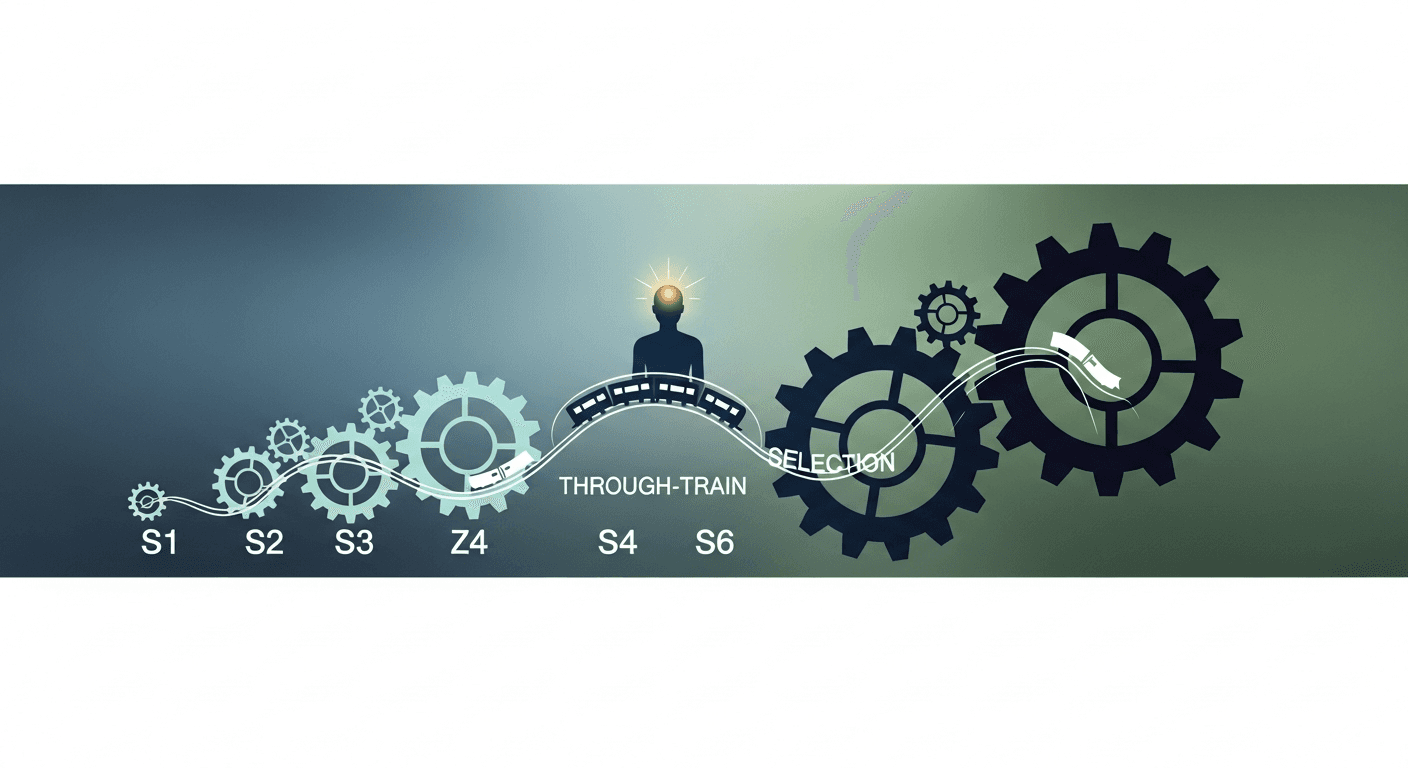
The S1-S6 Continuity Clause: Prioritizing Through-Train Secondary Selection for Sustainable HKDSE Mental Wellness
Have you ever felt like the transition from junior secondary to S4 hit you like a freight train? One moment, you are comfortably managing your S3 subjects, and the next, you are drowning in complex exam preparation for the HKDSE. You are definitely not alone. For countless students in Hong Kong, the senior secondary leap triggers immense academic friction and stress.
But what if the secret to surviving—and thriving—in the HKDSE wasn't just about studying harder, but about how seamlessly your educational journey was structured from the very beginning? Enter the S1-S6 Continuity Clause. Originally a concept rooted in "through-train" secondary school selection for primary students, this principle holds massive, untapped power for current HKDSE candidates. Whether you are currently in a through-train school or a traditional fragmented system, understanding and applying the psychology of "academic continuity" is your ultimate weapon for sustainable mental wellness and top-tier exam performance.
Let us break down exactly what the through-train advantage is, why it protects your mental health, and how you can simulate this seamless continuity right now using modern educational technology.
Decoding the "Through-Train" Advantage
In Hong Kong's education system, a "through-train" school model ensures that students progress seamlessly from S1 to S6 without the disruptive hurdles of high-stakes screening at the S3 level. But beyond simply guaranteeing a seat in a senior form, this model provides something far more valuable: psychological safety.
Quick Fact: The Transition Shock
Recent educational psychology studies indicate that abrupt changes in school environments, peer groups, or curriculum pacing during early adolescence significantly increase the risk of burnout. Students who experience a continuous, unbroken S1-S6 syllabus flow report up to 30% lower levels of chronic exam anxiety.
The Continuity Clause dictates that learning should be an unbroken narrative. In a perfect through-train environment, your S1 mathematics foundations are naturally woven into your S4 core math syllabus. Your teachers understand your historical weaknesses, your peer support system remains intact, and your brain does not have to expend precious energy adapting to a completely new academic ecosystem. For HKDSE students, realizing the importance of this continuity is the first step toward fixing broken study habits.
The S3-to-S4 Reality Check: Why Mental Wellness Takes a Hit
If you did not come from a through-train primary-to-secondary model, or if your school treats the junior and senior curriculums as completely separate worlds, you likely experienced the "S4 Shock." This occurs when the foundational concepts you barely grasped in junior forms suddenly become the non-negotiable building blocks for HKDSE advanced topics.
This academic fragmentation directly threatens your mental wellness. When you feel like you are constantly playing catch-up, the resulting imposter syndrome can derail your confidence. The anxiety isn't necessarily because the HKDSE topics are impossibly hard; it is because the bridge between your past knowledge and current expectations is broken. Healing this disconnect is crucial for your sanity and your scores.
Simulating the Continuity Clause in Your Own HKDSE Journey
Even if you cannot retroactively change your school selection, you can absolutely engineer the "through-train" experience for yourself right now. Here is how you can build an unbroken continuum of learning to safeguard your mental health.
1. Audit and Bridge Your Junior Form Foundations
You cannot build a sturdy S6 skyscraper on a shaky S2 foundation. If you are struggling with HKDSE Chemistry or Physics, the root cause is often a forgotten junior science concept. Take the time to step back and review. A quick refresher using reliable Junior Secondary School (S1 - S3) Study Notes can instantly clear up senior-level confusion. Acknowledging that learning is a continuum—not isolated grade levels—reduces the panic of feeling "lost."
2. Establish a Long-Term Peer "Study Pod"
One of the hidden benefits of through-train schooling is the stability of peer relationships. Do not underestimate the mental health benefits of studying with friends who have known your academic struggles since S1. Create a dedicated study pod that meets consistently from S4 through S6. This provides a safe space to ask "stupid" questions without judgment, fostering a collaborative rather than competitive mindset.
3. Trace the Syllabus Thread
Instead of treating each textbook chapter as a standalone obstacle, map out how concepts evolve. Ask yourself: "How does this current topic connect to what I learned last year?" When your brain recognizes patterns and connections, it retains information much faster and with less cognitive strain. For a comprehensive overview of what you need to master, always cross-reference with high-quality HKDSE Study Notes.
Bridging the Gap: How AI-Powered Learning Acts as Your Digital Through-Train
Here is the most exciting development for modern HKDSE students: you no longer need to rely solely on your school's structural model to experience the benefits of academic continuity. The rise of AI-powered learning has completely leveled the playing field.
Imagine having a private tutor who vividly remembers exactly which algebra concepts you stumbled on in Form 2, and automatically adjusts your Form 5 practice questions to help you bridge that specific gap. That is the magic of a smart study platform. By tracking your long-term performance data, artificial intelligence creates a hyper-customized educational pathway just for you.
Pro Tip: Embrace Adaptive Technology
Traditional revision forces you to waste time reading chapters you already know while ignoring hidden weak spots. A platform offering personalized learning analyzes your individual error patterns. If the AI detects that your HKDSE Biology struggles stem from a misunderstanding of basic cell structures taught years ago, it will subtly weave those foundational questions into your current practice. This seamless, stress-free remediation is the ultimate "Continuity Clause" in action.
For students looking to revolutionize their revision strategy without burning out, it is time to upgrade your toolkit. You can explore how adaptive technology maps to your unique syllabus needs by visiting the thinka Home Page.
Actionable Blueprints for Sustainable Mental Health
Maintaining your mental wellness during the DSE marathon requires intentional, systemic habits. Here are actionable ways to keep your mind sharp and your stress levels low:
A. Micro-Pacing Over Macro-Cramming:
Through-train models succeed because they spread learning out over years. Emulate this by breaking your exam preparation into micro-sessions. Studying for 45 minutes every day is psychologically easier and far more effective than a grueling 6-hour weekend cram session.
B. Focus on the "Delta" (Your Personal Growth):
Anxiety spikes when you compare your Chapter 5 progress to a classmate's Chapter 10 mastery. Personalized learning tools help you focus purely on your own metrics. Celebrate the fact that you scored 15% higher this week than last week. Progress is your best defense against exam depression.
C. Let Technology Carry the Cognitive Load:
Do not waste mental energy trying to plan what to study next. Let intelligent algorithms design your daily revision schedule. By outsourcing the planning phase to a smart platform, you reserve 100% of your brainpower for actual learning and comprehension. Ready to take the guesswork out of your routine? Start Practicing in AI-Powered Practice Platform today and feel the weight lift off your shoulders.
The Foundation Starts Earlier Than You Think
While you are currently battling the HKDSE, it is worth noting that the philosophy of continuity begins long before secondary school. If you have younger siblings, or if you are simply reflecting on your own educational timeline, recognizing the value of early fundamentals is key. A strong base built during primary years drastically reduces the friction felt a decade later. For younger learners looking to build that unbreakable foundation early, reviewing Primary School Study Notes can set the stage for a stress-free transition into the secondary world.
Conclusion: Securing Your Mental Wellness and Academic Future
The S1-S6 Continuity Clause is more than just an admissions policy for primary students; it is a profound blueprint for sustainable academic success. By recognizing the psychological toll of fragmented learning, you can take active steps to bridge your own knowledge gaps. You have the power to simulate a through-train environment by revisiting junior foundations, relying on strong peer networks, and utilizing advanced educational technology.
The HKDSE does not have to be a pressure cooker that sacrifices your mental wellness. By integrating AI-powered learning into your daily routine, you create a seamless, customized pathway that supports you at every step. Stop fighting the syllabus alone, embrace the tools designed to adapt to your unique pace, and turn your exam journey into a continuous, confident march toward success.