
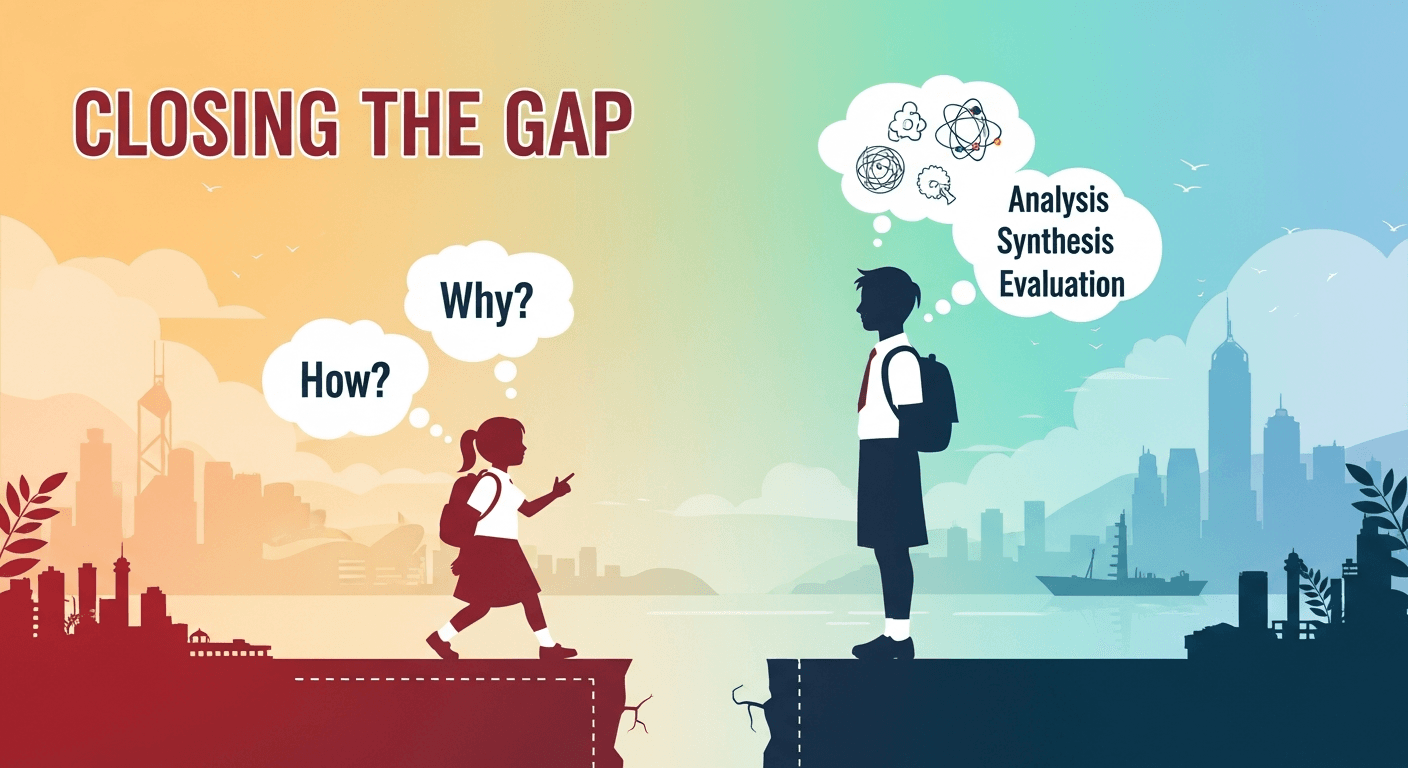
Close the Gap: Primary Inquiry Skills That Boost Your DSE Critical Thinking
You’re staring at a data response question in your Economics mock exam. Tables, charts, and paragraphs of text blur into one. The question asks you to "evaluate the effectiveness" of a government policy, but your mind goes blank. Where do you even begin? The pressure builds. You know all the textbook theories, but applying them feels like trying to solve a puzzle with missing pieces.
Sound familiar? Many HKDSE students feel this way. The secret to cracking these complex questions isn’t always about cramming more F.6 material. Instead, it’s about reactivating a powerful toolset you mastered long ago in your primary school classroom: inquiry skills.
It might sound too simple, but the curiosity that fuelled your P.3 General Studies project is the same engine that drives A-grade critical analysis in the DSE. The problem is, somewhere between endless dictations and memorising formulas, we forget how to ask, explore, and connect. This blog post will show you how to bridge that gap and transform your forgotten primary school talents into your greatest DSE advantage.
What Exactly Are “Inquiry Skills”? The Superpower You Already Have
Before you dismiss this as child’s play, let’s be clear. Inquiry skills aren’t about finger painting or singing songs. They are the fundamental building blocks of all higher-order thinking. Think back to your primary school days. Remember those group projects where you had to investigate a topic like "The Lifecycle of a Butterfly" or "Water Pollution in Hong Kong"?
That process was inquiry-based learning. It involved:
- Asking Questions: Not just "what" is a butterfly, but "how" does it change? "Why" is its chrysalis that colour?
- Observing and Gathering Information: Watching videos, reading simple texts, and maybe even looking at pictures to find clues.
- Making Connections (Inferring): Realising that the caterpillar disappearing and the butterfly appearing weren't separate events, but part of a single process.
- Sharing and Explaining: Presenting your poster to the class and answering your classmates' questions.
This cycle of questioning, investigating, and concluding is the very essence of critical thinking. The DSE doesn’t ask for different skills; it just asks you to apply them to more complex information. You've had the training—now it's time for the upgrade.
From Weather Diaries to DSE Data Response Questions (DRQs)
One of the most common hurdles in subjects like Economics, Geography, and BAFS is the dreaded Data Response Question (DRQ). It throws a mix of sources at you and expects a sophisticated, evidence-based answer. This is where your primary school training shines.
The Primary School Foundation: The "Weather Diary"
Remember that project? For a week, you’d look out the window, record if it was sunny, cloudy, or rainy, and maybe note the temperature. You weren't just writing facts; you were observing patterns. You might have concluded, "It’s usually colder in the morning" or "It rained a lot this week." Simple, yet powerful.
The DSE Level-Up: The Economics DRQ
Now, look at a DSE Economics DRQ about income inequality. You’re given a table of Gini coefficients for different years and a cartoon about the wealth gap.
- Observe and Record (The "Weather Diary" Step): Don't just glance at the data. Systematically analyse it. What is the trend in the Gini coefficient over the past decade? Is it increasing, decreasing, or fluctuating? Identify the peak and the trough. Note the specific figures. This is your "sunny" or "rainy" observation.
- Ask "Why?" (The Curious Student Step): Your primary school self would ask, "Why did it rain today?" Your DSE self must ask, "Why did the Gini coefficient increase sharply between 2018 and 2020?" This question pushes you beyond mere description and into analysis. You start recalling concepts: Was there a recession? A change in tax policy? How did the pandemic affect low-income jobs?
- Make Connections (The "Group Project" Step): How does the cartoon (Source B) relate to the data (Source A)? Does the artist's depiction of the "working poor" support the statistical trend of rising inequality you identified? Using multiple sources to build a single, coherent argument is the hallmark of a top-tier answer.
Pro Tip: Treat every DRQ like a detective case. The sources are your clues, your subject knowledge is your toolkit, and your inquiry skills are your method for solving the mystery. The process you learned in General Studies is more relevant than you think.
Reviving Your Inner Scientist for DSE Science Subjects
For students taking Biology, Chemistry, or Physics, the connection is even more direct. The entire scientific method is a formalised process of inquiry.
The Primary School Foundation: The "Growing a Bean Sprout" Experiment
You were given a simple hypothesis: "A bean sprout needs sunlight to grow." You set up two cups—one on the windowsill (the experiment) and one in a dark cupboard (the control). You observed them daily, recorded the changes, and drew a conclusion. This simple procedure taught you the core principles of experimental design.
The DSE Level-Up: The Experiment-Based Question
In a DSE Biology paper, you might be asked to design an experiment to test the effect of pH on enzyme activity or evaluate a given experimental setup.
- Hypothesis and Variables: The question might ask you to identify the independent variable (the thing you change, like pH) and the dependent variable (the thing you measure, like the rate of reaction). This is a direct extension of your "sunlight vs. no sunlight" setup.
- Controls are Crucial: Why did you need the bean in the dark cupboard? To ensure that any difference in growth was due to sunlight and nothing else. In the DSE, you must identify controlled variables (e.g., temperature, enzyme concentration, substrate concentration). Forgetting to mention these can cost you dearly. It shows you haven't fully grasped the "why" behind the experimental design.
- Critical Evaluation: This is where you really level up. Instead of just conducting the experiment, you analyse it. "Was the sample size of five test tubes sufficient to draw a valid conclusion?" "Did the student wait long enough for the reaction to complete?" Asking these critical questions demonstrates a deep, inquiry-based understanding.
Mastering this thinking process requires more than just reading textbooks. This is where modern educational tools can give you an edge. An AI-powered learning platform like Thinka doesn't just let you do past papers. Its adaptive system can generate thousands of unique, experiment-based questions, allowing you to practice the process of scientific inquiry repeatedly. When the AI detects you're struggling with identifying controlled variables, it can provide targeted HKDSE practice on that specific skill, ensuring your exam preparation is both efficient and effective.
Your Action Plan: 3 Steps to Re-awaken Your Inquiry Skills
Feeling motivated? Here’s how you can actively retrain your brain to think like a curious investigator again.
Step 1: Master the "5 Whys" Technique
For any DSE concept you're trying to memorise, force yourself to ask "why?" five times.
Example: Photosynthesis
- Why do plants need sunlight? To make food.
- Why do they need to make their own food? To get energy to live and grow.
- Why do they use this specific process? Because they have chlorophyll to capture light energy.
- Why is chlorophyll green? Because it reflects green light and absorbs red and blue light.
- Why is absorbing red and blue light effective? Because those wavelengths contain the right amount of energy for the chemical reactions.
Step 2: Become a Daily "Source Detective"
Critical thinking isn’t just for exams. Practice it every day. When you see a post on social media, a news headline, or an advertisement on the MTR, ask yourself:
- Who created this?
- What is their purpose or bias?
- What information are they leaving out?
- How are they trying to make me feel or think?
This daily habit trains your brain to automatically question information, a skill that is priceless in Liberal Studies/C&SD and English Language source analysis.
Step 3: Use Smart Tools for Targeted Practice
Grinding through past papers without a clear goal is inefficient. The key to improvement is identifying your specific weaknesses. A personalized learning platform uses AI to analyse your performance. It can pinpoint that you excel at identifying trends in a graph but struggle to explain their underlying causes. The system can then give you practice questions focusing specifically on that skill. This transforms your study sessions from a guessing game into a targeted training program. For a structured way to apply these skills, you can start with our curated HKDSE Study Notes.
Conclusion: Your Past Is Your Greatest Asset
The gap between primary school curiosity and DSE-level critical thinking is not as wide as it seems. The skills are the same; only the context has changed. Critical thinking isn't an elite talent reserved for a select few—it's a muscle that you began developing from the first day you asked "why?".
So, the next time you face a challenging DSE question, don’t panic. Channel that curious primary school student who wasn't afraid to explore, question, and connect the dots. That innate drive to understand is your most authentic and powerful tool for success.
Ready to sharpen your inquiry skills and turn them into exam points? Explore Thinka's AI-powered practice platform and discover how personalized feedback can transform your approach to HKDSE preparation.