
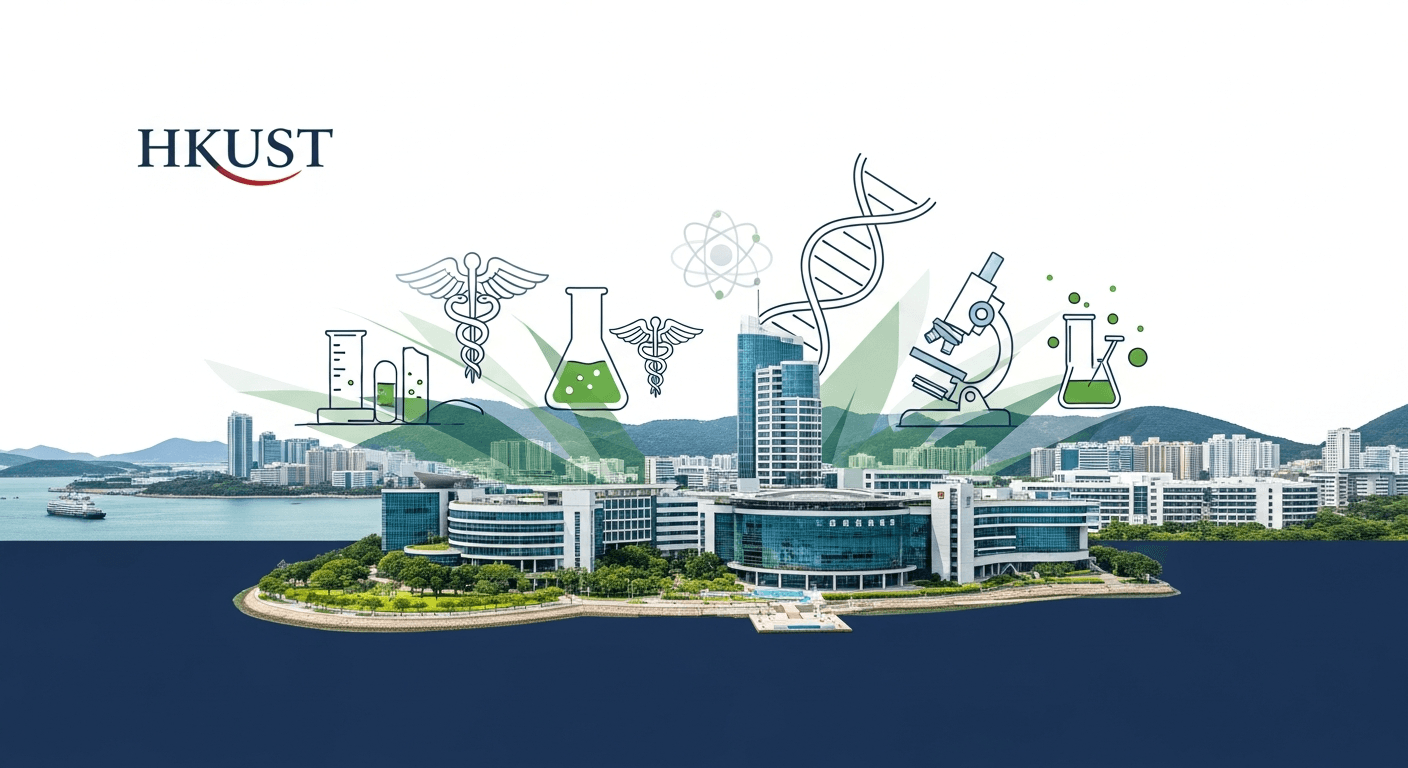
The Third Medical School: Analyzing HKUST’s Physician-Scientist Track for Aspiring HKDSE Medicine Applicants
For decades, aspiring medical students in Hong Kong have faced a highly competitive, two-lane highway: achieving near-perfect HKDSE scores to secure a coveted spot at either HKU or CUHK. But the educational landscape is experiencing a massive seismic shift. The Hong Kong University of Science and Technology (HKUST) has officially proposed the establishment of Hong Kong’s third medical school. For HKDSE students currently battling through their exam preparation, this isn't just breaking news—it is a game-changer that introduces a brand-new pathway: the Physician-Scientist track.
If you are a Form 4 to Form 6 student dreaming of a white coat, this development fundamentally alters how you should strategize your subject selection, university planning, and daily study habits. Let’s dive deep into what HKUST’s vision means for you, how it differs from traditional medical degrees, and how you can leverage modern tools like a smart study platform to future-proof your medical ambitions.
What is a "Physician-Scientist"? Decoding the HKUST Vision
To understand the magnitude of this update, we first need to define what a "Physician-Scientist" actually is. Traditional medical schools primarily train clinical doctors—professionals whose main focus is diagnosing illnesses and treating patients in hospitals or clinics. While clinical practice is vital, modern medicine is rapidly evolving alongside technology.
A physician-scientist operates at the exciting intersection of clinical care and cutting-edge biomedical research. They don't just administer existing treatments; they develop the next generation of cures. They work with genomic sequencing, bioinformatics, targeted cancer therapies, and medical robotics. HKUST’s proposed curriculum aims to produce doctors who are just as comfortable writing algorithms and analyzing big data as they are wielding a stethoscope.
Quick Facts: The Third Medical School Proposal
• The Approach: HKUST is initially pushing for a graduate-entry model. This means students would first complete a relevant undergraduate degree (like Biomedical Science or Bioengineering) before entering the medical program.
• The Focus: Heavy integration of molecular medicine, artificial intelligence in healthcare, and clinical trials.
• The Advantage for You: It provides an alternative route into medicine that doesn't rely solely on the traditional Form 6 JUPAS bottleneck.
How This Changes Your HKDSE Strategy
If the third medical school adopts a graduate-entry physician-scientist model, the pressure of securing straight 5**s in your immediate DSE exams is uniquely redirected. Instead of a do-or-die sprint for a direct MBChB admission, your goal shifts to securing a spot in a top-tier undergraduate feeder program. This requires a highly strategic approach to your HKDSE electives.
1. Biology and Chemistry: The Non-Negotiable Core
For any medical or biomedical pathway, Biology and Chemistry remain your foundational pillars. However, to thrive in a research-focused environment, rote memorization won't cut it. You must deeply understand concepts like DNA recombinant technology, cellular respiration, and organic synthesis. When markers assess your HKDSE Paper 1, they are looking for your ability to apply these concepts to novel scenarios—exactly what a scientist does in a lab.
2. The Rising Power of Physics and Extended Mathematics (M1/M2)
Here is where the physician-scientist track diverges from the traditional path. Modern medical research heavily relies on physics (think MRI machines, radiotherapy, and biomechanics) and advanced mathematics. For instance, understanding clinical trial data requires robust statistical knowledge.
In fact, medical biostatistics frequently utilizes complex probability models to determine the efficacy of a new drug or the accuracy of a diagnostic test. A classic example is Bayes' Theorem, often encountered in advanced statistics, which calculates the probability of an event based on prior knowledge of conditions. In a medical diagnostic context, it is represented as:
\( P(\text{Disease}|\text{Positive Test}) = \frac{P(\text{Positive Test}|\text{Disease}) \times P(\text{Disease})}{P(\text{Positive Test})} \)
Students equipped with M1/M2 and Physics will have a massive competitive advantage when applying for the bioengineering or data-science undergraduate degrees that will eventually feed into HKUST's medical program.
Building a Research-Ready Mindset with AI-Powered Learning
The leap from a secondary school student to a physician-scientist requires a shift in how you acquire knowledge. Relying on outdated study methods like passively rereading textbooks will limit your critical thinking skills. To excel in the dense HKDSE science syllabi, you need adaptive, personalized learning strategies that target your specific cognitive blind spots.
This is exactly where Thinka, Hong Kong's First AI-Powered Practice Platform, transforms your exam preparation. Thinka doesn't just provide generic mock papers; it utilizes sophisticated AI-powered learning algorithms to track your performance, identify exactly which sub-topics you are struggling with (such as Electromagnetic Induction in Physics or Heredity in Biology), and dynamically adjust the difficulty of your practice questions.
Pro Tips for Elevating Your Science Revision:
• Master the Basics Early: Advanced medical concepts build on fundamental principles. Don't wait until Form 6 to patch up your foundational knowledge. You can review core scientific concepts and build the basics early with our Junior Secondary School (S1 - S3) Study Notes.
• Engage in Deliberate Practice: Use Thinka's diagnostic tools to stop practicing what you already know and start attacking your weakest areas. Are you ready to level up your study efficiency? Start Practicing in AI-Powered Practice Platform today.
• Connect Concepts Cross-Curricularly: A true physician-scientist sees the links between subjects. How does the chemistry of buffers relate to the biology of human blood pH? Mapping these connections helps you score higher in DSE structured questions.
Actionable Steps for Aspiring Medical Applicants
Preparing for the third medical school requires foresight. Here is a step-by-step approach to align your current secondary school journey with this future opportunity:
Step 1: Optimize Your JUPAS Band A Choices
If you are aiming for the graduate-entry medical route, research undergraduate degrees that emphasize laboratory skills, bioinformatics, and clinical research. Programs like BSc in Biomedical Sciences, BEng in Biomedical Engineering, or BSc in Biotechnology are excellent stepping stones. Check their specific HKDSE subject weightings and tailor your study time accordingly.
Step 2: Excel in Your SBA (School-Based Assessment)
For science subjects, your SBA is essentially a mini-research project. Treat it as your first foray into the physician-scientist world. Focus on rigorous experimental design, meticulous data collection, and critical error analysis. These are the exact skills HKUST will be looking for in its future medical cohorts.
Step 3: Utilize Smart Resources
Do not drown in unstructured revision. Organize your study materials effectively. Access high-quality, synthesized information to streamline your workflow. You can explore our comprehensive HKDSE Study Notes to solidify your understanding of complex syllabus requirements.
Step 4: Engage in STEM Extracurriculars
Move beyond the textbook. Participate in local science fairs, bioinformatics hackathons, or university-hosted STEM workshops. Demonstrating a genuine passion for scientific inquiry will make your future undergraduate and medical school applications stand out in a sea of identical academic profiles.
The Future of Medicine is Adaptive (And Your Studies Should Be Too)
The announcement of HKUST’s third medical school is a clear signal: the future of healthcare belongs to innovators. It belongs to students who are not just memorizing facts, but who are deeply curious about the mechanisms of human health and the technologies that can improve it.
To meet the rigorous demands of this new pathway, your exam preparation must evolve. Transitioning from passive studying to an interactive, data-driven approach will give you the edge you need to conquer the HKDSE and secure your place in a competitive undergraduate science program.
By leveraging an intelligent study platform, you ensure that every minute of your revision is optimized for maximum retention and analytical growth. The journey to becoming a physician-scientist is a marathon, not a sprint. Equip yourself with the right tools, focus on building a robust scientific foundation, and embrace the future of personalized learning.
If you want to discover more about how innovative educational technology can propel your academic journey forward, visit the Thinka Home Page and transform the way you learn today. The future of medicine awaits—start engineering your success now!