
The Earworm Phenomenon: Why You Can't Stop Thinking About Unfinished Business
Have you ever had a catchy song randomly loop in your head all day, only to finally disappear the moment you listen to the track all the way through to the end? Or perhaps you have binge-watched a Netflix series late into the night simply because the previous episode ended on a massive cliffhanger? If you have experienced this relentless mental itch, you have already fallen victim to a powerful psychological quirk.
For HKDSE students, this phenomenon is not just a frustrating distraction—it is a hidden superpower waiting to be unlocked. Welcome to the Zeigarnik Effect.
In the high-stakes world of exam preparation, maintaining study momentum is often the hardest battle. You sit down at your desk, stare at a towering stack of past papers, and suddenly, cleaning your room seems like a fantastic idea. Procrastination sets in, and motivation flatlines. But what if you could hack your brain to literally crave finishing your revision? By understanding and exploiting the psychology of unfinished tasks, you can transform study resistance into a relentless drive for completion.
Quick Fact: The Waiter's Secret
The Zeigarnik Effect was first observed in the 1920s by Russian psychologist Bluma Zeigarnik. While sitting in a bustling café in Vienna, she noticed something fascinating about the waiters. They could remember complex, lengthy food orders for unpaid tables with perfect clarity without writing anything down. However, the exact moment the bill was settled and the loop was closed, the waiters completely forgot what the customers had ordered! Zeigarnik's subsequent studies proved a fundamental human truth: our brains are hardwired to remember and fixate on incomplete or interrupted tasks far more than completed ones.
Translating Psychology into HKDSE Study Momentum
So, how does a 1920s café observation help a Form 6 student trying to survive the HKDSE?
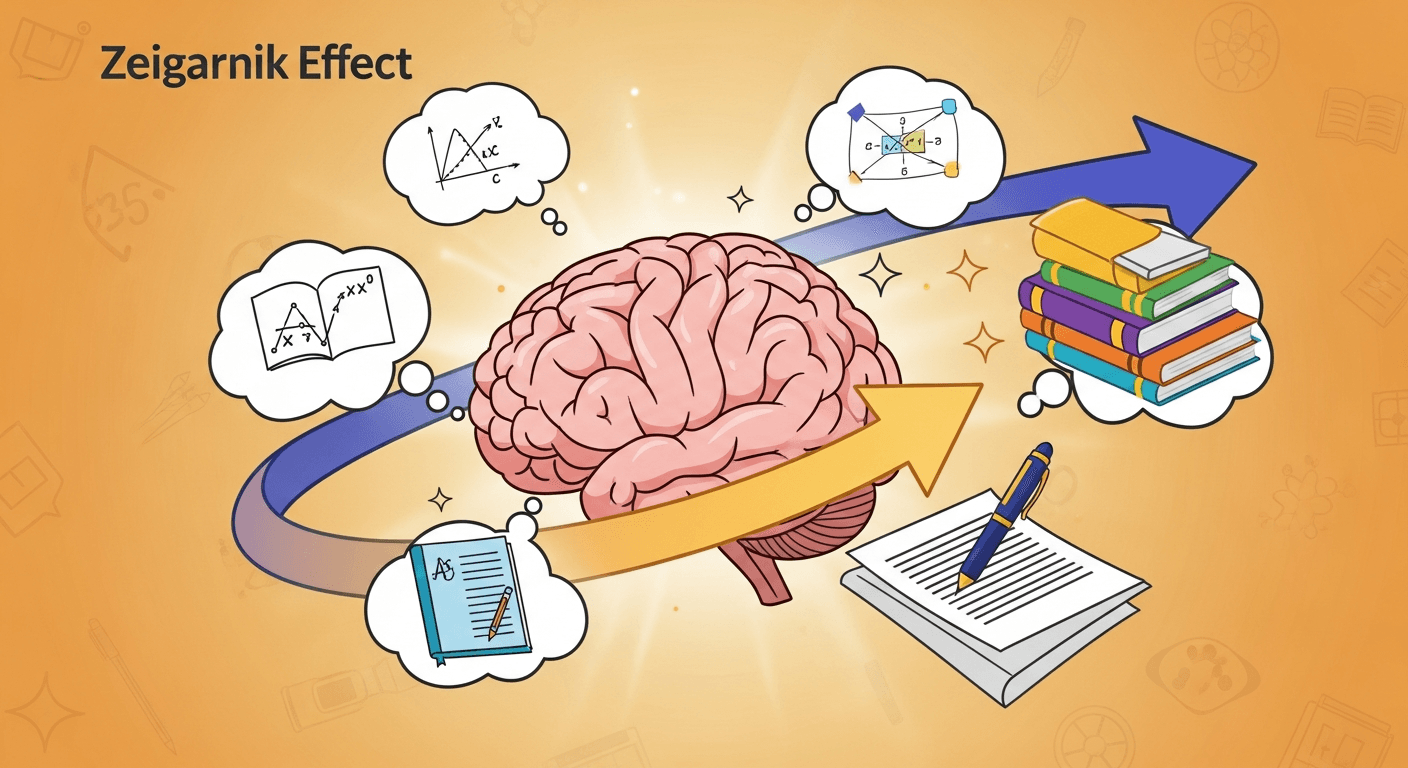
When you leave a task unfinished, it creates a state of cognitive tension. Your brain effectively opens a background application, draining mental battery life by constantly reminding you, "Hey, we still need to finish that!" While this sounds stressful, it is actually the ultimate antidote to procrastination if you control the narrative. Here is how you can weaponize the Zeigarnik Effect to sustain your study momentum.
Strategy 1: The "Five-Minute Fiction" to Beat Task Paralysis
The heaviest weight to lift is always the initial one. When you are dreading a massive revision block, the thought of completing a whole module is paralyzing. To bypass this, lie to your brain. Tell yourself you are only going to study for five minutes, and then you are allowed to quit.
The execution: Open your book, read just one paragraph, or set up a single equation. Because of the Zeigarnik Effect, once you initiate the task, your brain suddenly registers an "open loop." The cognitive itch begins. You will find that after the five minutes are up, the urge to simply finish what you started will often overpower the initial dread of beginning. You have successfully tricked yourself into momentum.
Strategy 2: The Art of the "Strategic Cliffhanger"
Conventional wisdom tells you to finish a chapter before taking a break or wrapping up your study session for the night. The Zeigarnik Effect strongly disagrees. If you completely finish a topic, you close the loop. The next day, starting a brand-new topic will require a massive spike in willpower.
The execution: Stop studying right in the middle of something interesting or easily solvable. If you are writing a practice essay, stop mid-sentence. If you are doing Mathematics, write out the formula like \( x = \frac{-b \pm \sqrt{b^2 - 4ac}}{2a} \) but do not substitute the numbers yet. When you return to your desk the next day, your brain will immediately recognize the unfinished sentence or equation. The cognitive tension will pull you right back into the flow state instantly, bypassing the usual 20 minutes of dawdling and phone-checking.
Strategy 3: Micro-Tasking and Manufactured Milestones
A vague goal like "Study Biology" does not create a strong Zeigarnik Effect because there is no clear boundary of what constitutes a finished or unfinished task. To exploit the psychology, you need granular, highly specific open loops.
The execution: Break your subjects down into micro-tasks. Instead of "Study Biology," list out: 1. Outline the steps of mitosis. 2. Draw a diagram of a plant cell. 3. List three differences between arteries and veins. By creating a checklist of tiny, easily interrupted tasks, you provide your brain with multiple loops to open and excitedly close, generating a steady stream of dopamine that sustains your momentum over long hours.
Supercharging the Zeigarnik Effect with AI-Powered Learning
While sticky notes and strategic stopping points are great DIY methods, modern educational technology has fundamentally changed how we can manipulate cognitive loops for maximum retention. This is exactly where an innovative study platform can dramatically elevate your performance.
When you rely on static textbooks, you have to manually track your progress and decide when to interrupt yourself. However, embracing AI-powered learning allows the system to engineer these psychological hooks for you. A smart platform analyzes your performance metrics in real-time, strategically presenting you with the perfect level of challenge to keep you engaged without feeling overwhelmed.
For instance, Start Practicing in AI-Powered Practice Platform allows students to experience the benefits of personalized learning firsthand. The AI understands exactly where you left off, creating a seamless bridge between study sessions. It intentionally surfaces micro-assessments that create productive cognitive tension, pulling you back into the app to complete your personalized learning loop. By integrating these adaptive technologies, your exam preparation shifts from a chore into a highly engaging, momentum-driven experience.
Whether you are a senior secondary student polishing your final subjects or seeking foundational Junior Secondary School (S1 - S3) Study Notes, leveraging an intelligent system ensures your brain is always primed for the next academic challenge.
Real-World Applications for Core HKDSE Subjects
Applying this psychological framework requires a slightly different approach depending on the academic discipline. Let us look at how you can implement these strategies across various subjects to keep your study momentum surging.
Conquering English Language Writing
Writer's block is the enemy of the DSE English Paper 2. To use the Zeigarnik Effect, never end your study session at the conclusion of an essay. Instead, finish your body paragraph, write the very first sentence of the next paragraph, and then close your laptop. Your brain will spend the rest of the evening subconsciously formulating the arguments to complete that thought. When you sit down the next day, the words will flow effortlessly.
Navigating Complex Mathematics
Mathematical problem-solving relies heavily on recognizing patterns. If you are stuck on a particularly brutal geometry or calculus question, do not look up the marking scheme immediately. Try to solve it for ten minutes. If you are still stuck, walk away and do something completely unrelated, like taking a shower or doing the dishes. The open loop of the unsolved problem forces your subconscious to continue processing the mathematical parameters in the background. Often, the "Eureka!" moment hits when you are nowhere near your desk.
Mastering Elective Sciences
Science subjects require both memorization and application. Create artificial cliffhangers by reading the setup of an experiment in your HKDSE Study Notes, but purposefully stop reading right before the textbook reveals the final result or the chemical reaction. Guess the outcome. Let the suspense build for an hour while you study something else. The urge to know if your hypothesis was correct will draw you back to the material, cementing the actual result much deeper into your memory once the loop is finally closed.
Pro Tip: Balancing the Loops to Avoid Burnout
While the Zeigarnik Effect is a brilliant tool for initiating study sessions, keeping too many loops open simultaneously can lead to cognitive overload and severe exam anxiety. Your brain only has so much RAM.
The Solution: The "Brain Dump"
If you find yourself lying in bed, unable to sleep because your brain is reminding you of the twenty different Chemistry formulas and English vocab words you haven't mastered yet, you need to artificially close the loops. Keep a notepad by your bed. Write down every single unfinished study task that is bothering you. The physical act of transferring these tasks from your mental memory to a physical piece of paper tells your brain, "It is safe to close this application now; the data is saved externally." This simple act instantly reduces anxiety and allows you to rest.
Laying the Foundation Early
While Form 6 students are the most obvious beneficiaries of advanced study psychology, these habits are best cultivated early. Students who learn how to manage their cognitive momentum from a young age have a distinct advantage when high-stakes exams arrive. Accessing well-structured Primary School Study Notes and slowly introducing the concept of micro-tasking can help younger learners build resilience against procrastination long before the pressure of secondary school hits. For comprehensive educational tools that grow with you from primary through secondary education, explore the thinka Home Page.
The Future of Exam Preparation: Closing the Loop on Success
The HKDSE is an endurance marathon, not a sprint. Relying solely on fleeting bursts of motivation or sheer willpower will inevitably lead to exhaustion and burnout. To truly excel, you need to work with your brain's natural wiring, not against it.
By embracing the Zeigarnik Effect, you transform procrastination from an insurmountable wall into a tiny hurdle. You learn to manufacture your own momentum by using the "Five-Minute Fiction" to break task paralysis, employing strategic cliffhangers to make tomorrow's study session frictionless, and utilizing micro-tasks to trigger rewarding hits of dopamine.
Furthermore, by pairing these proven psychological strategies with an advanced, AI-powered learning environment, you remove the friction of manual planning. You step into an ecosystem designed entirely around optimizing your cognitive flow, providing genuinely personalized learning that adapts to your unique pace and ensures your exam preparation is as efficient as humanly (and artificially) possible.
So, the next time you sit down to revise, don't aim for a perfect, cleanly finished session. Leave a little bit of the puzzle unsolved. Give your brain a cliffhanger. You might just find that leaving things a little unfinished is the ultimate secret to achieving your 5** goals.