
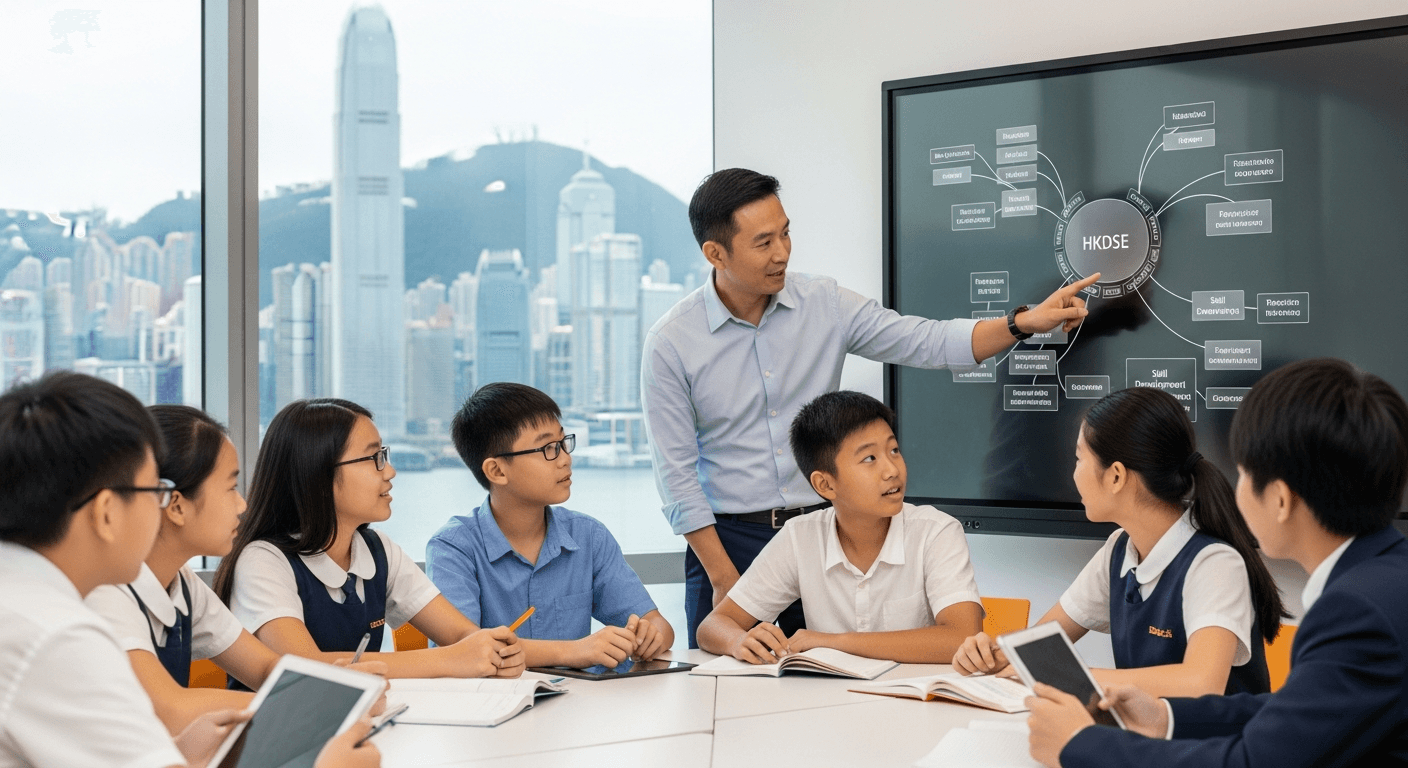
The Enrollment Contraction Upside: Evaluating S1 Options for Enhanced Individualized HKDSE Mentorship
If you’ve been following local education news, you’ve likely seen the headlines: shrinking student populations, primary schools facing closure risks, and the reduction of "door-knocking" places. While the media often frames Hong Kong’s enrollment contraction as a crisis for institutions, there is a hidden narrative that savvy students and parents need to understand. For the HKDSE candidate, this demographic shift represents a potential "Golden Era" of resource allocation. Whether you are advising a younger sibling on S1 selection, considering a school transfer, or simply trying to understand how to maximize your current study environment, the keyword you need to focus on is mentorship density. In this analysis, we explore how the contracting student population is reshaping the secondary school landscape and how you can leverage personalized learning—both in the classroom and through AI—to secure your university entrance ticket.The New Metric: Mentorship Density Over "Banding" Prestige
Traditionally, Hong Kong students and parents have obsessed over "Banding." While academic rigor is important, the enrollment contraction has elevated a new metric: the Teacher-to-Student Ratio. As class sizes naturally shrink due to migration and lower birth rates, schools that maintain their teaching staff levels effectively increase the amount of individual attention available per student.Why Small Cohorts Win in the HKDSE
In the high-stakes HKDSE environment, personalized feedback is the single biggest driver of grade improvement. Consider the mathematics of a typical 60-minute lesson: \( T_{attention} = \frac{T_{lesson} - T_{instruction}}{N_{students}} \) In a packed class of 36 students ($N=36$), if the teacher lectures for 30 minutes, there are only 30 minutes left for individual interaction. That is roughly 0.83 minutes of personal mentorship per student. However, in schools affected by enrollment contraction where class sizes might drop to 20-24 ($N=24$), that individual attention time jumps to 1.25 minutes—a 50% increase in mentorship capacity. Pro Tip: When evaluating S1 options (or transfer opportunities), look beyond the school's historical Banding. Ask specifically about average class sizes in senior forms (S4-S6). A slightly lower-band school with small class sizes may offer better support for School-Based Assessment (SBA) and personalized essay marking than a top-tier school with overcrowded classrooms.The Direct Impact on SBA and Electives
The upside of enrollment contraction is most visible in subject electives and the SBA. 1. SBA Guidance: In subjects like English Language and Liberal Studies (now Citizenship & Social Development), the SBA component requires drafting and redrafting. A teacher with fewer scripts to mark can provide granular, specific feedback rather than generic comments. 2. Survival of Niche Electives: Paradoxically, while some schools cut subjects, others use the surplus teacher capacity to offer smaller, niche classes. You might find yourself in a Physics or Literature class with only 8–10 peers. This is essentially private tutoring funded by the school. 3. University Counseling: With fewer competitors in your cohort, career masters have more bandwidth to help you craft compelling JUPAS strategies and SLP (Student Learning Profile) descriptions.The Reality Gap: What If You’re in a Crowded Classroom?
While the demographic trend suggests smaller classes are the future, many current HKDSE students are still stuck in the "old reality"—large classes, overworked teachers, and generic feedback. You might be asking: "How does the enrollment contraction help me if I'm one of 40 students right now?" If you cannot change your physical classroom environment, you must change your digital study environment. This is where the revolution in AI-powered learning bridges the gap between the mentorship you need and the mentorship you have.Bridging the Mentorship Gap with AI
If your school cannot provide that "1-on-1" mentorship experience due to class size, you need to simulate it. Modern EdTech platforms have evolved to function as on-demand academic mentors.1. Instant Feedback Loops
In a large class, you might wait two weeks to get a Math quiz back. By then, you’ve forgotten why you made the mistake. AI platforms like Thinka provide real-time error analysis. When you get a question wrong, the system doesn't just mark it "X"—it explains the misconception immediately, mimicking the guidance of a private tutor sitting next to you.2. Adaptive Difficulty Scaling
A classroom teacher must teach to the "average" ability of the room. If you are ahead, you are bored; if you are behind, you are lost. Personalized learning algorithms solve this. They analyze your performance data to adjust the difficulty of subsequent questions. This ensures you are always in the "Zone of Proximal Development"—the sweet spot where learning happens fastest.3. The "24-Hour Teacher"
The enrollment contraction benefits are limited to school hours. AI-powered practice extends mentorship to your late-night study sessions. Whether it's explaining a complex Chemistry concept or breaking down a tricky Grammar rule, Start Practicing in AI-Powered Practice Platform ensures you are never stuck without guidance, effectively giving you the benefits of a "class of one."Actionable Advice for HKDSE Students
Whether you are benefiting from a shrinking school population or fighting through a crowded one, here is how to secure the best mentorship for your exam preparation: * Audit Your Feedback Ratio: Are you getting detailed comments on your English writing and LS/CSD tasks? If your teacher is overwhelmed, be proactive. specifically ask for feedback on one particular paragraph or skill set. Teachers are more likely to respond to specific requests than general "check my work" demands. * Leverage "Door-Knocking" Trends: If you are in S3 or S4 and feel your current school’s environment is hindering your potential, research schools in your district that have faced enrollment drops. They may be more open to accepting transfer students with potential, offering you a chance to move to a smaller, more supportive learning environment. * Supplement with Smart Tech: Don't rely solely on school resources. Use HKDSE Study Notes to consolidate your base knowledge, and then use AI tools to drill weak areas. The combination of human instruction and AI practice is the most efficient study model available today. * Investigate "Through-Train" Implications: If you have siblings, advise your parents that "Through-Train" schools (linking Primary to Secondary) are safer bets in an enrollment contraction era, ensuring educational stability and consistent mentorship culture.Conclusion: Creating Your Own "Small Class" Advantage
The enrollment contraction in Hong Kong is reshaping the educational landscape, slowly shifting the power dynamic from institutions to students. While the macro trend points toward smaller class sizes and better teacher-student ratios, you do not have to wait for the system to catch up to reap the benefits. By actively seeking environments that offer individualized mentorship—whether by choosing schools with favorable ratios or by building a personalized AI-powered study ecosystem—you can ensure that your HKDSE preparation is tailored to your unique strengths and weaknesses. The "one-size-fits-all" era of education is fading. The future belongs to students who curate their own feedback loops and personalized support systems.Ready to experience the power of personalized mentorship? Start Practicing in AI-Powered Practice Platform today and turn every study session into a 1-on-1 masterclass.