
The DSE Pressure Cooker: Why Mental Health Strategies Can't Wait
Let's be completely honest: the journey to the HKDSE is often compared to a marathon, but for many Form 6 students, it feels more like an endless series of high-stakes sprints. Between juggling SBA deadlines, mock exams, and endless past paper drills, the pressure to perform can feel crushing. It is no secret that exam preparation in Hong Kong pushes students to their cognitive and emotional limits.
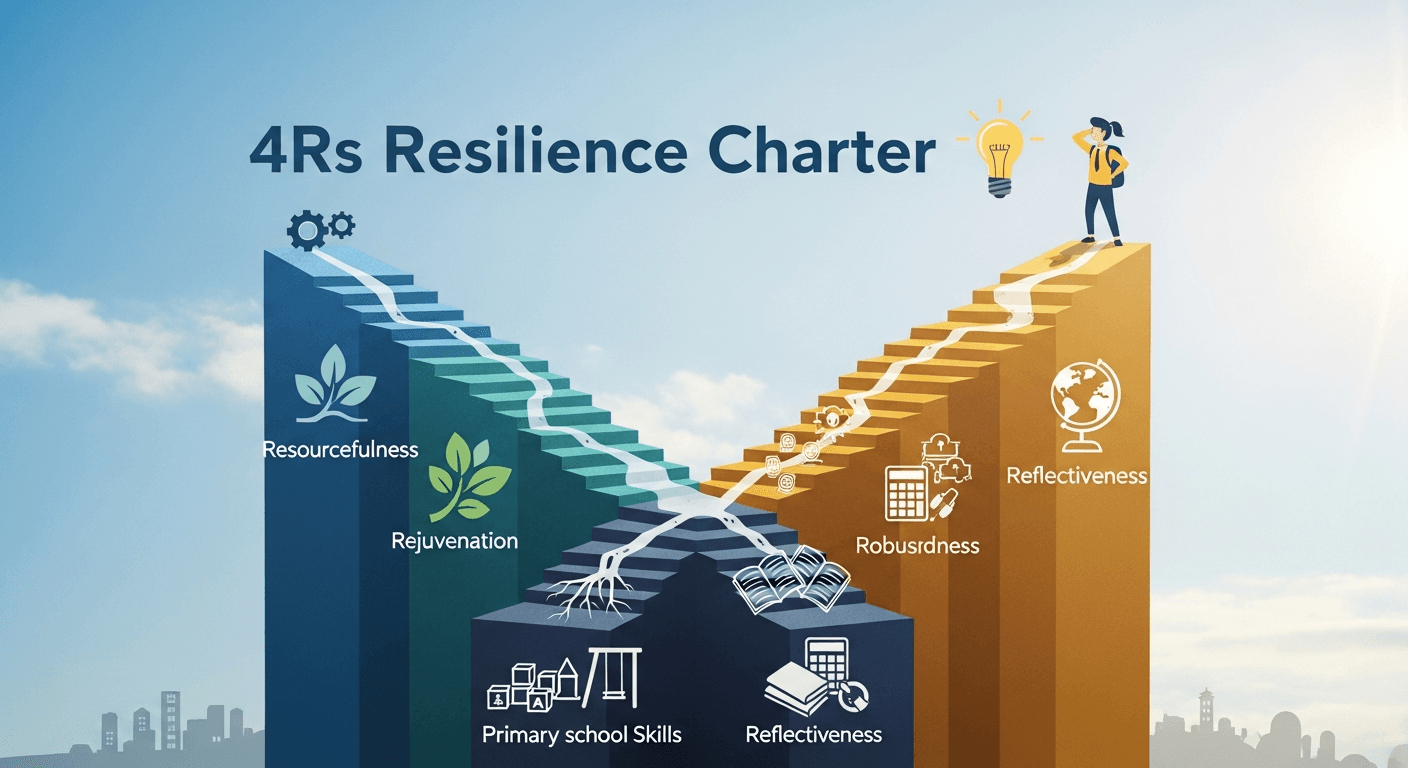
Recently, the Hong Kong Education Bureau (EDB) launched the "4Rs Mental Health Charter," an initiative initially introduced to help schools build a healthy, happy environment for younger students. But if you think these concepts are just for Primary School Study Notes, think again. The core principles of the 4Rs—Rest, Relaxation, Relationship, and Resilience—are actually the ultimate high-performance coping mechanisms.
In this article, we are going to explore how scaling up these foundational coping skillsets can act as a powerful buffer against HKDSE assessment pressure, and how modern tools like an AI-powered learning system can give you the time and space to actually practice them.
Decoding the 4Rs: Upgrading Primary Coping Skills for DSE Survival
When you were younger, "well-being" might have meant a longer recess or a fun class activity. Now, as a senior secondary student, well-being is a strategic necessity. If your brain is a smartphone, the 4Rs are the operating system updates required to keep it from crashing during heavy use. Let's break down how to scale each "R" for the HKDSE battlefield.
R1: Rest – Reclaiming Sleep for Cognitive Superiority
In primary school, rest simply meant going to bed on time. In the DSE context, Rest is your most potent biological weapon for memory consolidation. Many students fall into the trap of "revenge bedtime procrastination" or pull all-nighters, mistakenly believing that sacrificing sleep equates to higher productivity.
The DSE Upgrade: Science shows that during deep sleep, the brain transfers newly acquired information from the short-term memory vault (the hippocampus) to the long-term storage drive (the neocortex). If you skip sleep, you literally delete the study progress you made that day. Instead of viewing rest as "time wasted," view it as "time processing." Aim for 7-8 hours of quality sleep. If you are struggling with time management, utilizing a smart study platform can help you learn more efficiently during the day, so you do not have to steal hours from your sleep at night.
R2: Relaxation – Engineering Active Decompression
Relaxation is not just collapsing on the couch and doomscrolling through social media for three hours. While passive scrolling might feel numbing, it often increases baseline anxiety and cognitive fatigue.
The DSE Upgrade: You need Active Decompression. This means intentionally engaging in activities that switch your brain state. Whether it is a 20-minute run, playing a musical instrument, or practicing mindfulness breathing before a grueling Mathematics Paper 1 drill, active relaxation flushes out the stress hormone cortisol.
Pro Tip for DSE Relaxation:
Implement the "Hard Stop" rule. Set a specific time every evening (e.g., 10:30 PM) where all HKDSE Study Notes are put away. This clear boundary signals to your brain that the workday is over, allowing your nervous system to genuinely relax.
R3: Relationship – Building a Strategic DSE Support Network
The "Relationship" pillar originally emphasizes anti-bullying and teacher-student harmony. For a DSE student, this scales into building an academic and emotional support network. The DSE can feel incredibly isolating, especially when you are locked in your room studying alone.
The DSE Upgrade: You cannot survive the DSE on an island. Form strategic study alliances. A good study group doesn't just share notes; they share the emotional burden. When you teach a complex Chemistry concept to a peer, you reinforce your own understanding. Furthermore, do not hesitate to reach out to your teachers or mentors from your Junior Secondary School (S1 - S3) Study Notes days who know your learning style. A strong relationship with educators can provide you with targeted feedback that saves you weeks of misguided revision.
R4: Resilience – Reframing Setbacks into Data
Resilience is the crown jewel of the 4Rs Charter. In early education, it means trying again when you fall off a bicycle. In Form 6, it means surviving a devastating mock exam result without losing your motivation.
The DSE Upgrade: High achievers often tie their self-worth entirely to their grades. When a test goes poorly, it feels like a personal failure. Resilience in the DSE requires a growth mindset. You must view a poor grade not as a final judgment, but as diagnostic data.
Ask yourself: Did I misunderstand the core concept? Was my time management off? Did I misread the question? By separating your ego from the assessment, you can adapt your strategy. This is where personalized learning shines—by helping you identify exact knowledge gaps without the emotional baggage of traditional grading.
How Modern EdTech Protects Your 4Rs
You might be thinking, "This all sounds great, but I simply do not have the time to rest and relax. I have too much to study!" This is a valid concern, and it is exactly why the traditional "brute force" method of studying is outdated.
To successfully integrate the 4Rs into your life, you need to drastically improve your study efficiency. This is where an AI-driven approach becomes your best ally.
Maximizing Time with AI-Powered Practice
Imagine spending three hours drilling past papers, only to realize you spent 80% of that time answering questions you already knew, while completely ignoring your actual weak points. That is three hours of lost Rest and Relaxation.
By shifting to an innovative approach on the thinka Home Page, you leverage algorithms that analyze your performance in real-time. Instead of a one-size-fits-all study schedule, the platform curates a customized pathway just for you.
- Efficiency buys you Rest: By only targeting the areas where you are weak, you can cut your study time in half while doubling your retention.
- Clarity buys you Relaxation: Knowing that an intelligent system is tracking your syllabus coverage removes the "fear of missing out" (FOMO) that causes background anxiety.
- Data buys you Resilience: Seeing a visual breakdown of your progress helps you reframe mistakes as stepping stones rather than failures.
When you Start Practicing in AI-Powered Practice Platform, you aren't just preparing for an exam; you are outsourcing the heavy lifting of study planning to technology, giving yourself the breathing room to actually be human.
Quick Facts: The Science of DSE Well-being
Fact 1: The human brain consumes about 20% of the body's energy. High-stakes exam preparation depletes glucose levels rapidly, meaning strategic breaks (Relaxation) are mathematically necessary for continued focus.
Fact 2: Studies indicate that students who engage in collaborative learning (Relationship) score significantly higher on problem-solving tasks than those who study strictly in isolation.
Fact 3: Utilizing personalized learning algorithms can reduce study time by up to 30% by eliminating redundant practice, directly supporting the "Rest" pillar of the 4Rs.
Conclusion: Securing Your 5** in Mental Fortitude
The HKDSE is undoubtedly one of the most challenging academic hurdles you will face. However, treating your mental and physical health as secondary to your studies is a recipe for burnout. The EDB's 4Rs Mental Health Charter—Rest, Relaxation, Relationship, and Resilience—is not just a feel-good slogan for primary schoolers; it is a tactical blueprint for secondary school success.
By upgrading these four pillars to meet the demands of senior secondary education, and by utilizing smart, modern tools to optimize your study hours, you can break the cycle of endless stress. Remember, peak academic performance requires a healthy mind. Scale up your coping skills, embrace efficient technologies, and take control of your DSE journey today!