International School6 min read
IGCSE Core vs Extended: Grade Ceilings, Syllabus Gaps, and the Sixth Form Pathway Decision Matrix
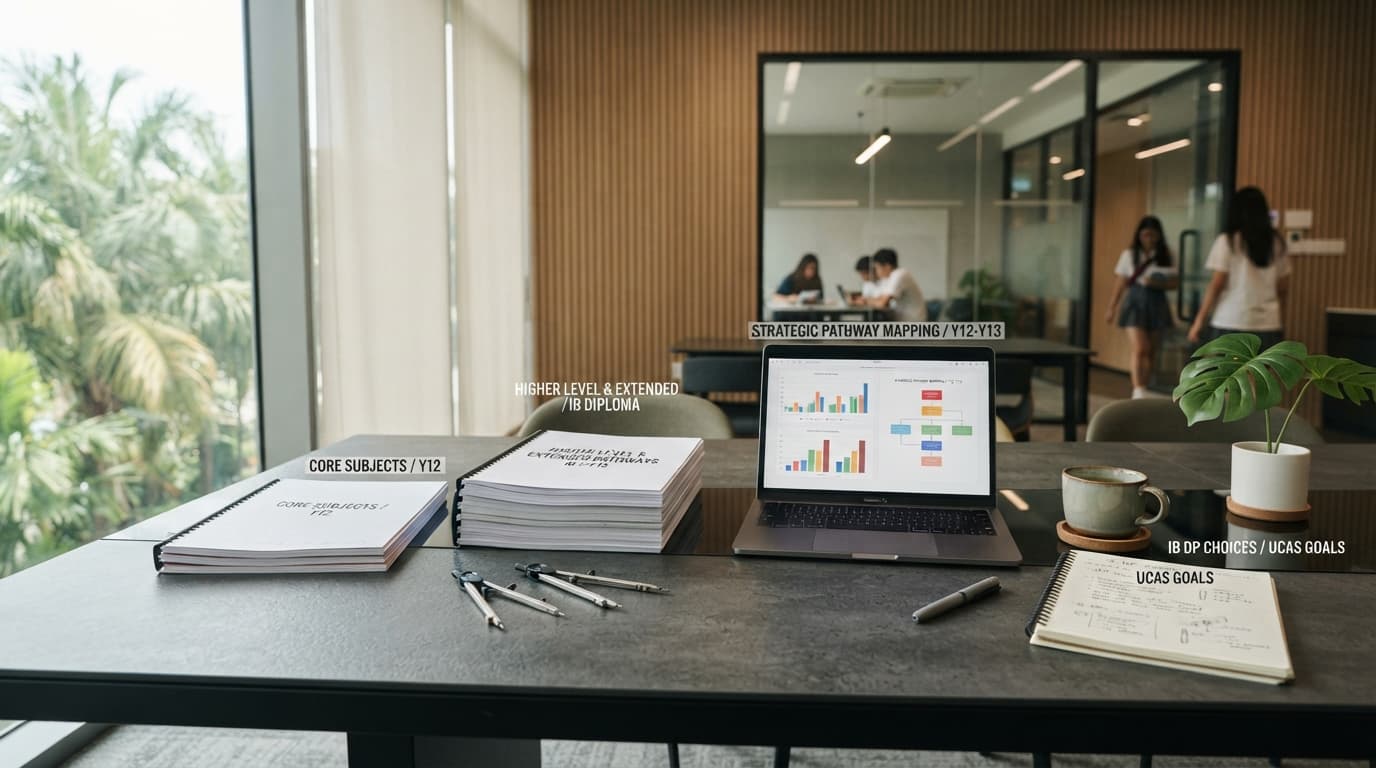
Demystifying IGCSE Core vs Extended: The Immediate Rule
In Cambridge (CAIE) and Pearson Edexcel IGCSE curricula, the choice between Core and Extended papers defines your maximum possible grade. The Core curriculum assesses foundational content and caps the highest achievable result at Grade C on the legacy scale or Grade 5/4 on the 9–1 scale. In contrast, the Extended curriculum encompasses the full Core syllabus alongside advanced supplement topics, unlocking the top tier of grades: Grade A* to G (or Grades 9 to 1).
For international school students in Singapore—whether attending institutions like UWCSEA, Tanglin Trust, Dulwich College, ACS (International), or SJI International—this tiering decision is rarely just about passing Year 11. Taking Core directly restricts entry into rigorous Sixth Form pathways, including International Baccalaureate (IB) Higher Level (HL) subjects and GCE / Cambridge International A-Level (H2 equivalent) disciplines, which top universities in Singapore (NUS, NTU, SMU), the UK, and the US require for competitive courses like Medicine, Law, Economics, and Engineering.
The Structural Breakdown: Grade Ceilings and Paper Allocation
Understanding why grade ceilings exist requires looking at paper structure. Exam boards design Core papers with targeted questions to test fundamental recall, straightforward applications, and essential numeracy/literacy. Extended papers integrate multi-step problem solving, non-routine proofs, and synoptic evaluation across topics.
1. Cambridge IGCSE Mathematics (0580 / 0980)
In Cambridge IGCSE Mathematics, candidates either sit the Core combination (Paper 1 and Paper 3) or the Extended combination (Paper 2 and Paper 4). On the Core route, your maximum score is capped at Grade C (or Grade 5). On the Extended route, scoring over approximately 70% to 75% of raw marks typically secures a Grade 7 or 8 (A/A*), depending on annual boundaries. If a student sits Extended and misses the minimum threshold for Grade E/3, they receive an Ungraded (U) result without a fallback to Core credit.
2. Cambridge Co-ordinated Sciences (0654) vs. Combined Science (0653)
Science subjects employ a split paper model. Core candidates sit Paper 1 (Multiple Choice - Core), Paper 3 (Theory - Core), and practical Paper 5/6. Extended candidates sit Paper 2 (Multiple Choice - Extended), Paper 4 (Theory - Extended), and Paper 5/6. In Singapore's competitive secondary landscape—analogous to the distinction between GCE O-Level Pure Sciences and Combined Science—taking Extended is vital to cover the depth of biochemistry, stoichiometry, and mechanics demanded in upper secondary study.
3. First vs. Second Language English (0500 / 0510)
English Language specifications evaluate analytical writing and summary tasks under tighter time constraints on Extended tiers. While Core allows students to demonstrate functional operational English, university admissions tutors in the UK and Singapore generally mandate Grade 6/B or above in First Language English (Extended) or English Literature to waive standard English proficiency test requirements such as IELTS or TOEFL.
Sixth Form Progression: The IB Diploma and A-Level Fallout
Your choice of tier during Year 10 and Year 11 directly governs your subject eligibility in Year 12 and Year 13. Most international schools and junior colleges establish strict prerequisite thresholds before permitting enrollment in advanced courses:
1. IB Mathematics: Analysis and Approaches (AA) vs. Applications and Interpretation (AI)
IB Mathematics AA HL requires mastery of calculus, vector geometry, and abstract algebraic manipulation that appear exclusively in the IGCSE Extended syllabus (and often benefit from Additional Mathematics 0606). A student completing Core Mathematics is almost universally restricted to IB Math AI SL or Math AA SL, immediately ruling out direct entry to top-tier Engineering, Physics, and Data Science degrees.
2. IB Sciences and A-Level STEM (Physics, Chemistry, Biology)
Entering IB Chemistry HL or A-Level Chemistry requires a solid foundation in mole concepts, organic reaction pathways, and redox calculations. Core science curricula omit approximately 35% to 45% of this theoretical depth. Schools will not permit a student holding an IGCSE Core Grade C to enroll in HL Sciences due to the extreme attrition rate during the first term of Year 12.
3. University Matriculation Benchmarks
Autonomous universities in Singapore (such as NUS, NTU, and SMU) and Russell Group institutions in the UK look closely at your IGCSE transcript. Even if your overall IB score or A-Level predicted grades are strong, an IGCSE transcript containing Core grades in prerequisite subjects signals a historic deficit in quantitative or scientific rigor.
The Raw Mark Risk vs. Reward Framework
Students hovering around a borderline 50% to 60% mark in mid-Year 10 internal assessments often question whether dropping to Core is a safer tactic to guarantee a passing grade. Here is how to evaluate the risk objectively:
Extended Tier Safety Net: On Cambridge Extended papers, achieving roughly 35% to 40% of the raw marks often yields a Grade D or C (Grade 4). This means that working hard to secure fundamental marks on an Extended paper carries almost the same statistical safety margin as sitting Core, but with the upside of securing a Grade 6, 7, 8, or 9 if performance peaks on exam day.
The Core Risk: Choosing Core eliminates the downside of a 'U' from missing higher-tier questions, but it permanently caps your potential. If you score 95% on a Core paper, your certificate will still display a Grade C / Grade 5. If your university or Sixth Form course demands a Grade B or 6, a perfect Core paper is still disqualified.
Step-by-Step Diagnostic: How to Bridge the Extended Gap
Before exam registration windows close in early spring, use this structured intervention framework to determine if you can bridge the supplemental content:
Step 1: Map the Syllabus Delta
Isolate the exact Extended supplement chapters in your subject guide. In Mathematics, these typically include trigonometry in 3D, matrix transformations, differentiation, and complex probability trees. In Chemistry, focus on equilibrium constants, electrolysis calculations, and organic isomers. You can access free structured guides across our curated study notes to compare Core and Extended topics side-by-side.
Step 2: Targeted Topical Drilling
Avoid taking full Extended past papers right away if fundamentals are unstable. Instead, isolate individual supplement topics. By utilizing an AI-powered practice platform, you can generate tiered problem sets that introduce Extended difficulty incrementally, diagnosing whether errors stem from conceptual misunderstandings or algebraic execution.
Step 3: Simulate Real Exam Timing and Mark Schemes
Extended papers punish slow pacing. Paper 4 in Cambridge IGCSE 0580 requires answering 100 to 130 marks in 2 hours. Practice writing complete solutions under strict conditions, ensuring your working matches the method mark allocations outlined in official mark schemes.
Step 4: Consult with Educators Using Performance Data
Do not make tier selections based on subjective confidence alone. Review diagnostic test data, homework submission accuracy, and mock exam percentiles with your subject teachers. Educators looking to construct customized diagnostic assessments can explore our teacher paper generation tools to build targeted gap-closing exams.
Final Recommendation: Strategic Tier Selection
Unless a student faces severe language barriers, significant learning difficulties, or has fallen multiple terms behind in class, international school candidates should aim to sit the Extended tier across Mathematics, Sciences, and First Language English. The Extended syllabus keeps every door open for IB Higher Level and A-Level courses, safeguarding competitive university applications.
If you are currently struggling with supplement topics, leverage personalized study support on Thinka to pinpoint weak units, master complex problem-solving routines, and secure the top-tier grades your academic pathway demands.
Related posts
- Sep 22, 2026
Edexcel IGCSE Maths Grade Boundaries: How to Secure a Grade 9 in Paper 1H and 2H
Crack Pearson Edexcel IGCSE Maths grade boundaries. Learn raw-to-9 conversion cutoffs, Paper 1H/2H marks, and target high-tariff questions to lock in a Grade 9.
- Sep 11, 2026
Hardest IGCSE Subjects Ranked: Cambridge & Edexcel Grade 9 Data, Workload Matrix, and IB Pathways
Discover the hardest IGCSE subjects ranked by Cambridge and Edexcel Grade 9 pass rates, cognitive load, and mark scheme rigor to balance your Year 10-11 subject selection.
- Sep 1, 2026
CIE IGCSE Grade Boundaries: Calculating Raw Marks, Component Scaling, and Thresholds
Master CIE IGCSE grade boundaries and component weightings. Learn how raw marks scale to 9-1 thresholds, calculate composite scores, and plan resits.
- Aug 22, 2026
Hardest A-Levels Ranked: Pass Rates, Syllabus Volume, and Singapore Pre-U Subject Selection Strategy
Discover the hardest A-Levels ranked by pass rates, syllabus volume, and cognitive demand. Learn how to craft a high-scoring subject combination for top universities.