Secondary School Selection for Primary Students5 min read
The Resilience Auditor: Evaluating Secondary Schools for ‘Productive Struggle’ and Adversity Quotient (AQ)
Beyond the PSLE Cut-Off Point: The New Metric for Success
For most Singaporean parents, the post-PSLE season is defined by a singular focus: the Cut-Off Point (COP). We pore over booklets, comparing the previous year’s entry scores for O-Level and Integrated Programme (IP) tracks, convinced that a higher entry requirement equates to a better future for our children. However, as the Ministry of Education (MOE) shifts toward Full Subject-Based Banding (Full SBB) and a more holistic definition of meritocracy, the COP is becoming an increasingly narrow lens through which to view a school’s value.
By 2030, the academic landscape will be dominated by AI-driven automation and complex, non-linear problems. In this environment, your child’s Adversity Quotient (AQ)—their ability to navigate setbacks and maintain performance under pressure—will be far more predictive of success than their ability to memorise model essays. As you visit Open Houses and evaluate your options, you must act as a 'Resilience Auditor.' You aren't just looking for a school that offers 'help'; you are looking for a school that intentionally designs Productive Struggle into its DNA.
What is Productive Struggle?
In the primary school environment, learning is often 'high-support.' Teachers and parents provide significant scaffolding to ensure children don't fall behind. However, the transition to Secondary 1 marks a psychological shift toward autonomy. Productive struggle is the pedagogical sweet spot where a student faces a challenge that is just beyond their current capability, requiring them to exert effort, try new strategies, and experience minor 'failures' before succeeding.
If a school removes all struggle, they remove the opportunity for the student to build AQ. A school that masters this does not leave the student to drown; instead, they provide Adaptive Support Systems—safety nets that catch the student only after the struggle has occurred, turning a moment of frustration into a milestone of grit.
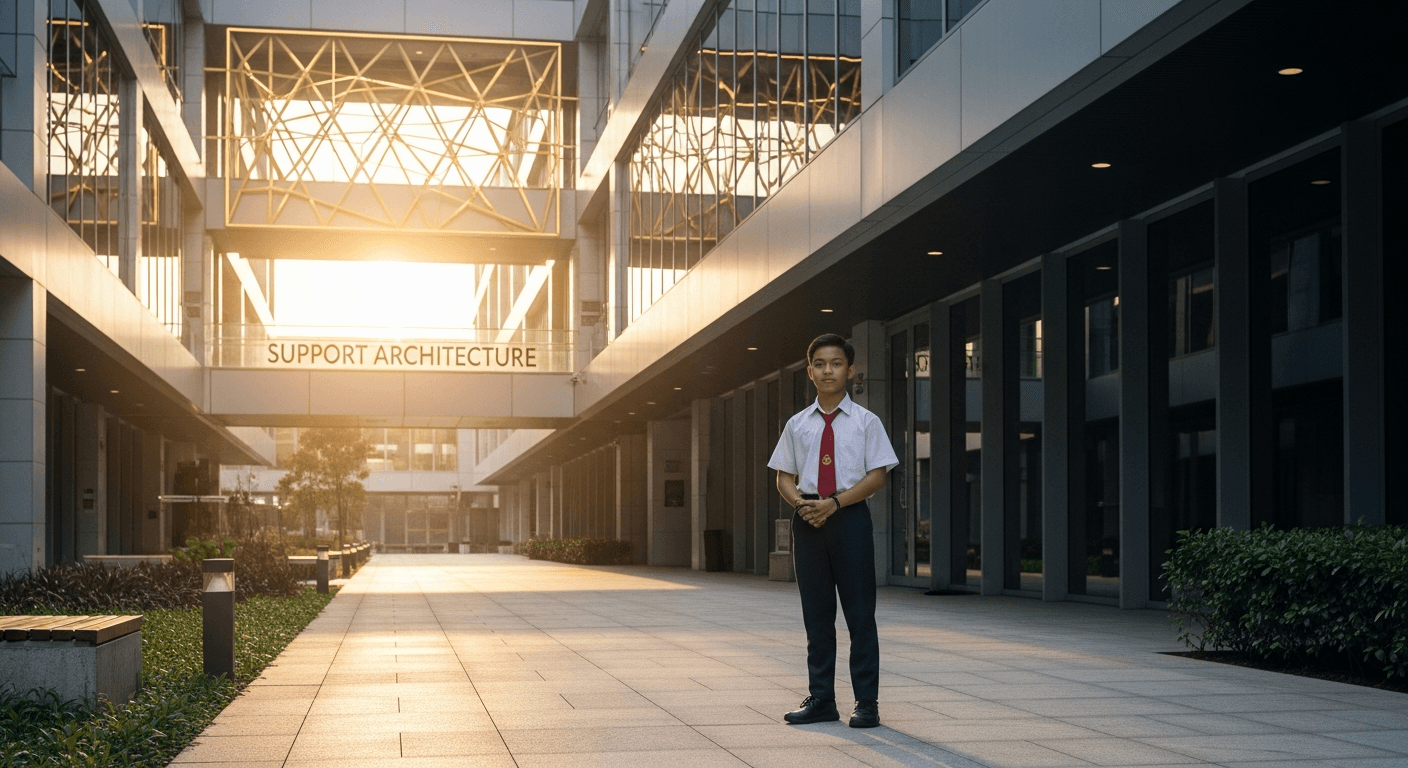
Auditing the ‘Support Architecture’ of Secondary Schools
When attending school talks or speaking to student ambassadors, move beyond questions about CCA options or canteen food. To audit a school’s resilience-building capacity, look for these three pillars of 'Support Architecture':
1. The Transition Bridge: From Guided to Autonomous Learning
The jump from P6 to Sec 1 is often where the 'Understanding Illusion' shatters. In primary school, a student might have a high score simply by following templates. In secondary school, the complexity of subjects like Lower Secondary Science and Geography requires higher-order synthesis. Ask: "How does the school manage the jump in cognitive load during Term 1?"
Look for schools that offer metacognitive coaching—teaching students how to learn rather than just what to learn. A school that encourages students to use an AI-powered practice platform to identify their own knowledge gaps is one that values self-directed growth over passive spoon-feeding.
2. The Error Culture: Normalising the 'Not Yet'
Resilience cannot grow in an environment where mistakes are penalised immediately. In your audit, observe how the school handles formative assessments. Do they use 'feedback-only' cycles where students are encouraged to iterate on their work before a final grade is recorded?
A school with a high AQ focus will treat a wrong answer as a data point. This aligns with modern study methods where students leverage AI for personalised feedback, allowing them to fail safely in a private environment before performing in a high-stakes exam. Ask the teachers: "How do you reward the process of solving a difficult problem, even if the final answer is initially wrong?"
3. Scaffolding for Emotional Regulation
Search data shows a 40% increase in queries regarding 'school transition anxiety.' The transition isn't just academic; it’s social-emotional. A school’s resilience architecture must include robust Social-Emotional Learning (SEL) frameworks. This includes peer support boards and accessible counselling, but also extends to the classroom. Does the school teach students how to manage the 'Zone of Proximal Development'—that feeling of being slightly overwhelmed—without giving up?
The Role of Technology in Building Grit
It may seem counterintuitive, but AI can be a powerful tool for building resilience. When students use free study materials paired with AI diagnostics, they aren't looking for shortcuts. Instead, they are engaging in a feedback loop that mimics the 'Productive Struggle.'
For example, if a student is stuck on a complex algebraic expression like \( (x+2)^2 - (x-1)(x+3) \), primary school habits might lead them to ask for the answer immediately. An AI-supported environment, however, provides a hint rather than a solution, forcing the student to re-engage with the logic. This incremental struggle builds the cognitive 'muscle' required for the O-Level and A-Level journey ahead.
Questions for Your School Audit Checklist
To help you decide, here are five specific questions to ask during your school visits:
- On Curriculum: "How does the curriculum integrate 'unstructured' problems that don't have a single right answer?"
- On Feedback: "Can you show me an example of how teachers provide feedback that encourages a student to try a second or third draft?"
- On Technology: "How does the school use AI or digital tools to personalise the level of challenge for each student?" (Check if they allow for tools that generate custom practice papers to target specific weaknesses).
- On Resilience: "What happens when a student who was a 'top scorer' in primary school suddenly struggles with the increased rigour of Sec 1?"
- On Autonomy: "What percentage of study time is dedicated to independent inquiry versus teacher-led instruction?"
Conclusion: Selecting for the 2030 Reality
In the Singapore of 2030, the most valuable currency won't be a specific PSLE score, but a student's ability to adapt. By auditing secondary schools for their Adversity Quotient and their commitment to Productive Struggle, you are ensuring your child doesn't just survive the transition—they thrive through it.
Look for the 'Resilience Architects'—the schools that understand that the best way to help a child is not to smooth every path, but to provide them with the boots and the map to climb the mountains themselves. Start your child on the path to academic autonomy today by exploring how targeted AI practice can turn their current struggles into their future strengths.
Related posts
- Sep 30, 2026
Secondary School Cut Off Points: PSLE AL Score Guide and the 6-Choice Posting Strategy
Demystify secondary school cut off points in Singapore. Learn how PSLE AL scores, Full SBB posting groups, tie-breakers, and 6-choice ranking secure your placement.
- Sep 20, 2026
11 Plus Pass Marks by Region: Decoding Standardised Age Scores, Grammar Cut-Offs, and Allocation Thresholds
Understand 11 plus pass marks by region, Standardised Age Scores (SAS), and regional grammar cut-offs. Master the post-results CAF decision protocol.
- Sep 9, 2026
S1 Posting Choice Ranking Strategy: How Singapore Parents Can Optimise the 6-Option Form and Hedge Cut-Off Risks
Master the Singapore S1 posting exercise. Learn a 6-choice ranking strategy under Full SBB and AL scoring to hedge cut-off risks and avoid computerized balloting.
- Aug 30, 2026
Singapore Secondary School Ranking and S1 Posting Guide: Navigating PSLE Cut-Off Points, Full SBB, and School Choice for 2026
Master Singapore secondary school selection. Deconstruct PSLE AL cut-off points, Full SBB posting groups, IP vs O-Level tracks, and build a risk-hedged S1 choice list.