Secondary School Selection for Primary Students5 min read
The Resilience Architect: Auditing Middle and High Schools for ‘Productive Struggle’ and Future-Proof Grit
Beyond the GreatSchools Rating: The Rise of the Adversity Quotient (AQ)
For decades, American parents have relied on a familiar checklist when selecting a middle or high school: high SAT averages, a long list of AP (Advanced Placement) offerings, and state-of-the-art sports facilities. However, as we look toward a 2030 workforce increasingly defined by AI-driven automation and rapid pivot cycles, these metrics are becoming secondary. The new gold standard in elite education isn't just high grades—it is the Adversity Quotient (AQ). Unlike IQ or even EQ (Emotional Intelligence), AQ measures a student's ability to navigate difficulty, tolerate frustration, and turn setbacks into strategic advantages.
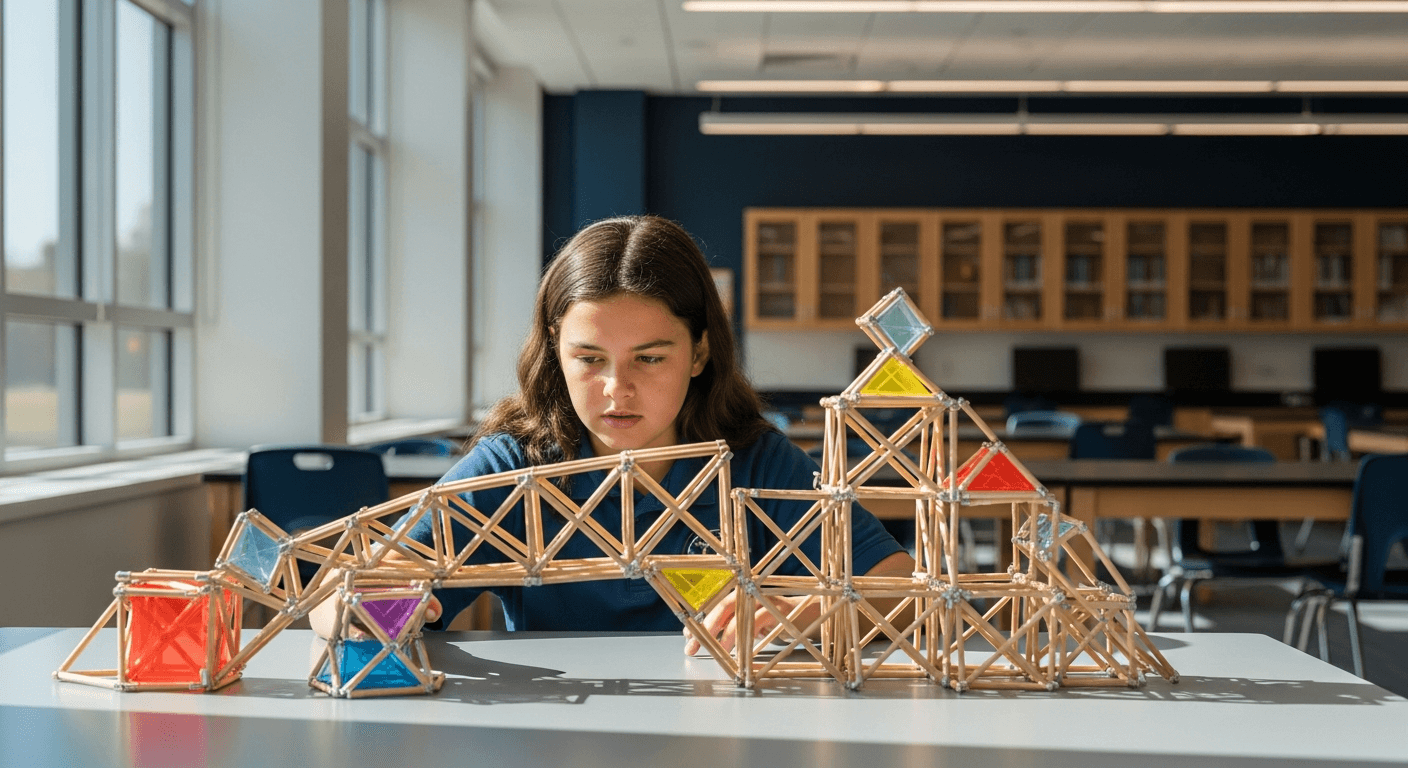
As your child prepares to transition from the supportive, often hand-held environment of elementary school to the more autonomous world of middle and high school, the goal shouldn't be to find the "easiest" path. Instead, parents must become 'Resilience Architects,' auditing potential schools to ensure they provide an environment of Productive Struggle—a pedagogical approach where students are intentionally given tasks that are just beyond their current reach to build the cognitive muscles needed for long-term success.
What is Productive Struggle and Why Does It Matter Now?
In many traditional American classrooms, the focus is on 'getting the right answer' quickly. If a student gets stuck on a math problem like solving for x in the equation \(3x + 12 = 45\), the instinct for many teachers (and parents) is to jump in and provide the solution immediately. Productive struggle flips this script. It is the process of effortful learning where the student is allowed to grapple with a concept, test hypotheses, and fail—safely—before receiving the scaffolding needed to succeed.
Research shows that this 'effortful' phase is where the most significant neural growth occurs. In an era where AI can solve basic equations or draft simple essays in seconds, the human value-add lies in the ability to persevere through complex, non-linear problems. Schools that prioritize productive struggle are essentially training students for the rigors of AP Calculus, college-level research, and the high-stakes environments of the modern economy.
The Middle School Transition: From 'Nurturing' to 'Autonomous'
The jump from 5th to 6th grade (or 6th to 7th, depending on your district) is often the first major stress test for a child's AQ. In elementary school, the single-teacher model often acts as a safety net. In middle school, students must manage multiple teachers, varying instructional styles, and a sudden increase in executive function demands. When auditing potential schools, look for how they manage this 'Support Architecture.' You aren't looking for a school that removes the struggle, but one that scaffolds it.
Questions to Ask During School Tours and Open Houses
To determine if a school truly values resilience over rote performance, move beyond the brochure and ask these specific questions:
1. "How does your curriculum reward the process of learning rather than just the final product?"
Look for schools that use rubrics emphasizing revision and 'error analysis.' A school that allows students to analyze why they missed a question on a midterm and earn back partial credit is building AQ. This mimics the real-world iterative process of engineering and business.
2. "What is your approach to 'Social-Emotional Learning' (SEL) during academic setbacks?"
A school with a strong resilience culture will have formal systems to help students manage the anxiety of the 'learning pit.' Ask if they teach growth mindset strategies specifically in the context of difficult subjects like STEM or foreign languages.
3. "How do you prepare students for the shift toward high-stakes testing like the PSAT and SAT?"
The goal here isn't just test prep; it's psychological prep. Does the school teach students how to manage 'cognitive load' and time pressure, or do they simply focus on memorizing formulas? You want a school that uses high-quality study materials to build conceptual depth rather than just surface-level recognition.
Bridging the Gap: How AI Supports Productive Struggle
One of the biggest challenges for parents is maintaining this balance of 'struggle' at home. It is tempting to step in during homework time to keep the peace. This is where AI-powered learning platforms are revolutionizing the transition. Rather than giving the student the answer, advanced AI tools act as a Socratic tutor, providing the 'just-right' hint at the 'just-right' time.
For example, if a student is struggling with a complex word problem, an AI-driven platform like Thinka's practice interface can identify the specific logic gap—perhaps a misunderstanding of how to distribute a negative sign—and offer a targeted prompt that encourages the student to find the error themselves. This maintains the productive struggle while preventing the 'destructive' frustration that leads to burnout. By using these tools, parents can shift from being 'homework managers' to 'strategic consultants,' focusing on their child’s emotional regulation rather than their math accuracy.
Evaluating the 'Safety Net' vs. the 'Scaffold'
When you visit a school, observe the students. Do they look terrified of making a mistake, or do they seem comfortable saying, "I'm not sure, but here is how I'm trying to figure it out"? A school that builds high AQ will have a culture where 'I don't know yet' is a standard part of the vocabulary.
As your child moves toward high school, the stakes increase. The pressure of maintaining a high GPA for college admissions can often lead to 'grade grubbing'—where students avoid difficult courses to protect their transcript. A school that successfully implements productive struggle will have a healthy balance of honors and AP tracks that encourage students to take intellectual risks without the fear of social or academic catastrophe. Teachers can even use AI tools to generate diverse practice papers that challenge students in new ways, ensuring they are prepared for the unpredictable nature of future standardized digital exams.
Final Thoughts: Selecting for 2030
The most successful students of the next decade won't be the ones who never failed; they will be the ones who learned how to fail forward. When choosing a middle or high school, look past the shiny new buildings and the trophy cases. Look for the grit in the hallways. Look for the teachers who allow their students to be 'confused' for a few minutes before helping them see the light. By prioritizing a school’s ability to foster productive struggle, you are giving your child a gift far more valuable than a perfect report card: you are giving them the resilience to thrive in an uncertain world.
Related posts
- Sep 30, 2026
Secondary School Cut Off Points: PSLE AL Scoring Matrix, Posting Bands, and Strategic Ranking Guide
Master secondary school cut off points, PSLE AL score bands, Full SBB posting groups, tie-breaker rules, and a 3-tier choice ranking strategy for your child.
- Sep 20, 2026
11 Plus Pass Marks by Region: Standardized Age Scores, Regional Cut-Offs, and Placement Benchmarks
Demystify 11 plus pass marks by region. Learn how Standardized Age Scores (SAS) work, compare regional benchmarks, and navigate cut-offs before application deadlines.
- Sep 9, 2026
Middle School Choice Ranking Strategy: How to Hedge Lottery Risks and Master Public School Matching Systems
Master your middle school choice ranking strategy. Learn how deferred acceptance algorithms work, hedge lottery cut-offs, and secure top magnet placements.
- Aug 30, 2026
Middle School Admissions Decoded: How to Build a Balanced School Portfolio Using ISEE, SSAT, and Selective Tiers
Master middle school admissions rankings and score thresholds. Learn how to audit selective tiers, evaluate ISEE/SSAT percentiles, and build a balanced school portfolio.